The key difference isn’t the scenery; it’s the radical shift in risk and self-reliance that demands new, non-intuitive safety protocols for UK hikers.
- Familiar UK wildlife savvy is irrelevant; in boreal forests, unassuming animals like moose pose a greater statistical threat than bears.
- Navigation instincts honed on varied UK trails fail in uniform boreal landscapes, requiring a sensory recalibration from landmarks to shadows and sun.
Recommendation: Before planning a trip to Scandinavia or Canada, hikers must transition their mindset from casual enjoyment to protocol-based backcountry preparation.
For a hiker accustomed to the charming, human-scale woodlands of the United Kingdom, the idea of trekking through the immense boreal forests of Canada or Scandinavia is intoxicating. You picture vast expanses of pine and spruce, mirror-like lakes, and the soul-stirring silence of true wilderness. While this picture is accurate, it’s dangerously incomplete. The common advice—pack for cold, watch for bears—barely scratches the surface of the fundamental ecological differences that separate these two worlds.
The transition from a temperate forest to the boreal taiga is not merely a change of scenery. It is a profound ecosystem shift that renders many of a UK hiker’s ingrained skills and instincts obsolete, or even hazardous. Where a walk in the New Forest is governed by well-marked paths and a predictable environment, a hike in a boreal landscape is governed by a new set of rules dictated by its unique climate, wildlife, and sheer, unforgiving scale. Assuming that your experience with British nature prepares you for this is the first and most critical mistake.
This guide moves beyond the platitudes. We will not just tell you « there are bugs »; we will explain why they demand a military-grade layered defense system. We will not just say « don’t get lost »; we will deconstruct why your landmark-based navigation skills will fail you and what to use instead. By contrasting the familiar challenges of UK parks with the specific demands of the boreal north, we will equip you with the essential mindset shift: from temperate walker to self-reliant boreal hiker. This is about understanding the ‘why’ behind the new protocols, ensuring your northern adventure is memorable for the right reasons.
This article breaks down the essential contrasts between your familiar UK hiking environment and the demanding boreal wilderness. The following sections will guide you through the critical adjustments you need to make for a safe and responsible journey into the great northern forests.
Summary: A UK Hiker’s Guide to the Boreal Mindset
- Why Do Boreal Forests Require Different Wildlife Safety Protocols Than British Woodlands?
- How to Avoid Getting Lost in Repetitive Boreal Forest Landscapes?
- Summer Midnight Sun vs Autumn Colors: When Should You Hike Boreal Forests?
- The Boreal Forest Error That Makes Mosquitoes and Blackflies Unbearable for Unprepared Hikers
- When Do Boreal Hiking Routes Require Full Backcountry Self-Sufficiency?
- Why Do Some UK Nature Reserves Close Trails During Bird Nesting Season?
- Why Does One Shortcut Across Moorland Vegetation Create Damage Lasting a Decade?
- How to Hike Responsibly in UK National Parks and Nature Reserves?
Why Do Boreal Forests Require Different Wildlife Safety Protocols Than British Woodlands?
In British woodlands, « wildlife » might mean startling a deer, avoiding a badger sett, or keeping an eye out for adders. These encounters are rarely life-threatening. This casual attitude towards fauna is the first dangerous piece of mental baggage to discard when entering a boreal forest. Here, the wildlife operates on a completely different scale of size, power, and potential risk. The entire human-animal dynamic is inverted; you are no longer the dominant species in the ecosystem.
The obvious concerns are large predators like bears and wolves. While awareness and proper food storage are crucial, the more statistically significant danger often comes from herbivores. For instance, in northern regions, moose injure more people annually than bears do. An agitated or surprised mother moose is a formidable and aggressive force. In-depth research on human-wildlife encounters shows that moose attacks can be frequent and severe, a risk category that simply doesn’t exist in the UK.
Beyond direct encounters, the environment itself carries hidden biological threats. A crystal-clear boreal stream looks inviting, but can be contaminated with pathogens like Giardia lamblia, often called « beaver fever. » This is not just a theoretical risk; it’s a documented public health issue. The following case study highlights the danger.
Case Study: The Hidden Threat in « Pristine » Boreal Water
A genomic study traced Giardia duodenalis, the parasite causing « beaver fever, » through water, wildlife, and human populations. The study found that this single pathogen is responsible for a significant number of gastrointestinal illnesses, with an average of 627 new giardiasis infections reported yearly in British Columbia alone. This underscores a critical boreal protocol: never trust an untreated water source, no matter how clean it appears. For a UK hiker used to refilling from a village tap, this requires a fundamental shift to carrying filtration or purification systems at all times.
This evidence demonstrates a crucial point: boreal safety isn’t just about avoiding what you can see, like a bear. It’s about respecting what you can’t see, from microscopic parasites to the unpredictable behaviour of megafauna. Every stream must be treated as contaminated, and every large animal must be given a wide berth. This is a non-negotiable protocol shift from the relative safety of a walk in the Cotswolds.
How to Avoid Getting Lost in Repetitive Boreal Forest Landscapes?
In a typical British national park, navigation is a matter of interpreting a varied landscape. You tick off features: a distinctive lone oak, a stone wall, a stream junction, a rise in the terrain. Your brain is conditioned to seek and follow unique landmarks. This instinct, so reliable in the UK, becomes a liability in the vast, homogenous expanse of a boreal forest. Here, the landscape is defined by its profound and disorienting uniformity.
For miles in every direction, you may see nothing but a sea of nearly identical pine, spruce, and fir trees, all of a similar age and height, growing on a flat or gently rolling, moss-covered floor. One section of forest looks exactly like the last, and exactly like the next. There are few distinctive stone walls, ancient trees, or man-made features to act as signposts. Relying on « that big rock » or « the clearing » for navigation can quickly lead to disaster when you discover ten more identical rocks and clearings.
This requires a complete « sensory recalibration » for the visiting hiker. You must stop looking for landmarks and start reading the more subtle, consistent cues of the northern environment. This means a heavy reliance on a map and compass, and a deeper understanding of natural indicators. The sun, which sits much lower in the sky at northern latitudes, becomes a primary tool. Its position and the long, distinct shadows it casts provide a reliable directional guide that the uniform trees cannot.
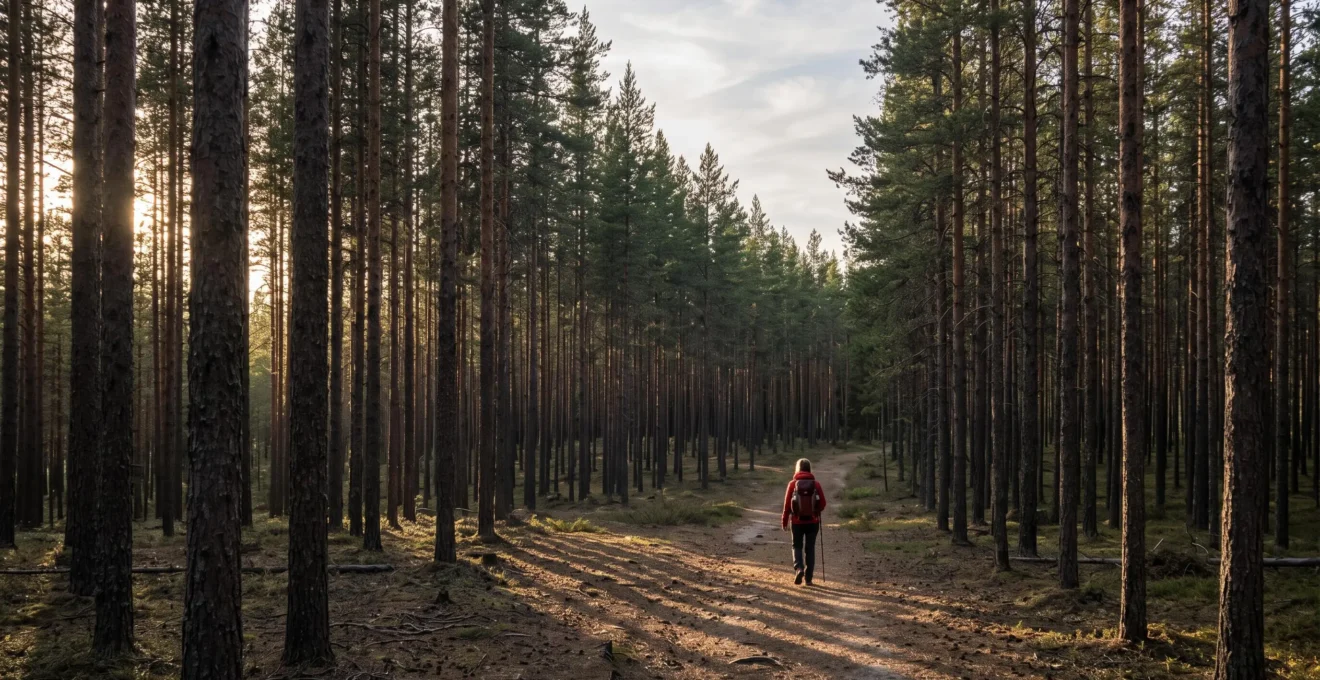
As the image above illustrates, the angle of the sun creates long, predictable shadow lines on the forest floor. In the northern hemisphere, shadows at midday will point north. By observing how these shadows move and lengthen throughout the day, a hiker can maintain a sense of direction even without a clear view of the sun itself. This is a core boreal navigation technique—reading the environment’s patterns, not its unique features. This is a skill that must be learned and practised, as it runs counter to every navigational instinct developed in a varied temperate landscape.
Summer Midnight Sun vs Autumn Colors: When Should You Hike Boreal Forests?
Choosing when to hike in a boreal forest is a strategic decision with significant trade-offs, far more pronounced than choosing between a spring and autumn walk in the Lake District. The two most popular seasons, summer and autumn, offer wildly different experiences, each with distinct advantages and severe drawbacks. Your choice depends entirely on your priorities: are you seeking endless daylight for long-distance trekking, or a more comfortable, aesthetically pleasing journey?
Summer, from June to early August, is the season of the midnight sun. At high latitudes, the sun may not set at all, providing 20-24 hours of usable daylight. This is a massive advantage for ambitious hikers, allowing for incredible flexibility. You can start your day early, finish late, or hike through the surreal, quiet light of the « night » to cover huge distances. However, this advantage comes at a steep price: this is the absolute peak season for biting insects. Mosquitoes and blackflies emerge in dense, relentless swarms that can turn a dream hike into a living nightmare. Temperatures are at their warmest, but the air can be thick and humid in the forest.
Autumn, from late August to late September, presents a near-perfect inversion of summer’s conditions. The first frosts kill off the vast majority of the biting insects, bringing a profound sense of relief. The forest transforms into a blaze of gold and red as birch and aspen trees turn colour against the dark green of the conifers. The air is crisp, cool, and dry—often considered perfect hiking weather. The downside? Daylight hours are shrinking rapidly. The sun is lower, the nights are longer and significantly colder, with a real risk of early snowfall. You have a much shorter window for hiking each day, and you must be fully prepared for sub-zero temperatures overnight. This season demands more meticulous planning around daylight and much warmer gear.
Ultimately, the decision is a choice between two extremes. Summer offers limitless time but requires a full-scale war against insects. Autumn offers sublime comfort and beauty but imposes strict time and temperature constraints. There is no « perfect » season, only the season that best aligns with your tolerance for discomfort and your goals for the trip.
The Boreal Forest Error That Makes Mosquitoes and Blackflies Unbearable for Unprepared Hikers
For a UK hiker, « bad insects » usually means a few wasps at a picnic or some midges on a damp Scottish evening. The common solution is a quick spray of DEET-based repellent. Applying this same minimal approach to boreal forest insects is a catastrophic error in judgement. The sheer density, persistence, and variety of biting insects—primarily mosquitoes, blackflies, and no-see-ums—constitute not just an annoyance, but a serious physiological and psychological challenge that can ruin a trip and even pose health risks.
The mistake is thinking one product is a solution. A successful boreal insect strategy is not a product; it’s a system. It’s a concept of « layered defense » where chemical repellents are the last, not the first, line of protection. The foundation of this system is physical and textile-based. This begins with wearing loose-fitting, light-coloured clothing that covers all exposed skin. Blackflies are drawn to dark colours, and mosquitoes can bite through tight fabric like leggings. The most critical layer is clothing and gear treated with Permethrin, an insecticide that bonds to fabric and both repels and kills insects on contact. The effectiveness is not trivial; military-conducted tests found that using clothing treated with permethrin provided dramatic levels of protection. This pre-treatment of outer layers, tents, and packs creates a protective bubble.
The second layer is a physical barrier, most notably a head net. It may seem extreme, but when blackflies swarm your face and crawl into your ears and nose, a head net is the single piece of gear that provides the most significant mental relief. Only after these physical and textile barriers are in place does a topical repellent like DEET or Picaridin come into play, applied sparingly to any small areas of remaining exposed skin. As expert James H. Diaz notes in a study on repellents for *Wilderness & Environmental Medicine*:
The most effective application of insect repellents is a combination of topical chemical repellents and permethrin-impregnated clothing.
– James H. Diaz, Wilderness & Environmental Medicine (Chemical and Plant-Based Insect Repellents: Efficacy, Safety, and Toxicity)
Failing to adopt this multi-layered defense system is the error that leaves hikers miserable. They rely on a single can of spray, which is quickly overwhelmed by the sheer number of insects that are not repelled but merely displaced, waiting for an opportunity. Understanding this concept is as crucial as carrying a compass.
When Do Boreal Hiking Routes Require Full Backcountry Self-Sufficiency?
In the UK, even on a « wild » hike in the Scottish Highlands, you are rarely more than a few hours’ walk from a road, a farm, or a bothy. Cell service might be patchy, but there’s an underlying safety net of proximity. This creates a psychological comfort that must be consciously abandoned in the boreal north. Here, the distinction between a day hike and a true backcountry expedition is a fluid line that can be crossed unexpectedly. The « self-sufficiency threshold » is the point at which you can no longer rely on external help in a timely manner and must be prepared to handle any situation—injury, gear failure, weather event—entirely on your own for several days.
Many marked trails in Scandinavian or Canadian national parks may seem like UK-style routes initially, with clear signage and perhaps a trailhead facility. The critical difference is scale. A « short » trail might be 20km long with no intersecting paths, no shelters, and no escape routes. A twisted ankle five kilometers in doesn’t mean a limp back to the car park; it means a serious survival situation. The self-sufficiency threshold is crossed the moment your distance from the trailhead exceeds your ability to self-rescue with a minor injury, or when the weather forecast becomes unpredictable beyond a 24-hour window.
Assessing whether your planned route crosses this threshold is the most important part of your trip planning. It dictates your gear, your food supply, and the skills you need. Do you have a satellite messenger or personal locator beacon (PLB)? Do you have the first aid knowledge to stabilize a fracture or treat severe hypothermia? Do you have a shelter system and enough food to wait out a 72-hour storm? These are not questions for extreme mountaineering; they are standard considerations for what might appear to be a simple multi-day hike in a boreal park.
For a UK hiker, this is a dramatic escalation in personal responsibility. The mindset must shift from assuming help is implicitly available to assuming it is not. Every kilometre you walk away from the road, you are stepping further into a world where you are your own and only emergency service. Recognizing that threshold before you cross it is the hallmark of a prepared and responsible boreal hiker.
Action Plan: Assessing Your Boreal Self-Sufficiency Threshold
- Map the Point of No Return: On your map, identify the furthest point of your planned route from any road or official rescue point. Calculate the realistic walking time from there, assuming a minor injury (e.g., sprained ankle). If it’s more than 3-4 hours, you’ve crossed the threshold.
- Inventory Your Communication Lifeline: Check your gear. Do you have a device that works without cell signal (e.g., a PLB, satellite messenger like a Garmin inReach or Zoleo)? If the answer is no, you are not prepared for a route that crosses the threshold.
- Audit Your Shelter & Survival Gear: Confront your pack. Does it contain only a day-hike rain jacket, or does it include a full emergency shelter (tarp or bivy), fire-starting kit, water filter, and at least 24 hours of extra emergency calories? The former is for pre-threshold hikes; the latter is mandatory for post-threshold.
- Evaluate Medical Autonomy: Review your first-aid kit and, more importantly, your knowledge. Can you confidently manage major bleeding, splint a limb, or recognise the signs of severe hypothermia? If not, you must stick to routes where help is demonstrably close.
- Plan for Weather Isolation: Analyse the long-range forecast. Does your plan have the flexibility and your pack the supplies (food, fuel) to allow you to shelter in place for 48-72 hours if an unexpected storm system moves in? If not, your plan is only suitable for short, fair-weather, pre-threshold hikes.
Why Do Some UK Nature Reserves Close Trails During Bird Nesting Season?
After considering the grand-scale challenges of the boreal forest, it’s easy to view UK nature as robust and forgiving. However, this is a misconception. British ecosystems have their own distinct fragilities, and understanding them is part of being a responsible hiker, both at home and abroad. A prime example is the seasonal closure of trails in nature reserves and on coastlines during spring and early summer. For hikers, this can seem frustrating, but it is a critical conservation measure rooted in the specific biology of the UK’s most vulnerable bird species.
The core issue is ground-nesting. While we might picture birds nesting safely in trees, a surprising number of species make their homes on or near the ground, hidden in long grass, heathland, or shingle beaches. This includes iconic birds like the Skylark, Nightjar, and Lapwing, and coastal species like Little Terns and Ringed Plovers. The problem is that the RSPB reports that more than half of the UK’s most threatened breeding birds are ground-nesters. Their nests, eggs, and chicks are exceptionally camouflaged to hide from predators, which also makes them virtually invisible to the eyes—and feet—of human hikers.
The scale of the nests is almost impossibly small, making accidental trampling a huge risk. As Mike Shurmer, Head of Species for RSPB England, highlights: « A skylark egg can be as small as 17mm, that’s around the width of a 5 pence piece. » But direct destruction isn’t the only threat. Repeated human presence, even from hikers sticking to a path, creates significant disturbance. A parent bird that is constantly flushed from its nest by passing people and dogs will spend less time incubating its eggs or feeding its chicks. The eggs can fail to hatch from cold, and the chicks can starve. The cumulative impact is devastating, and this is not just a theory; it is backed by scientific evidence. An experimental study published by the Royal Society found that bird plots subjected to controlled human disturbance showed a 15.0% reduction in the number of territories and a 15.2% reduction in species richness compared to undisturbed areas.
Therefore, trail closures are not an overreaction. They are a necessary, data-driven tool to create a sanctuary for these birds during their most vulnerable period. It demonstrates a key principle of responsible hiking: the most significant impact is often invisible and unintentional. Respecting these closures is a non-negotiable part of protecting the delicate balance of Britain’s own wild spaces.
Why Does One Shortcut Across Moorland Vegetation Create Damage Lasting a Decade?
The principle of invisible, long-term damage extends from fauna to flora, especially in the UK’s unique upland habitats like moorlands and peat bogs. To an impatient hiker, a desire line cutting across a switchback or a shortcut across a boggy patch seems like a harmless, time-saving manoeuvre. It feels insignificant. This perception is profoundly wrong. In these fragile ecosystems, a single boot print can initiate a process of degradation that lasts for years, or even decades.
The key to understanding this is appreciating the nature of the vegetation, particularly Sphagnum moss. This is not just grass. Sphagnum is the building block of peatland ecosystems. It’s an incredible plant that can hold up to 20 times its own weight in water, acting as a giant, living sponge that regulates the landscape’s hydrology. It grows incredibly slowly—perhaps only a millimeter per year. When you step on it, you’re not just flattening some leaves; you are crushing a delicate, water-saturated structure that took years to form. The compression squeezes out the water and breaks the plant’s fragile cellular structure. It cannot simply « spring back » like lawn grass.
Once one person creates a muddy bootprint, it creates a weak point. The exposed, compressed peat is now susceptible to erosion. Water, instead of being held by the moss, starts to channel through the depression, scouring it out. The next hiker sees the muddy patch and walks to the side, widening the area of damage. Very quickly, a single shortcut becomes a braided, eroded scar that can grow into a deep gully, draining the surrounding peat and permanently altering the local hydrology. Re-vegetating these scars is a slow, difficult, and expensive process that can take more than a decade of active conservation work.
This is a powerful lesson in cumulative impact. The problem isn’t one person; it’s the hundredth or thousandth person following the first. By choosing to take a shortcut, a hiker isn’t just saving 30 seconds; they are actively participating in the long-term destruction of a fragile habitat. Sticking to the designated, hardened path isn’t just a rule; it’s a recognition that in these ancient landscapes, our temporary presence can leave a permanent wound.
Key Takeaways
- Risk Recalibration: The primary mindset shift is from the low-risk UK environment to the high-consequence boreal one, where benign-looking animals and water sources can be dangerous.
- Navigational Unlearning: Success in the boreal forest requires abandoning the UK-honed instinct for landmark-based navigation and embracing pattern-based methods like reading shadows and sun angles.
- Fragility Is Universal: While the scale of risk is different, both UK and boreal ecosystems are fragile. Understanding the specific vulnerabilities of each—ground-nesting birds in the UK, slow-growing mosses in both—is key to responsible hiking everywhere.
How to Hike Responsibly in UK National Parks and Nature Reserves?
Having explored the demanding nature of boreal ecosystems, it’s tempting to return to UK national parks with a sense of casual ease. This would be a missed opportunity. The lessons learned from the boreal—a heightened sense of awareness, a respect for invisible threats, and an understanding of long-term impact—can and should transform how you hike at home. Hiking responsibly in the UK isn’t about a lesser degree of care; it’s about applying the same principles of foresight and respect to a different set of ecological challenges.
The core of responsible UK hiking is summarised by the Countryside Code: respect everyone, protect the environment, and enjoy the outdoors. This translates into concrete actions that directly address the vulnerabilities we’ve discussed. Protecting the environment means keeping dogs on a lead, especially during nesting season, to prevent disturbance to ground-nesting birds. It means taking all your litter home, and packing out everything you pack in. Crucially, it means staying on marked paths to prevent the exact kind of erosion and habitat destruction seen on moorlands.
This last point is perhaps the most direct parallel between the two environments. Whether it’s to protect a skylark’s nest in the South Downs or to prevent the erosion of a peat bog in the Cairngorms, the designated path is there for a reason. It is the managed corridor that allows human access while minimising our footprint on the wider, fragile landscape. As Sara Humphrey of the RSPB succinctly put it, the request is simple: « Asking people to follow the countryside code and to stick to paths to avoid disturbing ground-nesting birds. » This simple discipline is the foundation of sustainable enjoyment of our natural spaces.
Ultimately, the experience of preparing for a boreal expedition should instill a deeper appreciation for the interconnectedness of any ecosystem. You return to your local trail not as a passive consumer of scenery, but as a more conscious participant. You understand that every landscape, from the grandest taiga to a small British copse, operates on a delicate balance. The truly expert hiker is not the one who conquers the most extreme environments, but the one who moves through any environment, home or away, with the lightest possible touch and the greatest possible understanding.
Apply this heightened awareness to your next adventure. Whether you’re planning a trip to the vast Canadian wilderness or simply a weekend walk in your local woods, start by researching the specific ecological sensitivities of that exact place. This deeper level of preparation is the definitive step from being a tourist to becoming a true custodian of the trails.