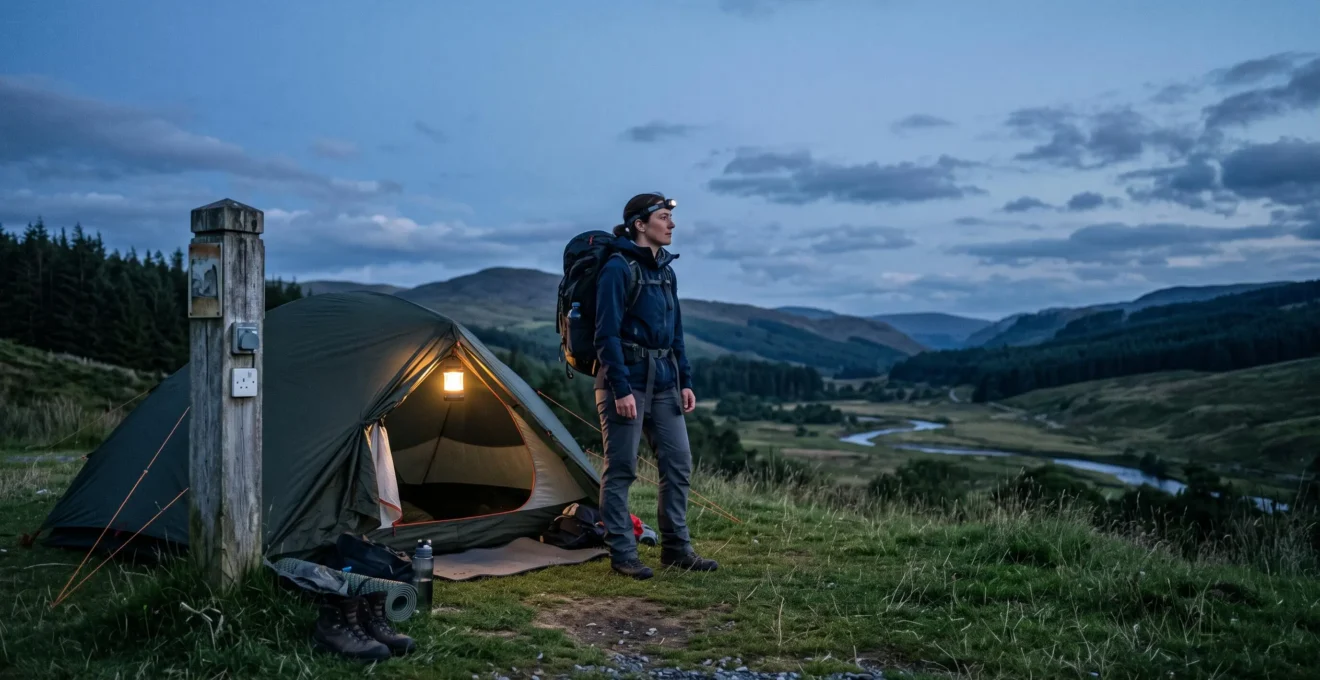
For a serious hiker, a serviced pitch isn’t a luxury; it’s a strategic investment in better, longer, and more enjoyable time on the trails.
- It drastically reduces « logistical drag »—the time and energy wasted on campsite chores like fetching water and charging gear.
- It acts as a « recovery multiplier, » using power for warmth and cooking to help you bounce back faster for the next day’s hike.
Recommendation: Evaluate the pitch cost not in isolation, but as a percentage of your total trip value. For multi-day hikes, the benefits often far outweigh the price difference.
The feeling is familiar to any dedicated UK hiker. You’ve conquered a windswept ridge, navigated a boggy trail, and your boots are heavy with mud and triumph. But back at the campsite, a different challenge begins: the damp tent, the dwindling power on your phone, the chilly evening air, and the thought of another trip to the communal tap in the dark. You enjoy camping, but the inherent discomforts can start to chip away at the joy of the hike itself. You see the pricier « serviced pitches » with their own water and electric hookups, and you wonder: is that just for massive caravans, or could it be the secret to a better hiking holiday?
The common wisdom suggests these pitches are a luxury, a step away from the « true » spirit of camping. Many dismiss them as expensive add-ons for those who can’t live without their creature comforts. But this view misses the point entirely, especially for a hiker. This isn’t about glamping. It’s about strategy. The real question isn’t whether a serviced pitch is more comfortable—it is—but whether that comfort translates into a quantifiable improvement for your primary mission: hiking.
This guide reframes the debate from my perspective as a campground manager who sees this dilemma play out every season. We will move beyond a simple cost-vs-comfort argument. Instead, we’ll analyse a serviced pitch as a strategic base camp. We’ll explore how it mitigates the common failure points of a hiking trip, how to use its features wisely without losing the camping ethos, and when it represents peak value for money. By the end, you’ll be able to calculate for yourself if the extra cost is a needless expense or a smart investment in your valuable time on the trail.
In this article, we’ll break down the real-world costs and benefits, look at common mistakes, and analyse the specific scenarios where a serviced pitch becomes an undeniable asset. Here’s what we’ll cover.
Summary: Is a Serviced Pitch the Hiker’s Ultimate Base Camp?
- Why Do 80% of Campers Over 50 Prefer Serviced Pitches to Basic Sites?
- How to Use Electric Hookups Wisely Without Losing the Camping Spirit?
- Serviced Pitches for Week-Long Stays vs Basic Sites for Weekends: Which When?
- The Serviced Pitch Booking Error That Costs £200+ in Last-Minute Alternatives
- When Does Prolonged Rain Make Serviced Pitches Worth Double the Basic Site Cost?
- Why Do Identical Campervans Cost £70/Day from Some Companies and £250/Day from Others?
- Why Do 70% of « Eco-Friendly » Hotels Lack Third-Party Sustainability Certification?
- How to Rent a Campervan in the UK Without Overpaying or Getting Inadequate Vehicles?
Why Do 80% of Campers Over 50 Prefer Serviced Pitches to Basic Sites?
While the « 80% » figure might be anecdotal, the trend is undeniable on any campsite: seasoned campers often gravitate towards pitches with services. From my experience as a manager, this isn’t simply an age-related desire for comfort; it’s a calculated decision based on a deep understanding of energy and time management. These campers have learned that their most valuable resource isn’t money, but their own physical energy for enjoying their holiday. A serviced pitch directly addresses what we can call « logistical drag »—the cumulative physical and mental cost of repetitive campsite chores.
Every trip to a communal water tap, every walk to the waste disposal point, and every journey to the toilet block is a small withdrawal from your energy bank. For a hiker, that’s energy that could be spent on an extra mile of trail or simply recovering more effectively. As one experienced tourer noted about the core appeal of these sites, « The object of a serviced pitch regardless of base is to remove the fetch and carry of water and wastewater surely. » It’s a simple, pragmatic calculation. The extra £15 a night is an investment to eliminate dozens of small, draining tasks over the course of a trip.
This mindset isn’t exclusive to campers over 50. It’s relevant to anyone who values their time and wants to maximize their primary activity, be it hiking, cycling, or simply relaxing. By automating the supply of essentials like water and power directly to your pitch, you are buying back time and preserving energy. It’s a strategic choice to focus your efforts on the adventure, not the administration of your temporary home. This shifts the pitch from a mere patch of grass to a highly efficient strategic base camp.
How to Use Electric Hookups Wisely Without Losing the Camping Spirit?
The presence of a blue electric hookup point doesn’t have to mean turning your tent into a living room with a giant television. For the strategic hiker, electricity isn’t about distraction; it’s a powerful tool for recovery and preparation. Using it wisely means focusing on utilities that enhance your hiking mission, turning your pitch into a « recovery multiplier. » Think less about entertainment and more about efficiency: a small, low-wattage slow cooker preparing a hot stew while you’re on the fells, electric boot dryers to ensure your gear is ready for the next morning, or a small tube heater to take the damp chill out of the air before bed.
Of course, with great power comes great responsibility. The key is understanding your limits. Most modern UK campsites now offer a robust 16A / ~3,600W supply, which is more than enough for a kettle, a small heater, and charging devices. However, you must never assume. Overloading the circuit by running a domestic kettle and a powerful fan heater at the same time can trip the breaker for your pitch, or even a section of the campsite, which is a quick way to become unpopular with your neighbours. The camping spirit is also about being a considerate member of the community.
Using your hookup safely and efficiently is paramount. It’s not just about etiquette; it’s about preventing fire, electrical shock, and equipment damage. Following a clear set of guidelines ensures you can harness the power of your serviced pitch without any of the risks.
Your Essential Electric Hookup Safety Checklist
- Know Your Limit: Check your appliance wattage before plugging it in. Add up the total and ensure it stays well within your pitch’s amperage limit (e.g., 16A, 10A, or 6A).
- Check for RCD Protection: Ensure your mobile mains unit has a built-in Residual Current Device (RCD). This is a non-negotiable safety feature that protects against serious electric shocks.
- Keep It High and Dry: Never place the power unit directly on the tent floor. Use the integrated hooks or place it on a box to keep it away from potential condensation, spills, or rainwater ingress.
- Use the Correct Entry Point: Route the cable through a dedicated power cord flap in your tent, not through the main doorway. This prevents trip hazards and stops rain from running down the cable into your living space.
Serviced Pitches for Week-Long Stays vs Basic Sites for Weekends: Which When?
The decision between a basic and serviced pitch often hinges on a simple question: is the extra cost worth it for the length of my stay? The answer requires a « value-per-night » calculation. For a short weekend trip (1-2 nights), the convenience of a serviced pitch might feel like a minor luxury. The time spent setting up a water hose and electrics might seem disproportionate to the time you’re actually there. In this scenario, a basic pitch can be a perfectly sensible, budget-friendly choice.
However, the equation changes dramatically as the trip extends. On a week-long hiking holiday, the benefits of a serviced pitch compound daily. The small convenience of having your own tap becomes a significant time and energy saver over seven days. The ability to keep a small fridge running, charge all your devices without anxiety, and have reliable light in the evenings transforms your campsite from a temporary shelter into a comfortable, functional base. According to the 2024 Great Britain Tourism Survey, the average tent camping trip duration is around 3.35 nights, putting many trips right at the turning point where a serviced pitch begins to offer exponential value.
The price difference, while noticeable per night, shrinks in the context of the total holiday cost. A serviced pitch becomes a small surcharge for a massive upgrade in quality of life. The table below illustrates the typical price structure you’ll find at UK campsites, showing how the features scale with the cost.
| Pitch Type | Typical UK Price Range (per night) | Included Features |
|---|---|---|
| Basic (unserviced) pitch | £15 – £20 | Grass pitch, shared water tap, shared toilet/shower block |
| Standard electric hookup pitch | £20 – £35 | 10–16A electric hookup, shared water & waste facilities |
| Fully serviced pitch | £35 – £50+ | Electric hookup, on-pitch fresh water, grey waste drainage, sometimes Wi-Fi |
For a week-long trip, the extra £100-£150 for a fully serviced pitch can be the difference between a trip that feels like an endurance test and one that feels like a genuine, restorative holiday.
The Serviced Pitch Booking Error That Costs £200+ in Last-Minute Alternatives
Here is a costly mistake I see campers make time and again: they book a serviced pitch, see the words « electric hookup, » and assume all hookups are created equal. They arrive with their high-wattage kettle and powerful fan heater, only to find that every time they turn them on, the power cuts out. They’ve made the critical error of booking a low-amperage pitch without understanding its limitations, a mistake that can lead to a frantic and expensive search for alternative accommodation or gear.
Many campsites, particularly older or more basic ones, offer different tiers of electrical supply. While a 16A supply is common, you can still find 10A or even 6A pitches. The price difference might only be a few pounds a night, so it’s tempting to grab the cheapest option. This is a false economy. On a 6-amp pitch, campers are limited to roughly 1,380W of power. A standard household kettle can easily draw 3,000W, and a 2,000W fan heater will also instantly trip the breaker. Suddenly, your « serviced » pitch can’t even boil water for a cup of tea.
When this happens on a cold, wet bank holiday weekend, the consequences cascade. The campsite is full, so moving pitches isn’t an option. The local B&Bs are charging over £100 a night. The camper is faced with a miserable, powerless weekend or spending over £200 on last-minute alternatives. This is a classic case of failure point mitigation. The « booking error » isn’t just an inconvenience; it’s a trip-ruining event that a little bit of knowledge could have prevented. Always check the amperage of the pitch you are booking. If it’s not clearly stated, call the campsite and ask. Paying an extra £5 per night for a 16A pitch is the cheapest insurance you’ll ever buy.
When Does Prolonged Rain Make Serviced Pitches Worth Double the Basic Site Cost?
In the UK, rain isn’t a possibility; it’s an inevitability. And it is during a period of prolonged, soul-drenching rain that the true value of a premium serviced pitch becomes crystal clear. When the weather turns, the extra cost isn’t for a luxury; it’s for survival—the survival of your holiday. There are two key features that make these pitches worth their weight in gold: hardstanding and reliable power.
A basic grass pitch can turn into a quagmire after just a few days of rain. It becomes a muddy, slippery mess that makes walking a hazard and packing away a clean tent impossible. As the experts at Cover4Caravans point out, this can be more than just an inconvenience: a sodden field poses real logistical problems. As they note in their guide, « Extended rainfall may make manoeuvring more difficult, particularly for heavier caravans or vehicles without four-wheel drive. » For tent campers, it means living in a bog. Most fully serviced pitches are hardstanding (gravel or tarmac), which guarantees a dry, stable base regardless of the weather. No mud, no mess, no sinking.
Secondly, the reliable power of a hookup becomes a lifeline. It allows you to run a small heater to dry out damp gear and take the chill from the air, transforming your tent from a cold, clammy cell into a warm, dry refuge. It’s the difference between shivering in your sleeping bag and sitting comfortably with a hot drink, listening to the rain outside, knowing you and your gear will be dry for tomorrow’s hike. In these moments, the psychological and physical relief is immense. The extra £20-£25 a night is no longer a cost but a bargain for salvaging your trip from the brink of misery.
Why Do Identical Campervans Cost £70/Day from Some Companies and £250/Day from Others?
While our main focus is the pitch, the « rig » you put on it is part of the same value equation. For hikers who opt for a campervan as their mobile base camp, the rental market can be baffling. You’ll see what looks like the same small van advertised for £70 a day by one company and £250 by another. This discrepancy isn’t usually a scam; it’s a lesson in understanding the total cost of ownership, a principle that applies to booking both vehicles and pitches.
The headline daily rate is often just the starting point. Cheaper offers may have significant hidden costs or limitations that explain the price gap. For example, budget-conscious renters should watch out for £10-£25/day insurance waiver fees, strict mileage limits with high excess charges, or fees for using essential equipment like a generator or even basic cooking gas. The more expensive offer, by contrast, might be an all-inclusive package with unlimited mileage, comprehensive insurance, and all equipment included. The « expensive » option can quickly become the cheaper one once you factor in the extras.
The age and specification of the vehicle also play a huge role. A £70/day van might be five years old with basic fittings, while the £250/day model could be brand new with a high-end interior, solar panels, and a more efficient engine. As with pitches, you are choosing a tier of service and reliability. The table below gives a general idea of the pricing tiers in the UK campervan market.
| Tier | Price Range (per night) |
|---|---|
| Small 2-berth campervan | £70 – £110 |
| Medium 4-berth campervan | £100 – £160 |
| Large 6-berth motorhome | £140 – £220 |
| Luxury campervan/motorhome | £200 – £300+ |
The key takeaway for any hiker is to look beyond the daily rate. Whether renting a van or booking a pitch, you must compare the total, all-inclusive cost and match the specification to your actual needs for the trip.
Key takeaways
- A serviced pitch should be viewed as a strategic base camp that enhances a hiking trip, not just a luxury comfort.
- The true value lies in reducing « logistical drag » (chores) and acting as a « recovery multiplier » (warmth, cooking) after long days on the trail.
- For trips longer than three nights and in unpredictable weather, the extra cost is often justified by mitigating trip-ruining failures like mud and power loss.
Why Do 70% of « Eco-Friendly » Hotels Lack Third-Party Sustainability Certification?
For the conscientious hiker, there can be a nagging question: is using an electric hookup at odds with the « leave no trace » ethos? It’s a valid concern. As we become more aware of our environmental impact, we start to question the claims made by travel providers. The title of this section refers to hotels, but it raises a crucial point about « greenwashing » that is just as relevant to the camping world. Many campsites might claim to be « eco-friendly, » but what does that actually mean without verifiable proof?
The disconnect between claims and reality is a widespread issue. For instance, a Washington State University study of over a thousand properties found that there was no significant financial performance gap between hotels with third-party eco-certifications and those without. This suggests that many businesses may not see a strong incentive to invest in rigorous, independent verification of their green credentials. They can simply market themselves as « green » and many customers will take them at their word.
This creates a conundrum for the camper. As study author Christina Chi, from Washington State University’s Carson College of Business, explains, their research set out to investigate this very issue:
Our work examines the gap between customers’ intent to patronize eco-friendly hotels and where they are booking nights.
– Christina Chi, Washington State University, Carson College of Business
So, is your serviced pitch truly green? The answer is complex. A campsite that invests in solar panels to power its hookups, uses greywater recycling for its facilities, and actively manages its biodiversity is making a real difference. In this context, your hookup usage is part of a sustainable system. Conversely, a site powered by an old diesel generator is a different story. The solution is to be a critical consumer: look for recognised certifications (like the Green Tourism award), ask the campsite about their energy sources, and support businesses that are transparent about their environmental policies.
How to Rent a Campervan in the UK Without Overpaying or Getting Inadequate Vehicles?
Whether you arrive with a tent or a rented campervan, the goal is the same: to build an effective and cost-efficient « rig » for your hiking base camp. The principles of avoiding overpayment and inadequacy are universal. It boils down to research, planning, and matching your equipment to the specific demands of your trip. The temptation is often to either go for the cheapest possible option and suffer the consequences, or to over-spec and pay for features you never use.
The first rule is to book well in advance, especially for peak seasons like bank holidays and school summer holidays. This applies equally to sought-after serviced pitches and popular campervan models. Booking at least two to six months ahead secures better rates and availability. Second, always compare the total trip cost. A cheap daily rate for a van or pitch can be misleading if it comes with high insurance excess, limited mileage, or requires you to buy extra equipment that would have been included in a slightly more expensive package.
Finally, be honest about your needs. Do you really need a fully serviced pitch with grey waste disposal for a two-night tent trip? Probably not. Do you need a luxury six-berth motorhome for a solo hiking week? Definitely not. Matching the gear to the mission is the absolute key to value. By applying a strategic mindset to your planning, you ensure every pound spent directly contributes to a better, more successful hiking adventure.
Ultimately, the decision to opt for a serviced pitch is a personal one, but it should be an informed one. By viewing it not as a luxury but as a potential strategic tool to enhance your primary hobby, you can make a choice that aligns perfectly with your goals for the trip. The next time you plan a multi-day hiking excursion, calculate the real value of more time, more energy, and a guaranteed dry refuge.