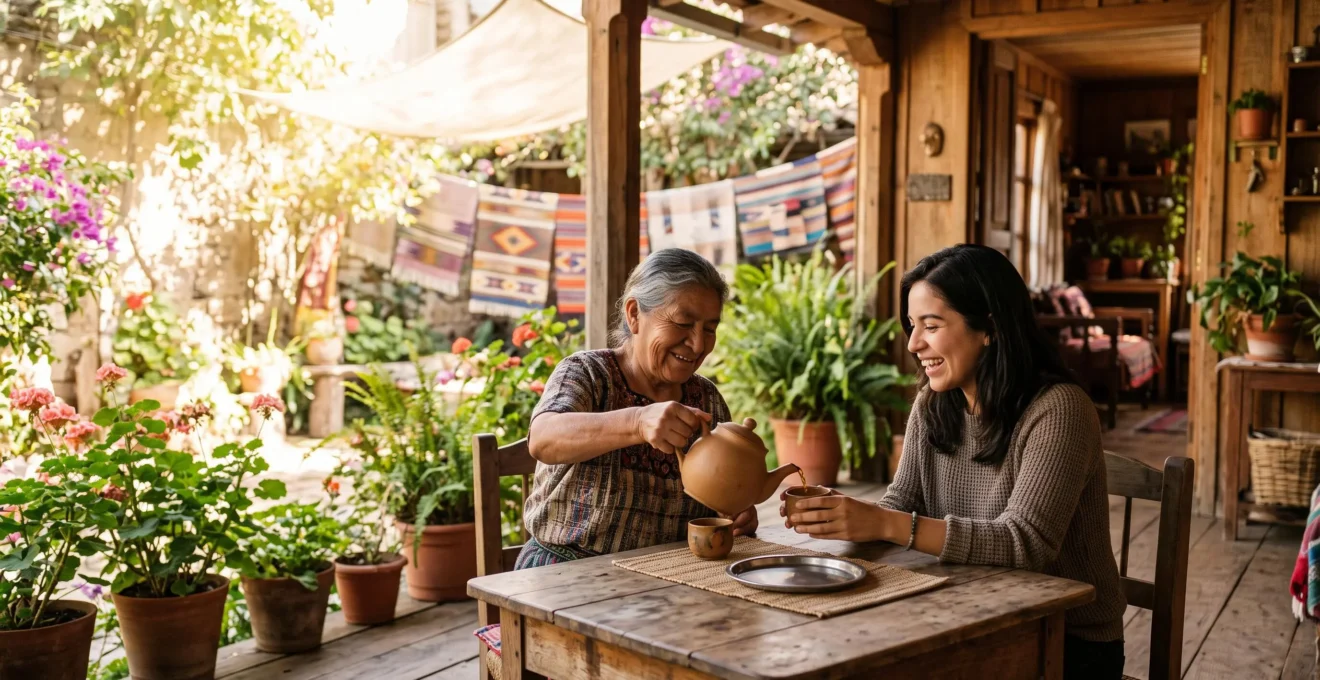
Finding a guesthouse that offers true cultural exchange is not about luck; it’s about learning to decode the host’s primary intent before you book.
- Look for structural clues (like a shared entrance) and personal details (family photos) over professional polish.
- Prioritize multi-night stays (3-4 nights) to build the trust necessary for genuine interaction.
Recommendation: Shift your search from finding a ‘place’ to finding a ‘person’—a host who is a cultural ambassador, not just a rental operator.
You’ve been there. You meticulously book a « locally-owned guesthouse » in a charming neighbourhood, expecting authentic connection, only to find yourself in a sterile, IKEA-furnished room with a key in a lockbox. The host is a phantom, a name on a booking app. While a comfortable bed is provided, the promise of cultural immersion evaporates. This experience is frustratingly common, leaving travellers feeling like they’ve merely observed a destination from behind glass. Many articles will tell you to « read the reviews » or « stay off the beaten path, » but this advice is superficial and unreliable.
The common approach to finding accommodation is flawed because it focuses on the wrong criteria: location, price, and amenities. These are metrics for a hotel, a transaction. A genuine cultural exchange, however, is not a transaction; it’s a relationship, however brief. The key isn’t in finding the right *place*, but in identifying the right *person*—a host whose primary motivation is sharing their life, not just renting a room. This requires a shift in strategy from a consumer to a detective, learning to spot the subtle signals that separate a true homestay from a commercial rental masquerading as one.
This guide will equip you with a new framework for selecting accommodation. We will move beyond generic advice and delve into the strategic analysis of a listing. You’ll learn to decode visual and structural clues, understand the critical difference between host archetypes, and recognize the booking errors that kill any chance of connection before you even pack your bags. We’ll explore why the duration of your stay is more important than the location and how to see past « green » certifications to find true, innate sustainability. It’s time to stop booking beds and start finding doorways into a culture.
This article provides a detailed roadmap for this new approach. The following sections will break down each strategic element, empowering you to make choices that lead to the meaningful travel experiences you seek.
Summary: A Strategic Guide to Authentic Accommodation
- Why Do Small Guest Houses Offer 5x More Cultural Learning Than Standardized Hotels?
- How to Identify Guest House Hosts Who Enjoy Sharing Culture Versus Those Just Renting Rooms?
- City Centre Guest Houses vs Village Homestays: Which Location Offers Better Cultural Immersion?
- The Guest House Booking Error That Prevents Cultural Exchange Despite Perfect Location
- When Should You Book 4-Night Guest House Stays Instead of Single Overnight Stops?
- Why Do Hotel-Based Travelers Miss 90% of Local Cultural Heritage Authenticity?
- Internationally Certified Eco-Hotels vs Locally-Owned Small Guest Houses: Which Is Actually Greener?
- How to Move Beyond Tourist Experiences to Genuine Cultural Heritage Immersion?
Why Do Small Guest Houses Offer 5x More Cultural Learning Than Standardized Hotels?
The fundamental difference between a standardized hotel and a small guesthouse lies in their very design and purpose. A hotel is engineered for efficiency, scalability, and consistency. Its goal is to remove friction and provide a predictable, anonymous service to a mass audience. While comfortable, this structure is inherently sterile. It presents a polished, controlled version of a place, effectively building a wall between the guest and the authentic, messy, vibrant reality of local life. The culture you experience is often a performance—a « cultural night » or a themed buffet—rather than an organic reality.
A small, owner-occupied guesthouse, by contrast, is structurally designed for connection. It is not a product but a home. The very act of staying there means stepping into the rhythm of a local family’s life. The business model isn’t based on maximizing occupancy through standardized rooms, but on a personal exchange. This model is perfectly illustrated by government-backed homestay programmes, such as one in Malaysia, where operators are empowered to act as development tools for the tourism industry. The experience is packaged with local tradition, cultural elements, and natural heritage in a way that a standardized hotel, by its very nature, cannot replicate.
This intimate setting transforms the traveller from a passive consumer into an active participant. You aren’t just sleeping in a city; you’re sleeping in a home, waking up to its sounds and smells, and navigating its social norms. The « amenities » are not a gym or a pool, but spontaneous conversations over breakfast, a shared tip for a non-touristy market, or the simple act of learning how to brew the local tea correctly. It is in these unscripted, human moments that true cultural learning occurs—a depth of understanding a hotel is simply not built to provide.
How to Identify Guest House Hosts Who Enjoy Sharing Culture Versus Those Just Renting Rooms?
The most critical factor in a successful guesthouse experience is the host’s intent. You must learn to distinguish between two primary archetypes: the Cultural Ambassador and the Rental Operator. The former shares their home and life as a passion; the latter runs a business that happens to be in a residential property. The Rental Operator optimizes for efficiency and minimal guest interaction. The Cultural Ambassador thrives on it. Your job is to find the Ambassador.
This isn’t about guesswork; it’s about forensic analysis of the listing. Rental Operators betray themselves with sterile professionalism: identical rooms, generic « hotel-style » decor, and pristine kitchens that show no sign of daily use. A Cultural Ambassador’s listing feels like a home. You might see personal touches like family photos on a wall or the charming imperfection of a well-used kitchen. As one traveller in Kerala’s backwaters experienced, the difference is profound. A true host doesn’t sell you a tour; he takes you out in his personal canoe at dawn and his wife cooks the catch for breakfast. This is the difference between a host who invites you into unpaid, personal moments and one who merely rents a bed.
You must become adept at reading these signals before you book. Pay attention to the host’s language, the layout of the property, and the visual evidence provided. This systematic audit is the only way to ensure you are booking an experience, not just a space.
Your Checklist for Decoding a Host’s True Intent
- Scan for Personal Life: Review all photos for signs of a real home, not a showroom. Look for family pictures, pet items, or personal (not generic) decor.
- Audit the ‘Lived-In’ Factor: Examine the kitchen and common areas. A pristine, untouched look is a red flag; a functional, slightly-used space is a green flag.
- Check for Room Uniformity: Compare all guest rooms in the listing. If they are identical, with boutique-hotel decor, it’s likely a commercial rental operation, not a shared home.
- Analyze the Language: Read the host’s description and pre-booking messages. Do they talk about « our home » or « the property »? Do they mention family or personal interests?
- Evaluate the Entry Point: Clarify if the room has a private, separate entrance. A shared entrance is a strong structural indicator of a host who is open to interaction.
City Centre Guest Houses vs Village Homestays: Which Location Offers Better Cultural Immersion?
The conventional wisdom is that a village homestay is inherently more « authentic » than a guesthouse in a city. This is a dangerous oversimplification. The potential for cultural immersion is not determined by a simple urban vs. rural dichotomy, but by a combination of host engagement and the « radius of authenticity »—the walkable area of genuine local life surrounding the property. A disengaged host in a tourist-heavy village can offer a more isolating experience than a passionate host in a vibrant, residential city neighbourhood.
This photo of a lived-in city alley captures the essence of a large, walkable radius of authenticity. It’s not a major landmark, but a place of daily life, with local eateries and the hum of a real neighbourhood—the kind of place a great host can unlock for you.
A study of rural homestays in Himachal Pradesh, which attract millions, offers a crucial insight. It found that while accommodation quality was important, guest satisfaction and the degree of cultural immersion were heavily influenced by the guests’ own profiles and, critically, the engagement of the host. This shows that location alone does not guarantee immersion. A village can be just as much a « tourist bubble » as a city centre if its economy has been reshaped entirely around tourism. The following table breaks down the strategic considerations.
This comparative analysis, inspired by accommodation experts, highlights the nuanced factors at play. As shown in a study of rural homestays attracting over 16.83 million domestic tourists in Himachal Pradesh, guest profiles and host interaction are the true drivers of a meaningful experience, not just the pin on the map.
| Criteria | City Centre Guest House | Village Homestay |
|---|---|---|
| Access to authentic daily life | Depends entirely on host engagement; a rooted host unlocks neighborhood markets and local-only spots on foot | Often assumed automatic, but a disengaged host in a touristified village can offer little beyond a main road |
| Walkable radius of experiences | Can be large in a non-touristy, residential neighborhood | Can be small if the village’s economy is limited to a single tourist strip |
| Location research needed | Checking proximity to attractions and transport still matters | Same proximity checks apply, plus transport logistics to reach town |
| Risk of ‘staged’ authenticity | Lower if the host lives locally full-time | Higher in villages heavily reshaped around tourism |
The Guest House Booking Error That Prevents Cultural Exchange Despite Perfect Location
You can find the perfect host in the perfect neighbourhood and still sabotage any chance of genuine interaction with one simple booking error: choosing a room with a separate, private entrance. This architectural feature, often marketed as a desirable amenity, is the single biggest structural barrier to the spontaneous encounters that define a true homestay experience. It transforms a shared home into a duplex, turning your hosts into, at best, friendly neighbours and, at worst, invisible landlords.
A private entrance signals a specific intent from the host: to provide a rental unit, not to share a home. It allows you and the host to operate on parallel tracks, never intersecting in the kitchen for a morning coffee or in the hallway for a quick chat about your day. These small, unplanned moments are the very fabric of cultural exchange. By opting for a private entrance, you are pre-emptively cutting the threads of that fabric. You are choosing privacy over connection, a transaction over a relationship.
Before you book, you must explicitly ask the host: is this a private room within the main family home, or a separate dwelling on the same property? This question cuts through marketing language and gets to the structural reality of the stay. As the experts at Moto World Explorer point out, the language itself is a clue:
Authentic homestays rarely call themselves ‘home stays’ — they call themselves ‘our home’ or ‘family room.’ If the listing says ‘private entrance, no interaction,’ it’s a rental, not a homestay.
– Moto World Explorer, How to Find Authentic Homestays Instead of Hotels
To avoid this mistake, you must communicate clearly about expectations before booking. It’s not just about rules and check-in times; it’s about establishing a foundation of mutual respect and clarity. This ensures the positive shared experience you’re looking for is structurally possible from the moment you arrive.
When Should You Book 4-Night Guest House Stays Instead of Single Overnight Stops?
The modern travel itinerary, with its emphasis on seeing as much as possible, often encourages a series of one-night stops. This approach is the enemy of cultural immersion. Genuine connection requires trust, and trust requires time—more time than a single overnight stay can provide. This is reflected in tourism data; for example, research on homestay tourism in Thailand found the average stay is 2 days, a duration that barely allows a guest to unpack, let alone form a meaningful bond.
A single night is a transaction. The host provides a bed; you provide payment. A multi-night stay (ideally 3-4 nights) transforms the dynamic. The first night is for introductions. The second is for comfort and familiarity. It is on the third or fourth night that the « trust threshold » is crossed. This is when conversations deepen, when you are no longer a « guest » but a temporary part of the household. This is when you might be invited to a family event, shown a personal favorite spot, or simply share a quiet, comfortable silence.
This concept of a « connected experience » is more than anecdotal. Studies show that a guest’s engagement with local families, cuisine, and culture directly shapes their emotional involvement and loyalty. This deep connection, built over several days, is the reward for resisting the urge to move on too quickly. It’s the difference between collecting destinations and experiencing them.
This image of a shared meal represents the pinnacle of a guesthouse stay—an outcome only possible when you’ve invested enough time to move from stranger to friend.
Why Do Hotel-Based Travelers Miss 90% of Local Cultural Heritage Authenticity?
There is a vast and growing disconnect in the world of travel. On one hand, travellers are increasingly seeking out meaningful, authentic experiences. On the other, the traditional tourism infrastructure is failing to provide them. One striking report revealed that while 74% of travelers want meaningful, educational experiences, fewer than 10% actually receive them at major destinations. The primary reason for this gap is the reliance on accommodation models, like hotels, that are structurally incapable of delivering genuine cultural immersion.
Hotels treat heritage as a product to be consumed. They offer convenience, comfort, and predictability, but they do so by creating a « bubble » that insulates guests from the local environment. The front desk can book you a tour to see a heritage site, but it cannot facilitate a conversation with the person who lives next to it. The hotel restaurant might serve a « local » dish, but it’s a standardized recipe, disconnected from the home kitchen where its traditions were born. This approach reduces culture to a series of photo opportunities and transactions.
A systematic review of dozens of homestay studies confirms this. It concludes that a successful homestay goes far beyond an enjoyable visit; it enables intimate cross-cultural exchange while upholding the native authenticity that attracts guests in the first place. The hosts cultivate a familial ambiance and a sense of belonging that is deeply integrated with the local nature and culture. This provides access to a « living heritage » that is simply inaccessible from within the walls of a hotel, which is designed to view that same heritage as a commodity. By choosing a hotel, travellers are, by default, choosing a filtered, commercialized version of a culture, missing out on the vast majority of its authentic expression.
Internationally Certified Eco-Hotels vs Locally-Owned Small Guest Houses: Which Is Actually Greener?
In an era of conscious travel, the « eco » label has become a powerful marketing tool. Many travellers gravitate towards internationally certified eco-hotels, assuming their audited systems for waste and water management represent the gold standard of sustainability. However, this perspective often overlooks a more profound, integrated form of green living: the innate sustainability of a traditional, locally-owned small guesthouse.
This image captures the essence of « innate sustainability »—not a certification, but a lifestyle of resourcefulness and connection to the immediate environment, symbolized by sun-dried linen and garden-fresh food.
The difference lies in the approach. A certified eco-hotel practices formal, engineered sustainability. It’s often a top-down system of technologies and policies designed to reduce impact, which is commendable. A small guesthouse, however, often practices lifestyle-based, innate sustainability. This isn’t about a brand strategy; it’s about a way of life passed down through generations. It’s about sourcing food from a backyard garden, using local, natural building materials, minimizing consumption out of practicality, and having a deep, economic link to the immediate community. A case study of one eco-stay co-owned by a local resident highlights how this model keeps tourist money directly within the community, funding local projects in a way a foreign-owned chain hotel, even a green-certified one, rarely does.
This table, based on expert analysis, contrasts these two models of sustainability:
The comparison, drawn from insights on eco-friendly hotel practices, reveals that true sustainability has social and economic dimensions that certifications alone may not capture.
| Dimension | Certified Eco-Hotel | Locally-Owned Small Guest House |
|---|---|---|
| Approach to sustainability | Audited, engineered systems (certifications, formal waste/water management) | Lifestyle-based: local sourcing, minimal consumption, local materials |
| Community relationship | Sustainability framed as brand differentiation | Sustainability tied directly to daily household life and local supply chains |
| Business model | Boutique or chain hotel, locally staffed but not always locally owned | Owned and staffed by the resident family |
Key Takeaways
- True cultural exchange is a byproduct of a host’s mindset, not an amenity on a listing. Learn to distinguish « Cultural Ambassadors » from « Rental Operators ».
- A private entrance is the biggest structural barrier to connection. Prioritize rooms within a shared home to enable spontaneous interaction.
- Invest in time. A multi-night stay is essential to cross the « trust threshold » that unlocks genuine relationships and deeper cultural insights.
How to Move Beyond Tourist Experiences to Genuine Cultural Heritage Immersion?
The shift from being a tourist to being a temporary member of a community is an active one. It requires a conscious change in your own mindset and behaviour, not just a change of address. Genuine immersion is not something that happens *to* you; it’s something you co-create with your host. The right guesthouse provides the stage, but you must be willing to step into your role as a respectful, curious, and engaged participant.
The first step is to cede your role as the « expert ». Put away the guidebook, at least for a while, and ask your host for their insider tips on the best places to visit and eat. This not only gives you better recommendations but also signals respect for their knowledge. Secondly, make space for them to teach you. Ask direct, open-ended questions about their daily life, traditions, and perspectives. This invites them to share their culture in a way that is far more meaningful than a canned tourist presentation. Finally, simply spend quality time with them. Instead of retreating to your room after a day of sightseeing, linger in the common areas. A recent netnographic study of homestays in rural Vietnam confirmed this, finding that guest satisfaction was primarily driven by host families’ attitudes, authentic cuisine, and shared facilities—proving that reciprocal contact is the key.
Ultimately, your goal is to become a contributor to the household, not just a consumer of its services. This doesn’t mean you need to do chores, but rather that you contribute to the social fabric of the home. Share stories from your own life, show genuine interest in theirs, and be present. By embracing this role, you move beyond the transactional nature of tourism and step into the relational world of genuine human connection. This is the essence of true cultural immersion.
By adopting this strategic, human-centric approach to selecting and engaging with your accommodation, you fundamentally change the nature of your travels. You stop collecting sights and start collecting relationships, transforming each journey from a simple trip into a profound and memorable experience. Apply these principles to your next travel plan and discover the depth of connection that awaits.