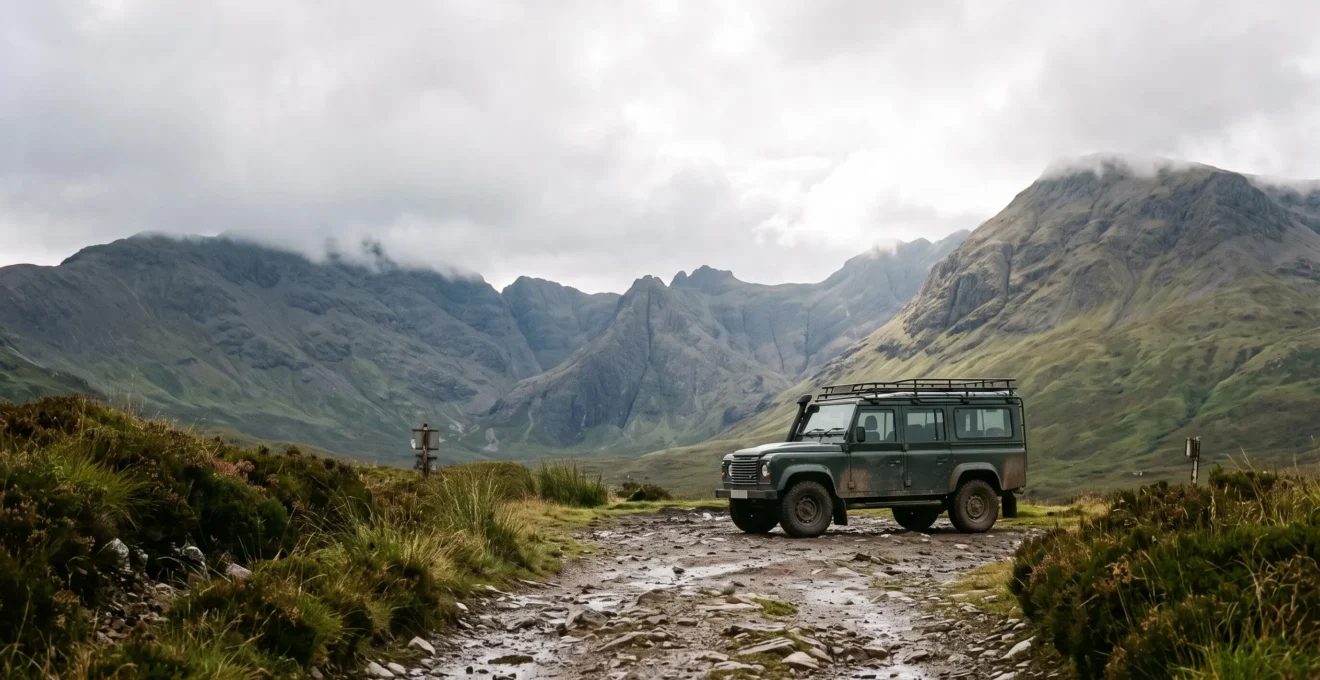
The primary cause of vehicle damage on UK trailhead tracks is not a lack of a ‘4×4’, but a fundamental mismatch between a standard car’s ground clearance, tyres, and drivetrain and the specific hazards of unpaved rural lanes.
- Assessing a track on foot for high central crowns, deep ruts, and sharp rocks is more critical than the badge on your vehicle.
- Inconsiderate parking in passing places is a major source of conflict and can block emergency access on vital single-track roads.
Recommendation: Before any trip, evaluate your specific vehicle’s limitations against satellite imagery of the access track and have a backup plan, whether it’s parking lower down or using dedicated hiker bus services.
For any UK hiker, the promise of a remote, crowd-free trailhead is a powerful lure. The reality, however, often begins with a gut-wrenching scrape of metal on rock. Many adventurers assume they need a formidable, expensive 4×4 to reach these starting points, while others optimistically push their city hatchbacks far beyond their design limits. This binary thinking—indestructible off-roader versus fragile town car—is where the costly mistakes are made.
The common advice is to simply « drive slowly » or « get an SUV. » Yet this overlooks the nuanced physics at play. A two-wheel-drive SUV with low-profile road tyres can be more vulnerable on a wet, grassy incline than a lighter hatchback with better traction. The key isn’t the vehicle category, but a sober understanding of specific mechanical attributes: ground clearance, tyre construction, and how power is delivered to the wheels.
This guide moves beyond the generic « buy a 4×4 » narrative. Instead, we will adopt the mindset of an off-road instructor, focusing on a vehicle-specific assessment of capabilities. The critical question is not « Can a car get there? » but « Can *my* specific car get there without risking hundreds or thousands of pounds in damage? » We will dissect the common failure points, provide a framework for evaluating track conditions, and explore alternative strategies that are often more practical and cost-effective than blind faith in your daily driver.
By understanding the precise relationship between your vehicle and the unique challenges of British unmaintained tracks, you can make informed decisions that protect your car, your wallet, and your access to the wild places you love. This article will break down the essential strategies for getting to the trailhead safely, covering vehicle assessment, parking etiquette, and smart alternatives to driving.
Summary: Your Guide to Trailhead Access Vehicles and Strategies
- Why Do 40% of Hikers Damage Their Cars on Unmaintained Trailhead Access Routes?
- How to Evaluate Track Conditions Before Committing Your 2WD Car?
- 4WD Rental vs Parking Lower and Hiking Further: Which Access Strategy Makes Sense?
- The Trailhead Parking Error That Blocks Emergency Vehicles and Angers Locals
- When Should You Take the Bus or Train to Trailheads Instead of Driving?
- Renting a Campervan vs Car Hire Plus Camping: Which Saves Money on 10-Day Trips?
- When Is Owning a Car Actually Necessary Versus Just Familiar and Convenient?
- How to Rent a Campervan in the UK Without Overpaying or Getting Inadequate Vehicles?
Why Do 40% of Hikers Damage Their Cars on Unmaintained Trailhead Access Routes?
The jarring sound of your car’s underbelly grinding against a rock is a depressingly common part of the UK hiking experience. The damage often stems from a misunderstanding of three critical vehicle limitations when faced with tracks designed for tractors, not family cars. The first and most significant is insufficient ground clearance. A typical hatchback may have only 130-150mm of clearance, which is simply not enough to clear the « crown » of a heavily eroded track or the large, loose rocks common in upland areas.
This central ridge, formed by water erosion and tyre compression, is the primary enemy of a car’s vulnerable components like the oil sump, exhaust system, and fuel lines. The illustration below captures this exact moment of costly contact.
As the image shows, even a seemingly minor ridge can cause significant scraping and potential punctures. The second factor is the drivetrain. A two-wheel-drive (2WD) vehicle, which sends power to only two wheels (usually the front), can easily lose traction on wet grass, loose gravel, or a muddy incline. Drivers get stuck not because of a lack of power, but a lack of grip. It’s important to distinguish this from All-Wheel Drive (AWD), which can send power to all four wheels but often lacks the robust, lockable gearing of a true Four-Wheel Drive (4WD) system designed for sustained, low-speed challenges.
Finally, standard road tyres are a major point of failure. Their thin sidewalls are easily punctured by sharp stones, and their tread pattern is designed for tarmac, offering minimal grip in mud or on wet vegetation. A combination of low clearance, a 2WD system, and road tyres on a wet, crowned, and rocky track is a near-guaranteed recipe for getting stuck or causing expensive damage. This isn’t bad luck; it’s a predictable mechanical mismatch.
How to Evaluate Track Conditions Before Committing Your 2WD Car?
The single most important decision you make is not in the driver’s seat, but on your own two feet. Before committing your vehicle to an unknown track, the golden rule is: park up and walk it first. A ten-minute reconnaissance walk can save you a ten-hour wait for a recovery truck and a four-figure repair bill. Your goal during this walk is to conduct a « track triage, » looking for specific deal-breakers for a standard 2WD vehicle.
First, assess the track’s surface and structure. Is it graded gravel, or is it a « two-strip » track with a high, grassy middle? This central crown is the number one risk for low-slung cars. Use your foot or a walking pole to gauge its height relative to where the bottom of your car would be. Next, look for deep ruts. Can your car’s wheels stay on the high points, or will they be forced into ruts so deep that the chassis will ground out? Look for evidence of other cars having scraped their undersides – fresh gouges in the earth are a clear warning sign.
Then, evaluate traction. Is the surface loose, shifting gravel or deep, wet mud? Is there a steep, grassy section that will be impossibly slippery after a morning dew or a rain shower? Finally, identify specific obstacles. Are there any large, embedded « rock steps » that would require high clearance to get a wheel over? Are there any sharp, angular rocks poised to shred a tyre sidewall? If the track is worse than the access road you’ve just left, the risk is escalating. This simple pre-assessment is the most effective tool a driver has.
Your 5-Point Pre-Drive Track Assessment Checklist
- Central Crown Height: Walk the first 50 metres. Is the central ridge higher than the midpoint of your car’s wheels? If yes, the risk of grounding the undercarriage is high.
- Rut Depth & Width: Find the deepest ruts. Will your car’s track width allow you to straddle them, or will one side be forced in? Measure the depth; if it’s more than half your tyre’s height, be extremely cautious.
- Traction Test: Scuff the surface with your boot on the steepest incline. If it’s loose gravel that slides away or slick mud/grass, your 2WD tyres will likely spin without purchase.
- Obstacle Scan: Look for individual « deal-breaker » hazards: sharp, flinty rocks pointing upwards (tyre risk) or solid rock ledges over 10cm high (sump/suspension risk).
- Turnaround & Passing Viability: Identify a safe, wide, and flat spot to turn around within the first 100 metres. If there isn’t one, and you meet another vehicle, you will have to reverse a long way on a difficult track.
4WD Rental vs Parking Lower and Hiking Further: Which Access Strategy Makes Sense?
When you’ve determined a trailhead track is impassable for your car, you face a strategic choice. The decision between renting a suitable 4WD vehicle and simply parking lower down to hike the extra distance isn’t just about convenience; it’s an access-cost-benefit analysis. This involves weighing the financial cost of a rental against the « cost » of your time, energy, and potentially a compromised hiking plan.
Renting a capable vehicle, like a Dacia Duster 4×4 or a Subaru Forester, might cost £50-£100 per day. For a one-off trip to a particularly remote location, this can be a sound investment. It guarantees access, saves you several miles of road-walking, and preserves your energy for the main event. It’s particularly sensible for groups, where the cost can be split, or for photographers and wild campers carrying heavy equipment where every metre of access counts. The rental provides certainty and can turn an impossible-to-reach location into a straightforward one.
However, the alternative—parking in a designated lay-by or village and walking the final one or two miles—is often the most pragmatic solution. The cost is zero, and the only investment is time and effort. This strategy requires a mental shift: the approach walk along the track becomes the warm-up for the hike itself, not a frustrating obstacle. For many, an extra 30-40 minutes of walking at the start and end of the day is a perfectly acceptable trade-off for saving £100 and the hassle of renting. The deciding factor is often the length and nature of the approach. If walking the track adds more than an hour each way or involves a significant, tiring ascent before the « real » hike even begins, the case for renting a 4WD becomes much stronger.
Ultimately, the « correct » choice depends on your priorities, budget, and the specific hike. For a short, easy walk, hiking further is almost always the better option. For a challenging, multi-day expedition into a remote corner of the Highlands, the cost of a rental can be a price well worth paying for a successful trip.
The Trailhead Parking Error That Blocks Emergency Vehicles and Angers Locals
Successfully navigating a rough track is only half the battle; parking correctly at the trailhead is just as critical. In the narrow, winding landscapes of the UK’s National Parks, the most common and dangerous parking mistake is obstructing a single-track road’s passing place. These small pull-outs are not parking bays. They are an essential part of the road’s circulatory system, allowing oncoming traffic to pass safely. Parking in one effectively turns a two-way road into a one-way dead end.
The consequences range from angering local residents and farm traffic to, most critically, blocking access for emergency services. A fire engine or ambulance unable to reach an incident because a car is parked in a passing place is a worst-case scenario. The official guidance is unambiguous. As an authority on road use, Traffic Scotland provides clear advice on this matter.
It is important that you do not park in passing places, as you will cause an obstruction for other road users.
– Traffic Scotland, Traffic Scotland – Country Roads guidance
This isn’t just a suggestion; it’s a fundamental rule of rural driving. The image below illustrates the problem perfectly: a single car, incorrectly parked, renders the entire road impassable for any other vehicle.
Beyond passing places, drivers must also avoid blocking farm gates (even if they look unused), field entrances, or residents’ driveways. The principle is to ensure your vehicle does not impede the movement of others in any way. If the designated parking area is full, the correct and responsible action is not to squeeze into a non-parking spot. It is to drive away and find a legitimate parking space elsewhere, even if that means a longer walk or choosing a different hike for the day. Responsible access is a pillar of the outdoor community, and it begins the moment you turn off your engine.
When Should You Take the Bus or Train to Trailheads Instead of Driving?
For many UK hikers, driving is the default option, but it’s not always the smartest. Using public transport can transform a trip, eliminating parking stress, avoiding track damage, and, most importantly, enabling incredible linear (A-to-B) hikes. A car tethers you to your starting point, forcing you into circular routes. A bus or train liberates you to walk from one valley to the next, finishing miles from where you began.
The best time to opt for public transport is when a dedicated « hiker bus » service exists. These routes are specifically designed to serve popular trailheads. A prime example is the Snowdon Sherpa network in Wales. It connects major car parks, villages, and the six main paths up Snowdon, allowing you to ascend via one route and descend via another, catching a bus back to your starting point. On peak summer weekends, some of these services are incredibly frequent; for instance, buses between Pen-y-Pass and Llanberis run as often as every 15 minutes, making it a highly practical alternative to the area’s notoriously full car parks.
The model is so effective it provides a blueprint for sustainable outdoor access, as highlighted in the following case study.
Case Study: The Snowdon Sherpa Network as a Model ‘Hiker Bus’ System
The Snowdon Sherpa (Sherpa’r Wyddfa) is a dedicated public bus network built specifically around walkers’ needs, connecting the six main footpaths up Snowdon along with the main car parks, villages, and tourist attractions in the area. This integrated system effectively removes the need for a walker to return to the same trailhead where their car was left. A hiker can start at Pen-y-Pass, ascend via the Pyg Track, descend via the Llanberis Path, and then simply take a direct bus from Llanberis back to Pen-y-Pass. This solves the logistical nightmare of linear hikes and massively reduces traffic congestion and parking pressure in the National Park.
Beyond dedicated services, consider trains. The West Highland Line in Scotland, for example, offers direct access to trailheads in Bridge of Orchy, Tyndrum, and Corrour (the UK’s most remote station). Similarly, the Settle-Carlisle line provides access to the heart of the Yorkshire Dales. If your planned hike is linear or located in a parking-congested « honeypot » area, a quick search for local bus or train services should be a mandatory part of your planning phase.
Renting a Campervan vs Car Hire Plus Camping: Which Saves Money on 10-Day Trips?
For a multi-day trip, a campervan seems to offer the ultimate freedom, combining transport and accommodation. However, comparing it to the classic car-plus-tent approach reveals a more complex financial and legal picture, especially in the UK. The perceived « freedom » of a campervan to park and sleep anywhere is largely a myth, particularly outside of Scotland. The key difference lies in the laws governing « wild camping. »
The following table, based on the legal frameworks across Great Britain, breaks down the critical distinctions for vehicle-based camping.
| Aspect | Scotland | England & Wales |
|---|---|---|
| Legal basis | Land Reform (Scotland) Act 2003 / Scottish Outdoor Access Code | No statutory right to roam for vehicles; local byelaws and trespass law apply |
| Covers motorhomes/campervans? | No — right to roam applies to people on foot, not motor vehicles | No — overnight vehicle stays require landowner permission |
| Typical legal overnight options | Aires, Certificated Locations, campsites, council-run overnight parking | Campsites, Certified Locations, or explicit landowner permission |
| Consequence of non-compliance | Asked to move on; parking law/byelaw enforcement | Trespass; refusal to leave can lead to a fine of up to approx. £2,500 |
As the table shows, the right to wild camp in Scotland does not extend to vehicles. While the Land Reform (Scotland) Act 2003 allows responsible wild camping, this right is for non-motorised access only. In practice, this means a campervan must use designated campsites, ‘Aires’ (basic overnight spots), or obtain landowner permission, just as in England and Wales. The idea of pulling up by a remote loch and legally staying the night is not supported by the access code.
On a 10-day trip, the costs quickly add up. A campervan rental can be £80-£150 per day, plus campsite fees of £25-£40 per night. In contrast, a small hire car (£30-£50/day) plus a tent (which *can* be used for genuine wild camping in Scotland) and occasional campsite fees offers far greater flexibility and is almost always the cheaper option. A campervan provides comfort and convenience, but for pure cost-saving and access to true wilderness camping, the car-and-tent combination remains unbeatable.
When Is Owning a Car Actually Necessary Versus Just Familiar and Convenient?
For many outdoor enthusiasts in the UK, owning a car feels like a prerequisite for the hobby. It’s the familiar, convenient tool we reach for without a second thought. But it’s valuable to pause and ask: is car ownership for trailhead access a genuine necessity, or a deeply ingrained habit? Distinguishing between the two can unlock more creative, sustainable, and sometimes more enjoyable ways to reach the mountains.
Ownership becomes a true necessity when your hiking habits are defined by three factors: frequency, spontaneity, and remoteness. If you are hiking multiple times a month, often deciding to go at the last minute, and consistently targeting trailheads with zero public transport links, then personal car ownership is likely indispensable. It provides the on-demand freedom that car-sharing clubs, rentals, or public transport cannot match. For those living in rural areas, this necessity is even more pronounced.
However, for the majority of hikers—especially those living in or near cities—car use is often driven by convenience and familiarity. A weekend hiker who plans trips in advance might find that a combination of strategies is more efficient. This could look like using a car club vehicle for one trip, taking the train for another, and renting a 4WD for a special expedition to the Highlands. This « access portfolio » approach challenges the one-size-fits-all solution of car ownership. It forces a more conscious decision for each trip, weighing cost, environmental impact, and the type of journey desired. It may require more planning, but it often results in a lower overall cost and a reduced reliance on a single, depreciating asset parked outside your home.
The question, therefore, is not whether a car is useful, but whether the specific level of convenience it offers justifies the significant costs of ownership (tax, insurance, maintenance, depreciation) compared to a more flexible, multi-modal approach to accessing the outdoors.
Key Takeaways
- The greatest risk to a standard car is grounding the undercarriage on a track’s high central crown.
- Never commit to a rough track without walking it first to assess clearance, traction, and specific obstacles.
- Parking in a single-track passing place is dangerous and can block emergency services; it is not a parking bay.
How to Rent a Campervan in the UK Without Overpaying or Getting Inadequate Vehicles?
Renting a campervan for a UK road trip is an appealing prospect, but success lies in choosing the right vehicle for the environment. A common mistake is to select a large, comfortable motorhome that is ill-suited to the UK’s narrow, hedge-lined country lanes. While spacious on the inside, a wide vehicle can turn a scenic drive into a stressful ordeal of constant braking, pulling over, and judging tight gaps. The most important factor to consider is not luxury, but appropriate dimensions.
Look for panel van conversions (e.g., VW Transporter, Ford Transit Custom) rather than coach-built motorhomes. These vehicles are only marginally wider than a large car, making them far more nimble and less stressful to drive on single-track roads. Before booking, ask the rental company for the vehicle’s exact width (including mirrors). Compare this to the width of your own car to get a real-world sense of how it will feel on the road.
To avoid overpaying, book well in advance, especially for travel during school holidays when prices can double. Look for smaller, independent rental companies located just outside major cities, as they often offer better rates than large operators based at airports. Be crystal clear about what is included in the price. Does it include unlimited mileage, comprehensive insurance for all drivers, and breakdown cover? A cheap headline price can quickly escalate if these are expensive add-ons. Finally, read recent reviews with a focus on vehicle maintenance and cleanliness. An older, poorly maintained van is a false economy that can ruin a trip. A well-chosen, compact, and reliable campervan is the key to a successful UK adventure.
Now that you are equipped with the knowledge to assess tracks, understand vehicle limitations, and choose the right access strategy, the next step is to apply this framework to your own hiking plans. Proactively evaluating the approach to your next desired trailhead is the most effective way to prevent costly damage and ensure a successful day in the mountains.