The advertised daily rate for a campervan is the single biggest misdirection in the rental industry.
- Huge price gaps reflect operational models (Professional Fleet vs. Peer-to-Peer) and included support, not just profit.
- The biggest financial risk isn’t the rental fee, but the £2,500+ insurance excess that standard waivers don’t fully cover for common damages like windscreens or tyres.
Recommendation: Stop comparing headline prices and start auditing the ‘Total Cost of Risk’—a framework this guide will teach you to master.
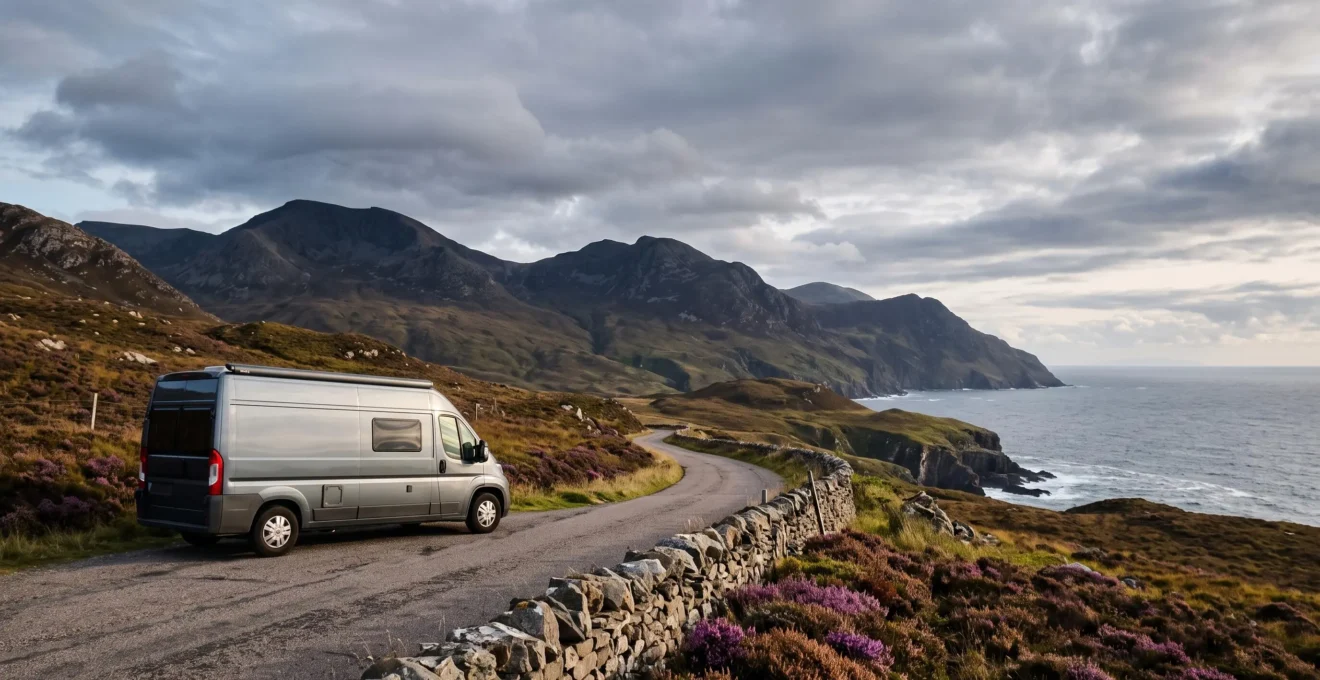
The vision is captivating: a winding road through the Scottish Highlands or along the Cornish coast, your home on wheels parked against a backdrop of sea cliffs or serene lochs. Renting a campervan in the UK promises ultimate freedom for a road-trip hiking adventure. So, you start browsing, and immediately confusion sets in. How can one van be £70 a day, while a seemingly identical one is £250? The standard advice— »book early, » « compare prices, » « read the reviews »—feels inadequate, like trying to navigate a minefield with a tourist map.
This isn’t a simple consumer choice; it’s a complex landscape of hidden liabilities and opaque pricing. The truth the rental industry doesn’t advertise is that the daily rate is often a decoy. The real game is played in the fine print of insurance policies, the list of un-bundled extras, and the operational standards that separate a well-maintained, professionally supported vehicle from a private owner’s passion project with questionable reliability.
But what if the key wasn’t finding the ‘cheapest’ van, but the one with the lowest ‘Total Cost of Risk’? This guide provides an insider’s framework, shifting your focus from the seductive, low headline price to a robust evaluation of the true, all-in cost and potential liabilities. We’ll deconstruct the pricing, demystify the insurance, and give you the tools to secure a vehicle that guarantees peace of mind, not just a low initial quote.
By following the strategic insights in this guide, you will learn to dissect rental offers like an industry professional. The following sections are structured to build your expertise, from understanding pricing and insurance to conducting crucial pre-trip checks and planning your itinerary effectively.
Summary: Your Strategic Guide to UK Campervan Rental
- Why Do Identical Campervans Cost £70/Day from Some Companies and £250/Day from Others?
- How to Check a Rental Campervan for Damage and Equipment Before Driving Off?
- Renting a Campervan vs Car Hire Plus Camping: Which Saves Money on 10-Day Trips?
- The Campervan Rental Error That Leaves You Liable for £5000 Windscreen Damage
- When Should You Book Campervans 6 Months Early vs Wait for Last-Minute Deals?
- Why Do 40% of Hikers Damage Their Cars on Unmaintained Trailhead Access Routes?
- Serviced Pitches for Week-Long Stays vs Basic Sites for Weekends: Which When?
- Are Serviced Camping Pitches Worth the Extra Cost for Hiking Trips?
Why Do Identical Campervans Cost £70/Day from Some Companies and £250/Day from Others?
The vast price difference you see online isn’t arbitrary; it’s a direct reflection of the vehicle type, the business model of the provider, and a host of bundled (or un-bundled) extras. Firstly, the vehicle itself is a major factor. An analysis of the market shows that compact campervans typically cost £45 to £60 per day, while larger coach-built motorhomes can easily climb to over £130, even before other factors are considered. This explains the initial spread, but not the difference for ‘identical’ vans.
The biggest structural reason for price variance is the operational model: are you hiring from a professional fleet company or a peer-to-peer (P2P) marketplace? Professional fleets have higher overheads—standardised maintenance schedules, dedicated support staff, and newer vehicles—which are factored into a higher, but often more inclusive, price. P2P rentals can appear cheaper because a private owner has lower costs, but this can come with greater variability in vehicle condition, maintenance history, and in-trip support.
This table breaks down the fundamental differences that drive the price gap. A lower P2P price might reflect a transfer of risk and responsibility onto you, the renter.
| Criteria | Professional Fleet Company | Peer-to-Peer Marketplace |
|---|---|---|
| Typical price level | Higher, standardised | Lower, variable |
| Vehicle maintenance | Industry-standard daily checks and valeting between trips | Depends on individual owner’s diligence |
| Support during trip | Dedicated roadside/product support | Owner-dependent, may be limited |
| Vehicle age/consistency | Newer, standardised fleet models | Highly variable, often older or DIY conversions |
Ultimately, the « headline rate » is often a poor indicator of the final price. A savvy renter must look past it and calculate the ‘True Total Cost’. Use this checklist to audit any quote before you compare.
Your 5-Step ‘True Cost’ Audit
- Baseline Quote Analysis: List the daily rate and total days. Does it include basic insurance and VAT? Note any mandatory, non-optional fees.
- Essential Add-ons Inventory: Does the price include bedding/towel packs, a gas bottle, kitchen equipment, and unlimited mileage? Price these up if they are charged separately.
- Insurance Gap Assessment: Check the standard excess amount. How much is the daily fee for the Collision Damage Waiver (CDW) to reduce this? Does this waiver cover tyres and windscreen?
- Logistical Extras: Are there fees for an additional driver, one-way drop-off, or out-of-hours collection? These can significantly inflate the total cost.
- Final Price Calculation: Sum the baseline quote with all the necessary add-ons and potential fees. Now, compare this ‘True Total Cost’ between providers, not the initial daily rate.
How to Check a Rental Campervan for Damage and Equipment Before Driving Off?
The 15-minute handover at the rental depot is the single most critical moment for limiting your financial liability. Any undocumented scratch, dent, or chip that was present before you took the keys can and will be charged against your security deposit. The generic advice to « look for damage » is insufficient. You need an evidence-based protocol. Your smartphone is your most powerful tool here, not just for photos, but for a continuous, narrated video.
Before you even touch the keys, begin a « pre-departure video walkaround. » This is non-negotiable. Start the video and state your name, the date, time, and vehicle registration. Then, walk slowly around the entire vehicle in one uninterrupted shot. Zoom in on every panel, wheel arch, bumper, and window. Narrate what you see, pointing out every single mark, no matter how small. Open the doors and film the interior, paying special attention to the windscreen and upholstery. This video, timestamped and immediately emailed to the rental company before you leave the premises, becomes irrefutable proof of the vehicle’s condition at pickup. It neutralises any potential for future disputes.
This process is especially crucial for glass, as an industry analysis reveals that chipped windscreens are the most common reason for claims on hire insurance. Finally, don’t just inspect, but test. Turn on the ignition, check the leisure battery level, run the water pump, ignite the hob, and test the heater. A faulty system discovered 200 miles away is your problem; a faulty system discovered at the depot is theirs.
Renting a Campervan vs Car Hire Plus Camping: Which Saves Money on 10-Day Trips?
The calculation of whether a campervan is ‘cheaper’ than a car and tent is entirely dependent on one crucial factor: your Trip Shape Economics. Are you planning a linear A-to-B journey like the North Coast 500, or a ‘base camp’ style trip where you explore a region like the Lake District from a single location? The answer fundamentally changes the financial equation. A campervan’s value lies in its mobility and the consolidation of transport and accommodation costs.
For linear trips, a campervan almost always offers better value and far greater convenience. You avoid the daily grind of packing up a wet tent and the sunk cost of a campsite you’ve left behind. The ability to spontaneously find a new spot for the night is the freedom you’re paying for. In this scenario, the higher daily rental cost is offset by the logistical simplicity and efficiency.
A real-world example illustrates this perfectly. In a detailed review, two travellers on a Scotland campervan trip with Bunk Campers showcased how a mobile itinerary makes the all-in-one nature of a van pay dividends. They could cover vast distances without being tied to a pre-booked pitch, making the most of their time.
However, for a trip focused on a single hiking area, the maths can flip. If you plan to spend 10 days hiking Munros around a single base in the Cairngorms, a cheaper hire car combined with a long-stay campsite booking could be significantly more economical, as the following cost comparison suggests.
| Option | Typical Cost Range | Best Suited To |
|---|---|---|
| Campervan hire (per day) | £55–£200 | Linear/mobile trips, e.g. NC500 |
| Basic camping pitch (per night) | £20–£30 | Single-base hiking trips near one trailhead |
| Serviced/facility pitch | Considerably more than basic pitch | Longer stays needing full recharge |
The Campervan Rental Error That Leaves You Liable for £5000 Windscreen Damage
Here is the most dangerous and misunderstood part of any campervan rental: the insurance. The single biggest mistake renters make is assuming the « insurance included » or the optional « Collision Damage Waiver » (CDW) they buy at the counter provides comprehensive cover. It does not. It is a system designed with intentional gaps, and falling into them can be financially catastrophic. The standard security deposit or excess you are liable for can be immense; it’s not uncommon for the excess to be anywhere from £500 to £2,500.
The CDW offered by rental firms only reduces this excess; it doesn’t eliminate it. Worse, these waivers are famous for their exclusions. The very things most likely to be damaged on a road trip—windscreens, tyres, the roof, and the undercarriage—are often explicitly excluded from the waiver’s protection. A single stone chip from a passing lorry on an A-road can leave you liable for the entire cost of a new windscreen, which on a large modern motorhome can run into thousands.
The solution is to understand the Insurance Pyramid. At the bottom is the basic liability insurance included in the rental. In the middle is the rental company’s expensive and incomplete CDW. At the top, and the only layer that provides true peace of mind, is a standalone, third-party Motorhome Hire Excess Insurance policy. You buy this policy independently before your trip. It’s often cheaper than the rental desk’s daily CDW and, crucially, it’s designed to cover the very items they exclude, like glass and tyres.
| Layer | What it covers | Cost profile |
|---|---|---|
| Company’s basic insurance | Third-party liability only | Included in rental price |
| Collision Damage Waiver (CDW) | Reduces excess but often excludes glass, tyres, roof, undercarriage | Daily add-on fee |
| Third-party excess insurance | Covers the excess plus items commonly excluded by rental firms | Often cheaper than company CDW |
When Should You Book Campervans 6 Months Early vs Wait for Last-Minute Deals?
The conventional wisdom to « book early » is only half true. The right time to book a campervan in the UK depends entirely on *when* you plan to travel. The rental market operates on a clear seasonal pricing structure, and understanding it is key to unlocking value or avoiding disappointment. Demand for campervans is not linear throughout the year; it’s concentrated in predictable peaks and troughs.
If your travel dates are fixed within the high season—July, August, or any bank holiday weekend—then booking 6 to 9 months in advance is not just advisable, it’s essential. The UK fleet of rental vans is finite, and popular models for school holiday periods sell out far in advance. Waiting for a last-minute deal in August is a fantasy; you’ll be left with either no vehicle or the most expensive, least desirable options.
The real opportunity for strategic booking lies in the shoulder seasons: April-June and September-October. During these months, demand drops, but the weather is often just as good, if not better, for hiking. Rental companies are keen to keep their fleets on the road, leading to significant discounts. It is not uncommon for rental rates to drop by 20% to 40% compared to the summer peak. For these periods, you have more flexibility. Booking 2-4 months out is wise, but you can also keep an eye out for late deals if your dates are flexible.
This table outlines the typical price behaviour across the rental year. Use it to align your booking strategy with your travel plans.
| Season | Approx. Months | Price Behaviour |
|---|---|---|
| Low season | November–March | Lowest rates, most flexible booking |
| Shoulder season | April–June, September–October | Discounted, good weather, lower demand |
| High season | July–August, bank holidays | Highest rates, book 6–9 months ahead |
Why Do 40% of Hikers Damage Their Cars on Unmaintained Trailhead Access Routes?
For hikers, the « last mile » to the trailhead is often the most perilous part of the journey for their vehicle. Remote car parks in places like Snowdonia, the Peak District, or the Scottish Highlands are frequently accessed via narrow, poorly maintained, or even unmade single-track roads riddled with potholes and loose surfaces. While the 40% figure might feel anecdotal, the risk is very real, and it’s compounded by a critical gap in rental insurance understanding: driving on these roads can void your cover.
Renters often assume their insurance covers them on any public road. However, rental agreements contain clauses about appropriate use, and damage sustained on an unmade road can be deemed the renter’s fault due to negligence. This is a grey area where rental companies can refuse a claim, leaving you liable for the full cost of damage to the undercarriage or suspension. The key is what the insurer considers a « road. »
An expert policy wording from Worldwide Insure provides a rare glimpse into this distinction. When asked about cover on unmade roads, they state that it applies on any road, made or unmade, for public use, with a crucial exception.
Cover applies on any road made or unmade that is intended for use by the general public, with the exception being travel to accommodation only accessible by unmade road, where due care must be exercised to minimise risk of damage.
– Worldwide Insure, Motorhome/Campervan Hire Excess Insurance policy terms
This « due care » clause is critical. If a trailhead access road is clearly in terrible condition, proceeding and causing damage could be interpreted as a breach of this clause. Furthermore, your third-party excess policy itself has terms. A claim may not be honoured if you have breached the rental agreement, for instance by driving somewhere you shouldn’t have. It’s a complex chain of liability where each link must hold. The best defence is caution: if a road looks too rough, it probably is. Find an alternative parking spot and walk the extra distance.
Serviced Pitches for Week-Long Stays vs Basic Sites for Weekends: Which When?
Choosing between a basic patch of grass and a fully serviced pitch with all the trimmings isn’t just about cost; it’s about matching your campsite to the rhythm and needs of your trip. The decision hinges on two things: the duration of your stay at any one site and the level of self-sufficiency of your campervan. A common mistake is to overpay for facilities you don’t need or to find yourself short of power on a trip that demanded more.
For short, mobile weekend trips, a basic, unserviced pitch is often the smartest and most economical choice. If you’re only staying one or two nights before moving on, your primary need is simply a safe, legal place to park. A modern campervan’s leisure battery, if fully charged, can easily last 2-3 days running lights, a water pump, and USB chargers. In this scenario, paying a premium for an electrical hook-up you’ll barely use is wasted money. The focus is on mobility, and the campsite is merely a stopover.
Conversely, for week-long stays or trips where you establish a ‘base camp’ for several days to explore an area, a serviced pitch becomes a near-essential investment in comfort and convenience. Over a longer period, you’ll be using more power—charging laptops, cameras, and phones, and perhaps running a heater or cooler box more extensively. The leisure battery will drain. A serviced pitch with an electrical hook-up (EHU) means you have uninterrupted power, which is crucial for recharging all your gear (and the van itself) after long days of hiking. It transforms the van from a temporary shelter into a comfortable, fully functional base of operations.
Key takeaways
- The ‘Total Cost of Risk’, including insurance excess and extras, is a more accurate measure of value than the advertised daily rental rate.
- A standalone third-party excess insurance policy is a non-negotiable purchase to cover common exclusions like windscreens and tyres.
- The most cost-effective choice of van, campsite, and booking time is determined by your ‘Trip Shape’—whether it’s a linear tour or a single-base stay.
Are Serviced Camping Pitches Worth the Extra Cost for Hiking Trips?
The question of whether a serviced pitch is « worth it » moves beyond simple duration and into the realm of value and self-sufficiency. The extra cost is only justified if you will actually use the facilities provided. This requires an honest assessment of your campervan’s off-grid capabilities and your personal comfort threshold. A van equipped with a decent solar panel system, for example, fundamentally changes the calculation.
Many modern conversions and professional fleet vans come with solar panels that constantly trickle-charge the leisure battery during daylight hours. As one experienced owner notes, this technology dramatically reduces the need for electrical hook-ups. The convenience of being self-sufficient often outweighs the small fee for a serviced pitch.
Solar saves me maybe £3-5 per trip in hookup fees; it will take about 3-4 years to pay for itself, but the convenience is worth it.
– Quirky Campers Owner, UK Owner Experiences
To make an informed decision, you must first understand what you’re actually paying for. A « fully serviced pitch, » as defined by major UK clubs, is more than just a power socket. It’s a premium package designed for maximum convenience, especially for larger motorhomes and longer stays. It typically includes:
- An all-weather pitching surface and an electrical hook-up bollard.
- On-pitch facilities for fresh drinking water and a direct connection for grey water disposal.
- Enhanced privacy, often with hedges between pitches, and sometimes a dedicated picnic bench.
For a hiker in a compact, self-sufficient campervan, many of these features are luxuries rather than necessities. If your van has large onboard water tanks and you’re comfortable using the site’s communal disposal points, the extra cost may not be worth it. The value proposition is clear: you are paying for convenience. Whether that convenience is worth the premium depends entirely on your van’s setup and your personal travel style.
Armed with this insider knowledge, you can now approach the rental market not as a price-taker, but as a savvy strategist. Your next step is to start building your ‘True Cost’ spreadsheet, comparing insurance policies, and securing a vehicle that guarantees peace of mind, not just a low headline price.