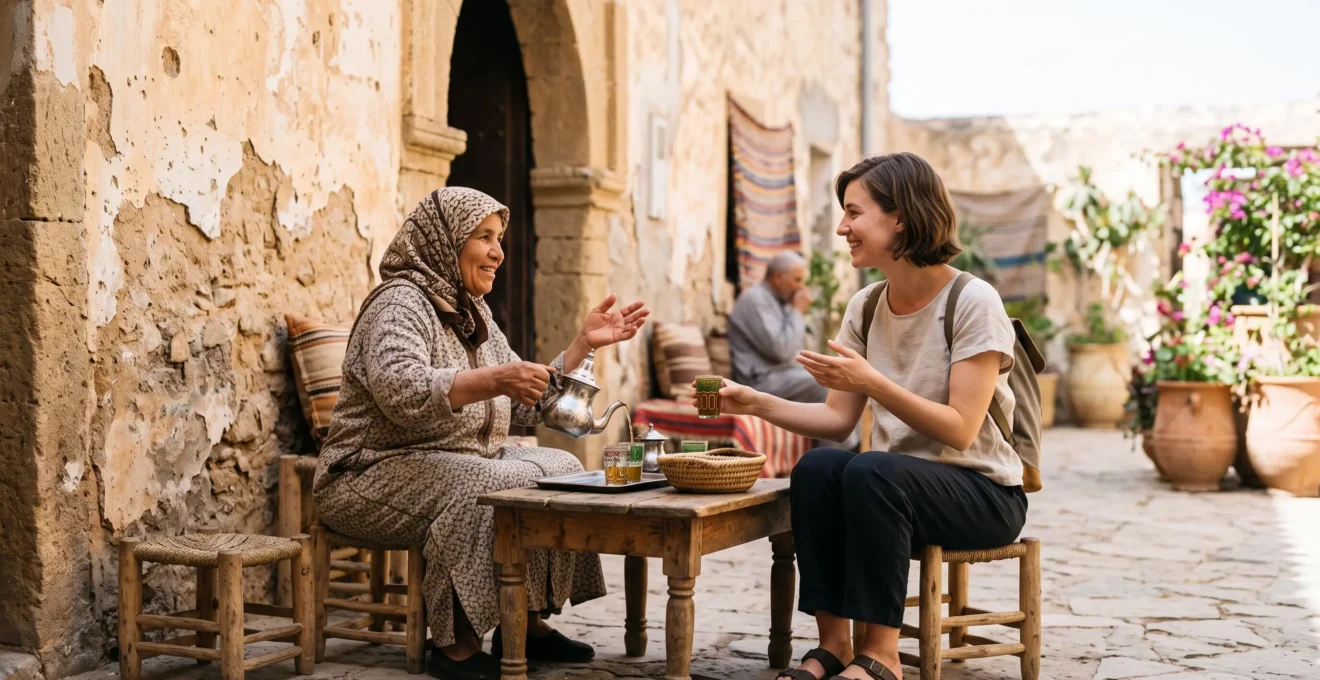
Genuine cultural immersion isn’t about avoiding « tourist traps »; it’s achieved by fundamentally re-engineering your trip’s structure to prioritise time and embeddedness over checklists.
- Standard hotel-based, short-duration travel creates a bubble that isolates you from the very cultural texture you seek to experience.
- True immersion comes from shifting from a passive observer to an active, albeit temporary, participant in a community’s daily rhythm.
Recommendation: Instead of asking « what should I see? », start by asking « how long can I stay and where can I live to become part of the local fabric? ».
There’s a pervasive discontent simmering among thoughtful travellers. It’s the feeling of returning from a trip with a camera full of photos but a distinct sense of having merely skimmed the surface. You followed the guides, ate at the recommended restaurants, and saw the famous sights, yet the authentic connection you craved remained tantalizingly out of reach. This gap between expectation and reality is vast; recent industry research reveals a striking disconnect where a huge majority of travellers want meaningful experiences, but very few feel they actually achieve them. The common advice— »eat local food, » « learn a few phrases »—is well-intentioned but insufficient. It treats cultural engagement as a series of boxes to tick.
This approach often leads to what can be described as extractive tourism: a model where the traveller takes experiences, photos, and memories without meaningful exchange or contribution, leaving the local culture as a backdrop. But what if the secret to genuine immersion isn’t in the activities you do, but in the fundamental structure of your journey? This guide proposes a paradigm shift. We will argue that the true key to unlocking deep cultural heritage is not a better checklist, but a radical rethinking of two core elements: your accommodation and your timeframe. By moving away from the insulated, transient nature of conventional tourism, you can create the conditions for authentic participation, transforming your role from a passive observer into an engaged member of a community.
This article explores the structural barriers and opportunities for deep cultural immersion. By understanding why certain travel styles fail and others succeed, you can begin to design journeys that offer genuine connection and understanding. The following sections break down this new approach.
Summary: A Guide to Genuine Cultural Heritage Immersion
- Why Do Hotel-Based Travelers Miss 90% of Local Cultural Heritage Authenticity?
- How to Participate in Cultural Ceremonies Without Causing Offense or Appearing Exploitative?
- Guided Heritage Tours vs Self-Directed Cultural Discovery: Which Offers Deeper Immersion?
- The Cultural Immersion Error That Reduces Heritage to Instagram Photo Opportunities
- When Does Not Speaking the Local Language Prevent Authentic Cultural Heritage Access?
- Why Do Small Guest Houses Offer 5x More Cultural Learning Than Standardized Hotels?
- Why Does Staying 12 Weeks Provide 10x the Cultural Depth of a 2-Week Vacation?
- How to Plan 3-Month Long Stays Abroad for Deep Cultural Integration?
Why Do Hotel-Based Travelers Miss 90% of Local Cultural Heritage Authenticity?
The modern hotel, for all its comfort and convenience, is an expertly designed bubble. Its primary function is to provide a standardized, frictionless environment that insulates guests from the unpredictability—and richness—of the outside world. From the international breakfast buffet to the English-speaking concierge, every element is designed to remove the need for genuine local interaction. This creates a paradox: the very place you stay to ‘experience’ a destination is often the biggest barrier to actually doing so. You are physically present, but culturally distant, operating in a parallel ecosystem of drivers, tour guides, and hotel staff that exists separately from the community’s daily life.
This model encourages a specific rhythm of travel: short, high-intensity bursts of sightseeing, followed by a retreat to the comfort of the bubble. There is no space for the serendipitous encounters, the slow observations, or the gradual trust-building that are the hallmarks of true immersion. The « local » experiences offered are often curated performances for a tourist audience, rather than an invitation into the authentic flow of life. You might see a traditional dance, but you won’t understand the years of practice or the role it plays in the community’s social fabric. This is the essence of extractive tourism. As Darrell Wade, co-founder of Intrepid Travel, noted in a Forbes report on travel trends, « It’s extractive–and this cannot continue for much longer. » The model is built on observation, not participation, and ultimately fails to deliver the meaningful connection travellers increasingly seek.
How to Participate in Cultural Ceremonies Without Causing Offense or Appearing Exploitative?
The invitation to witness or participate in a local ceremony, festival, or private ritual is a significant gateway to cultural understanding. It’s also a moment fraught with ethical complexity. The fear of causing offense, misinterpreting custom, or turning a sacred moment into a mere spectacle is a valid concern shared by many; market research indicates that nearly four in ten cultural travellers worry about the over-commercialization of local traditions. The key to navigating this is to shift your mindset from « spectator » to « respectful guest. » This begins with a foundation of humility, observation, and a willingness to be guided.
The first principle is to seek permission, not just for your presence, but for your actions. This is especially true for photography. The case of Ethiopia’s Omo Valley, where paying for photographs has become a major local income source, highlights the dilemma. While it provides economic benefits, it risks creating « staged » cultural performances that cater to the tourist gaze, eroding the very authenticity one hopes to witness. A better approach is to ask a guide or host about the local customs regarding photography beforehand. Often, putting the camera away is the most respectful act. The second principle is mimicry and deference. Watch what others are doing. If people are taking off their shoes, do the same. If they are sitting, don’t stand. Follow the lead of your hosts, and when in doubt, remain quiet and observant.
Ultimately, your intention is your most important guide. If your goal is to learn, connect, and show respect, it will be reflected in your body language and actions. If your primary goal is to « get the shot, » that too will be obvious. True participation is never about being the center of attention; it’s about being a quiet, humble, and appreciative presence on the periphery, grateful for the access you’ve been granted. It requires you to give up control and accept the role of a learner, which is the very essence of cultural immersion.
Guided Heritage Tours vs Self-Directed Cultural Discovery: Which Offers Deeper Immersion?
The debate between joining a guided tour and forging your own path is central to the quest for authenticity. On one hand, self-directed discovery promises serendipity and the thrill of personal discovery. On the other, a guided tour offers access and context that might be impossible to find alone. The prevailing trend is clear; in-destination experience data shows a significant rise in travellers booking guided tours. The question isn’t whether one format is inherently better, but rather how to distinguish a transformative guided experience from a superficial one.
A poor guided tour is a passive, checklist-driven experience. The guide points to a landmark, recites a script, and moves the group along. It’s an efficient way to « see » things, but it offers little in the way of deep understanding or connection. In contrast, a great guided experience is about interpretation and access. A skilled guide acts as a cultural translator, not just a narrator. They don’t just point out the « what »; they explain the « why. » They can open doors—both literal and metaphorical—that would remain closed to a solo traveller, facilitating interactions and providing a nuanced understanding of social etiquette.
Case Study: The Shift to ‘People-Positive’ Travel
Tour operator Intrepid Travel exemplifies this shift with its focus on « people-positive » experiences. This model moves beyond simply « sustainable » travel to actively create beneficial human connections. For example, instead of just visiting a fishing village, an Intrepid trip might involve diving with local fishermen in Indonesia who explain their traditional practices firsthand. The guide’s role is to facilitate this exchange, creating a scenario of participation rather than mere observation. This demonstrates that the true value of a guide lies in their ability to bridge the gap between the traveller and the community.
Therefore, the choice isn’t between « guided » and « self-directed » in the absolute. It’s about choosing the right tool for the job. For navigating complex historical sites or gaining access to specific communities, a well-chosen, small-group tour led by a local expert can provide a depth of immersion that would take a solo traveller weeks to achieve. For experiencing the daily rhythm of a city, self-directed wandering is often superior. The savvy immersive traveller uses both.
The Cultural Immersion Error That Reduces Heritage to Instagram Photo Opportunities
There is a critical moment in travel when the desire to experience is replaced by the urge to document. The camera, once a tool for memory, becomes a filter through which the world is viewed, and the smartphone, a constant tether to a digital audience. This is the great error of modern immersion: reducing vibrant, living heritage to a static backdrop for a photograph. The focus shifts from the tactile, sensory experience of being present to the visual composition of a future social media post. A 2024 travel trends survey found that 56% of US adults feel dependent on their smartphones while on holiday, a testament to the powerful pull of digital mediation.
This isn’t to say photography is inherently bad. It is a powerful art form. However, when the act of photographing supersedes the act of seeing, a problem arises. You become so focused on framing the perfect shot of the sunset that you miss the feeling of the evening air cooling on your skin. You spend your time at a bustling market looking for the most colourful composition instead of engaging with the vendors or absorbing the cacophony of sounds and smells. The experience becomes a means to an end: the acquisition of a digital trophy. As media scholar Caroline Scarles puts it, « An immanence of ethical consideration arises in the immediacy of the moment of photographing. » In that moment, we must ask: am I capturing a memory, or am I extracting an image?
Breaking this cycle requires a conscious act of will. It means intentionally putting the camera away for extended periods. It means choosing to sit and observe without the impulse to record. It means prioritizing the multi-sensory, embodied experience of a place over the purely visual. The goal is to collect moments, not just images. True cultural texture is felt, heard, and tasted; it cannot be fully contained within the four corners of a screen. The most profound travel memories are often the ones for which no photograph exists.
When Does Not Speaking the Local Language Prevent Authentic Cultural Heritage Access?
The language barrier is often perceived as the most formidable obstacle to authentic cultural immersion. Without a shared vocabulary, how can one possibly connect with local people or understand the nuances of their culture? While fluency is undeniably a powerful tool, the absolute necessity of speaking the local language is often overestimated, while the power of non-verbal communication and shared intention is underestimated. The real barrier isn’t the absence of shared words, but the absence of a genuine desire to connect in the first place.
A revealing study commissioned by GetYourGuide found a startling contradiction in travellers’ priorities. While claiming to crave authenticity, only 38% ranked « interacting with locals » as a key activity, compared to 70% for trying local food and 67% for sightseeing. This suggests that for many, « culture » is treated as a consumable product—food, views, attractions—rather than a living social fabric built on human interaction. In this context, language is irrelevant because no real conversation is being sought. The barrier is not linguistic; it’s intentional.
Conversely, when the intent to connect is present, communication finds a way. A smile, a shared laugh over a clumsy attempt to use a new utensil, the act of buying from the same baker every morning—these create a form of participatory rhythm that transcends language. Learning a few basic phrases (« hello, » « thank you, » « delicious ») is not about transactional utility; it’s a powerful signal of respect and a gesture of goodwill. It communicates, « I see you, and I am trying. » This effort, however imperfect, is often met with warmth and a reciprocal effort to communicate. Language, therefore, is not a binary switch for access. It is a spectrum, and moving even a few steps along it from zero can unlock a surprising depth of connection.
Why Do Small Guest Houses Offer 5x More Cultural Learning Than Standardized Hotels?
The choice of accommodation is perhaps the single most impactful decision in designing an immersive trip. A standardized hotel places you in an environment of other travellers, catered to by professional staff. A small, locally-owned guesthouse or homestay, however, immediately embeds you within the local social and economic fabric. The fundamental difference is one of context and relationship. In a hotel, you are a customer. In a guesthouse, you have the potential to be a guest, a neighbour, or even a temporary family member.
This difference manifests in countless small, cumulative ways that foster cultural learning. Your breakfast isn’t a buffet; it’s a meal prepared by your host, often featuring dishes they would eat themselves. You learn what people in that region actually eat to start their day. Your questions about getting around aren’t directed to a concierge with a map of tourist sites, but to a host who might tell you about their favourite neighbourhood market or the bus route they take to work. These casual, unscripted conversations are where the real learning happens. As one long-term traveller noted about their preference for such stays, « I like CouchSurfing, not because it’s free accommodation, but because I can share a lifestyle of the local people. »
Case Study: Living with a Mapuche Family in Chile
In the agricultural community of Llaguepulli, Chile, travellers have the opportunity to stay with indigenous Mapuche families in traditional wooden homes called ‘rukas’. This experience goes far beyond a simple bed for the night. Guests participate in cooking classes using local ingredients, learn about the use of medicinal herbs from the family matriarch, and are introduced to the Mapuche cosmovision and beliefs. This direct, person-to-person transmission of knowledge is an intimate and profound form of cultural exchange that is structurally impossible to replicate within the standardized environment of a hotel chain.
By choosing a guesthouse, you are not just renting a room; you are gaining access to a local perspective. You witness the daily routines, the family dynamics, and the subtle social cues that make up the « cultural texture » of a place. It’s a slower, less efficient, and sometimes less comfortable way to travel, but the return on investment in terms of cultural depth is immeasurably higher.
Key Takeaways
- True cultural immersion is determined by the structure of your trip (time and accommodation), not a checklist of activities.
- Shift your goal from passive observation (tourism) to active, respectful participation in the daily rhythm of a community.
- Extended time is the most crucial, non-negotiable ingredient for moving beyond superficial encounters to build genuine understanding and relationships.
Why Does Staying 12 Weeks Provide 10x the Cultural Depth of a 2-Week Vacation?
The most significant, and least substitutable, ingredient for deep cultural immersion is time. A two-week vacation operates on a logic of scarcity and efficiency. The goal is to maximize experiences within a compressed timeframe, leading to a « checklist » mentality. A twelve-week stay operates on a logic of abundance and rhythm. It allows you to move beyond the role of a tourist and into the realm of a temporary resident. The entire dynamic of your interaction with a place changes when you are no longer in a hurry.
With extended time, you can establish routines. You can find « your » cafe, « your » park bench, « your » stall at the local market. This repetition is transformative. You cease to be an anonymous transient and become a familiar face. The transactional interactions of a tourist (« one coffee, please ») evolve into relational ones (« the usual? »). This is the process of weaving yourself into the social fabric of a neighbourhood. You have time to get lost, make mistakes, be bored, and observe the subtle, mundane details of daily life that are invisible to the hurried visitor. This « slow travel » approach is not just a niche preference; it’s a significant and growing sector of the travel economy. Market research indicates the global slow travel sector reached USD 120.4 billion in 2024, reflecting a widespread demand for more profound travel.
This extended duration allows you to witness cycles, not just snapshots. You see how a neighbourhood changes from weekday to weekend, from the beginning of a festival to its end. You build a history with a place. As one traveller poignantly noted about a longer, slower trip they took, « I think about that trip to Cincinnati genuinely all of the time. » The memorability came not from a spectacular landmark, but from the depth of connection forged through time. A two-week trip gives you a collection of highlights; a twelve-week stay gives you a narrative.
How to Plan 3-Month Long Stays Abroad for Deep Cultural Integration?
Transitioning from the mindset of a two-week holidaymaker to a three-month temporary resident requires a shift in planning. The logistics are no longer about booking a return flight and a hotel; they’re about establishing a temporary life. Fortunately, this is more achievable than ever, thanks to a global shift in work culture and visa policies. As of early 2024, a Visa economic analysis notes that 41 countries had established digital nomad visa programs, explicitly designed to facilitate long-term stays for remote workers. This opens up unprecedented opportunities for deep immersion.
The planning process should focus on establishing a ‘home base’ and a daily rhythm, rather than a packed itinerary. Instead of planning what to *see* each day, plan how you will *live*. This means prioritising neighbourhood research over landmark lists. Look for areas with a strong sense of community, local markets, and public spaces where people gather. Your goal is to find a place where you can comfortably participate in the daily life of the city, not just observe it from a tour bus. This structural approach lays the foundation for all the authentic experiences that will follow.
Practical planning becomes paramount. This involves navigating visas, securing accommodation that isn’t a tourist hotel, and thinking about daily life logistics like groceries and laundry. While it seems daunting, breaking it down into manageable steps makes the process clear. The focus must always be on choices that foster integration rather than isolation. Every decision, from where you buy your coffee to how you spend your weekends, contributes to the depth of your immersive experience.
Action Plan: Structuring Your Long-Stay Immersion
- Accommodation Foundation: Choose accommodation that contributes directly to the local economy, such as vacation rentals in residential areas, homestays, or locally-owned guesthouses.
- Food Routine: Anchor your food habits in local markets, enrolling in a cooking class, and frequenting neighbourhood restaurants rather than international chains or tourist-centric spots.
- Language Effort: Learn foundational local language phrases (greetings, pleasantries, numbers) before departure to show respect and ease the friction of daily communication.
- Experience Seeking: Seek out recurring local experiences like weekly markets, community festivals, or artisan workshops rather than focusing solely on one-off tourist attractions.
The journey toward genuine cultural immersion begins not when you land in a new country, but when you decide to travel differently. By prioritising time, choosing embedded accommodation, and approaching new cultures with humility and a desire for participation, you can move beyond the superficial and forge the deep, memorable connections that are the true reward of travel. Start planning your next journey not as a vacation, but as a temporary life.