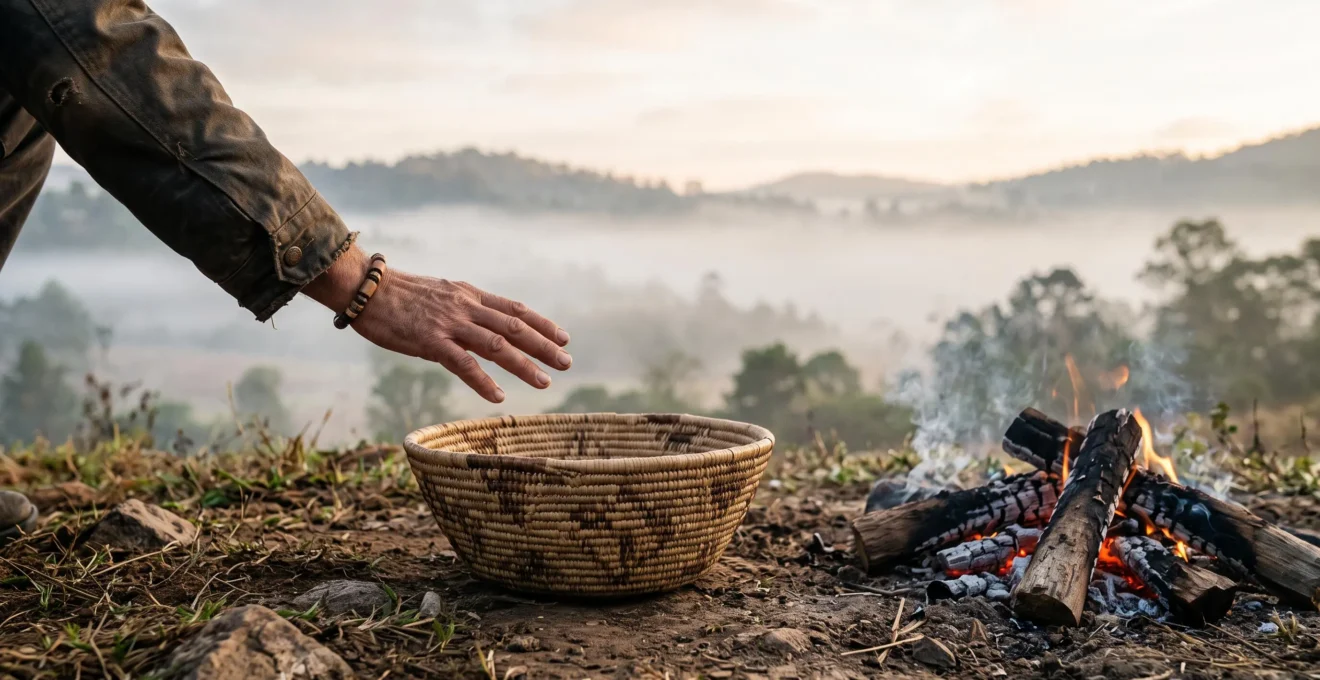
True respectful engagement with Indigenous cultures is not a checklist of behaviours, but a fundamental shift in perspective from a tourist’s right-to-access to a guest’s privilege-to-be-invited.
- Engagement must be grounded in an understanding of Indigenous sovereignty and the right to self-determination.
- Authenticity is found in community-owned enterprises where cultural sharing is on the community’s own terms, not in performances for tourists.
Recommendation: Before your trip, research the specific protocols of the nations whose lands you will visit and prioritise tour operators and cultural sites that are verifiably Indigenous-owned and managed.
For the conscious UK traveller, the desire to connect with the world on a deeper level is a powerful motivator. The prospect of learning from ancient cultures and traditional worldviews is a profound opportunity, a far cry from the superficiality of a fly-and-flop holiday. You want to ensure your presence is a positive force, a respectful exchange rather than an act of consumption. The common advice circulates readily: buy local crafts, ask before taking a photo, hire a local guide. While well-intentioned, these actions are merely the surface layer of a much deeper ethical consideration.
These behavioural tips often fail to address the root of the issue: the historical and ongoing power imbalance between visitors and Indigenous communities. They frame respect as a series of transactions rather than a continuous state of being. But what if the key to truly respectful engagement isn’t in following a list of rules, but in fundamentally reframing your role? What if the goal is not to be a perfect tourist, but to learn how to be a good guest? This guide moves beyond the checklist to explore the foundational principles of sovereignty, consent, and reciprocity that underpin genuine cultural exchange.
By adopting the mindset of a cultural anthropologist, we will unpack the ‘why’ behind the ‘what’. This is about shifting your perspective from one of entitlement—a right to see and experience—to one of privilege, recognising that you are being invited into a living culture with its own rules, protocols, and right to self-determination. It is only from this starting point that a truly meaningful and beneficial interaction can occur for both visitor and host.
This article provides a framework for that shift in perspective. We will explore the crucial concepts that separate ethical engagement from exploitation, providing you with the tools to make informed and respectful decisions throughout your journey.
Summary: A Guide to Respectful Engagement with Indigenous Heritage
- Why Do Indigenous Communities Set Stricter Boundaries for Tourist Engagement?
- How to Distinguish Authentic Indigenous-Operated Tours from Non-Indigenous Cultural Commodification?
- Indigenous Community-Run Cultural Sites vs Commercial « Native Experience » Parks: Which to Support?
- The Indigenous Heritage Error That Violates Sacred Sites Through Ignorant Tourism
- When Should You Not Photograph Indigenous People or Cultural Practices?
- Guided Heritage Tours vs Self-Directed Cultural Discovery: Which Offers Deeper Immersion?
- How to Verify That Tour Operators Actually Employ and Empower Local Residents?
- How to Practice Ethical Tourism That Benefits Local Communities Rather Than Exploiting Them?
Why Do Indigenous Communities Set Stricter Boundaries for Tourist Engagement?
The perception that some Indigenous communities have « strict » rules for visitors stems from a fundamental misunderstanding of the relationship. These boundaries are not arbitrary restrictions designed to be difficult; they are assertions of sovereignty. For centuries, Indigenous Peoples have had their lands, cultures, and stories extracted without consent or compensation. The protocols you encounter today are a direct response to this history, representing a vital act of self-preservation and self-determination.
These rules are the modern expression of an inherent right to control one’s own narrative, economy, and cultural future. When a community decides who can visit, where they can go, what they can photograph, and how they can interact, they are exercising a right that has long been denied. This isn’t about being unwelcoming; it’s about setting the terms for engagement to ensure it is not extractive. As research from a National Center for Biotechnology Information study highlights, the principle of sovereignty is the very foundation for Indigenous communities to maintain control over domains that impact their cultures. It confirms that the Indigenous Peoples’ right to sovereignty forms the foundation for advocacy and actions toward greater self-determination.
Understanding this changes your role from a consumer demanding access to a guest requesting entry. The boundaries are the terms of the invitation. They protect not only sacred sites and cultural practices but also the community’s right to exist on its own terms, free from external interference. By respecting these boundaries, you are not just following a rule; you are actively participating in an act of recognition and solidarity, acknowledging the community’s authority over its own heritage.
How to Distinguish Authentic Indigenous-Operated Tours from Non-Indigenous Cultural Commodification?
The line between genuine cultural sharing and exploitative commodification can often seem blurry, yet it represents a critical distinction for the ethical traveller. Commodification occurs when elements of a culture—ceremonies, dress, stories, art—are packaged and sold as products, stripped of their original context and meaning for the consumption of outsiders. This process is often controlled by non-Indigenous businesses, where the primary benefit flows out of the community, a phenomenon known as economic leakage.
Authentic, Indigenous-operated tourism, in contrast, is about cultural sharing on the community’s own terms. The key indicator is agency. Who is telling the story? Who is setting the agenda? Who is benefiting from the exchange? An authentic experience is led, owned, and managed by the community members themselves. It is not a performance *for* tourists, but an invitation *into* their world. This distinction is captured poignantly by Robert Hyatt of the Koorie Heritage Trust:
Cultural inclusion is not about speaking for us; it is about walking with us and hearing our voices.
– Robert Hyatt, Koorie Heritage Trust
To identify authenticity, look for tours and experiences that emphasise genuine interaction and context. Do they explain the history and significance of what you are seeing? Are the guides members of the community, sharing their own lived experiences and knowledge? Do they facilitate respectful interaction rather than a passive, show-like viewing? Be wary of experiences that feel overly polished, that present a romanticised or static version of the culture, or that rush you from one photo opportunity to the next. True cultural sharing is often slower, more nuanced, and focused on relationship-building rather than spectacle.
Indigenous Community-Run Cultural Sites vs Commercial « Native Experience » Parks: Which to Support?
The choice of where to spend your time and money has a direct impact on the empowerment or exploitation of Indigenous cultures. The distinction between a community-run cultural centre and a commercial « Native Experience » park is profound. The latter often presents a fossilised, stereotypical, or pan-Indian caricature of Indigenous life, designed for mass consumption. These parks are typically owned by outside corporations, and their primary goal is profit, not cultural preservation or authentic education. They may feature performances and exhibits that mix traditions from different nations inappropriately, perpetuating harmful myths.
In stark contrast, an Indigenous community-run cultural site or museum is a living institution. It is a space where the community tells its own story, in its own voice. These places are acts of cultural revitalization and self-determination. Here, the focus is on education, accuracy, and the celebration of a vibrant, evolving culture. As Sherry L. Rupert, CEO of the American Indian Alaska Native Tourism Association (AIANTA), notes, these are not relics of the past. One AFAR magazine article highlights her view that « Native Nations and communities are active, vibrant, rich places to visit with their own language, their own artisans, and their own songs, dance, and food. »
When you visit a community-run site, you are directly supporting the preservation of language, the passing down of traditions, and the local economy. The experience is rooted in a specific place and a specific people. It is an opportunity to learn about the complexities, triumphs, and ongoing challenges of that particular nation. Your support validates their narrative and contributes to their cultural and economic sovereignty. Always choose the place where Indigenous people are the hosts and authors of their own story, not merely the subjects of a commercial display.
The Indigenous Heritage Error That Violates Sacred Sites Through Ignorant Tourism
One of the most damaging and common errors travellers make is treating sacred sites as mere tourist attractions or backdrops for social media. This mistake is rooted in a failure to shift perspective from that of a consumer to that of a guest. A cathedral, a temple, a mountain, or an ancient ruin may be a point of interest on your itinerary, but for an Indigenous community, it can be a place of immense spiritual power, a connection to ancestors, or a site of ongoing ceremonial practice. It is not a public park; it is a church, and your entry is a privilege, not a right.
Violations occur not always through malice, but through ignorance: climbing on sacred structures, taking soil or rocks as souvenirs, being loud and disruptive in places of quiet contemplation, or ignoring posted signs and protocols. The rise of geotagging on social media has exacerbated this issue, leading hordes of visitors to previously unpublicised and sensitive locations, causing environmental degradation and cultural offense. The core principle to internalise is perfectly articulated by the Indigenous Geotags project:
Tourists aren’t owners, they are guests.
Before visiting any site with cultural significance, your responsibility is to research its meaning and the protocols for visiting. Are there areas that are off-limits? Are there restrictions on photography? Is there a required dress code? Is a local guide mandatory? If this information is not readily available, the most respectful course of action is to assume you should not go without an invitation or guidance from a community member. The absence of a « No Trespassing » sign does not imply an open invitation. Your guiding principle should be proactive respect, not reactive compliance. If you are unsure, err on the side of caution and restraint.
When Should You Not Photograph Indigenous People or Cultural Practices?
The camera is a powerful tool, but in the context of cross-cultural encounters, it can also be a problematic one. The desire to capture a memory or a beautiful image can easily override the respect and dignity of the people you are photographing. The fundamental rule is that a photograph of a person is never a right; it is a gift, requiring explicit and enthusiastic consent. This goes far beyond a quick nod or a gesture. In many cultures, a deeper spiritual belief is at play. As photographer Sofia Bergmann explains in a guide by Projects Abroad, » For many Indigenous groups, a little piece of your spirit is snatched away when you have your picture taken. » Whether you share this belief is irrelevant; respecting it is paramount.
Beyond individual portraits, there are entire situations where photography is inappropriate. Sacred ceremonies, rituals, and prayers are almost universally off-limits unless you have been explicitly invited to document them by community leaders for a specific purpose. These are not performances for an audience; they are intimate and powerful moments of cultural and spiritual practice. Inserting a camera into such a moment is a profound violation. Similarly, be mindful of moments of daily life. A person working, grieving, or simply resting is not a tourist attraction. Ask yourself: « Would I feel comfortable if a stranger photographed me in this situation back home? » This simple empathy check is often the best guide.
Ultimately, the best practice is to keep your camera down until you have built some level of rapport and understanding. Engage with people first as people. Learn their names, share a smile, buy something from their stall. Consent is a process, not a single checkbox. Even if permission is granted, be mindful of your actions. Avoid being intrusive, take only a few shots, and always offer to show them the picture. The memory of a respectful human connection will always be more valuable than a photograph taken without it.
Your Action Plan: Steps for Ethical Cultural Photography
- Research the specific customs and photography protocols of the community before you even arrive.
- Ask for permission politely, ideally facilitated by a local guide who can translate, and be prepared to accept « no » gracefully.
- Be conscious of the colonial history where cameras were used to objectify people as scientific specimens, often without consent; let this history inform your caution.
- If you sense any hesitation, discomfort, or if a person turns away, immediately lower your camera and abandon the shot without any pressure.
- With every image you consider taking, ask yourself if you are reinforcing stereotypes or telling a story that respects the people and places you are privileged to witness.
Guided Heritage Tours vs Self-Directed Cultural Discovery: Which Offers Deeper Immersion?
The romantic notion of « discovering » a culture on your own, stumbling into authentic experiences through serendipity, is a powerful travel trope. However, when it comes to engaging with Indigenous communities, this approach is often misguided and can be disrespectful. Wandering uninvited into communities or onto private lands, however well-intentioned, can be perceived as an intrusion. Without cultural context or language skills, a self-directed approach is more likely to lead to misunderstanding and surface-level observation than deep immersion.
A guided tour with a reputable, Indigenous-owned and operated company is almost always the more respectful and immersive option. A local guide is not just a navigator; they are a cultural translator. They can share the stories behind the landscapes, explain the nuances of social protocols, and facilitate meaningful interactions that would be impossible to achieve on your own. They can open doors that would otherwise be closed, providing access to experiences with the explicit consent and participation of the community. They ensure that your presence is understood and welcomed, and that your economic contribution directly benefits the right people.
This is particularly crucial when considering the sheer diversity of Indigenous nations. It is a common mistake to think of « Indigenous people » as a monolithic group. In the United States alone, as noted by Matador Network, there are 574 federally recognized tribes, each a sovereign government with its own unique history, laws, and customs. A guide from the specific nation whose land you are on is an invaluable resource for navigating this complexity respectfully. True immersion comes not from unguided wandering, but from guided understanding.
How to Verify That Tour Operators Actually Employ and Empower Local Residents?
In the growing market of Indigenous tourism, many companies use « local » or « cultural » as marketing buzzwords without genuine commitment to the communities they operate in. It’s crucial to look beyond the brochure and verify that an operator is truly empowering local residents, not just using them as window dressing. A non-Indigenous company might hire a few local guides for low-paying, frontline jobs while management positions and profits remain with outsiders. This is a form of exploitation, not empowerment.
The first and most important question is: Who owns the company? Prioritise businesses that are 100% Indigenous-owned. These are businesses where self-determination is enacted from the top down. When this isn’t possible or clear, you need to dig deeper. Look at their website’s « About Us » page. Do they feature their local team members and highlight their stories and roles within the company? Or are the owners based in a Western capital city, with no mention of local partnership? A truly committed operator will be transparent about their business structure and their relationship with the community.
To further assess an operator’s commitment, consider asking these questions directly (to them or to your travel agent):
- Beyond the guides, who holds management and ownership positions in the company?
- Does the company have a long-term relationship with the community, and can they describe how tourism revenue is directed back into local projects (e.g., schools, healthcare, infrastructure)?
- What training and career development opportunities are provided for local staff to advance within the company?
- Are other services, such as lodging, food, and transport, sourced from other locally-owned businesses within the community?
An operator dedicated to genuine empowerment will welcome these questions and have clear, proud answers. An operator who is evasive or cannot provide specifics is a red flag. Your careful vetting ensures your tourism dollars act as a tool for community development, not as a driver of economic leakage.
Key Takeaways
- Shift Your Mindset: The most crucial step is moving from the perspective of a tourist with a right to consume, to that of a guest with the privilege to be invited, always deferring to local protocols.
- Prioritise Indigenous Ownership: Your greatest power as a traveller is your wallet. Direct it exclusively towards tour operators, cultural centres, artisans, and lodges that are verifiably owned and managed by the Indigenous communities themselves.
- Consent is a Continuous Process: Consent is not a one-time transaction. It applies to taking photos, entering spaces, and participating in activities. It must be sought, given freely, and can be withdrawn at any time.
How to Practice Ethical Tourism That Benefits Local Communities Rather Than Exploiting Them?
Practicing truly ethical tourism requires moving beyond the simple transaction of paying for a service. It demands a commitment to reciprocity—the idea that the exchange should be mutually beneficial and build relationships, not just generate profit. The ultimate goal is a tourism model where communities are not just participants, but the primary authors and beneficiaries of the entire enterprise. As Anniina, the founder of Visit Natives, puts it, « Ethical Indigenous tourism should be a boon to the Indigenous people, and the most effective way to achieve this is through experiences that are thoughtfully crafted and managed by the Indigenous people themselves. »
This means seeking out models that build long-term community well-being into their very structure. It involves looking for operators who define « benefit » in the same way the community does. This might mean financial support for schools, but it could also mean funding for language revitalization programs, support for traditional agricultural practices, or the transfer of skills and technology that the community has identified as a priority. It is about listening to what is needed, not imposing what we think is helpful.
Case Study: Visit Natives’ Health Insurance Reciprocity Model
A powerful example of reciprocity in action is the model employed by the travel company Visit Natives. Their approach went beyond simple payment for services. For every trip booked with a community, the extended family of their local partners received health insurance in addition to their regular payment. This demonstrates a profound commitment to the long-term well-being of the community, addressing a critical need identified by the people themselves. It transforms the relationship from a temporary commercial transaction into a partnership invested in the holistic health and stability of the host family.
As a traveller, you participate in this by choosing such operators, but also by your own actions. Pay the requested price for crafts without haggling; the price reflects not just materials but the value of ancestral knowledge. When you return home, continue to support the community. Buy their art online (from authentic sources), promote their businesses on social media (with their consent), and educate others on what you have learned about respectful travel. The ethical journey does not end when you board the plane home; it continues in how you share the story and honour the relationship you have begun to build.
The journey towards respectful engagement is an ongoing process of learning, unlearning, and listening. It begins not when you arrive at your destination, but with the commitment you make today: to travel not as a consumer, but as a conscious, humble, and respectful guest, ready to receive the gift of an invitation into another’s world.