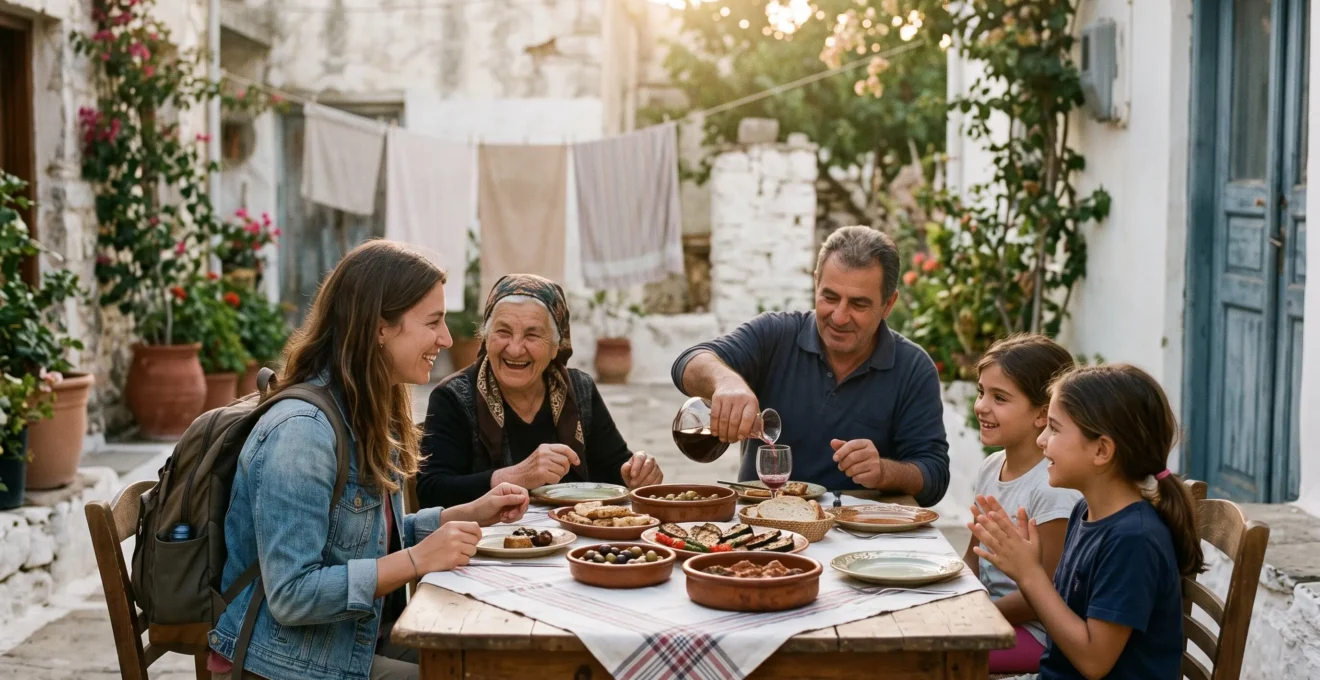
Genuine cultural immersion comes not from where you stay, but from mastering *how* you cohabit with locals.
- Living with locals exposes you to the daily routines and unspoken values that hotels and tourist zones structurally filter out.
- Success depends on « reciprocal integration »—actively participating, sharing, and contributing, not just passively observing.
Recommendation: Treat your homestay as a dynamic learning environment, not just a bed. Proactively discuss rules, share in daily life, and offer something of your own culture in return to build a genuine connection.
For the UK traveller yearning for something more than a postcard-perfect holiday, the frustration is familiar. You travel thousands of miles only to find yourself in a ‘tourist bubble’—a curated, sterile environment that feels worlds away from the authentic daily life humming just a few streets over. The standard advice is to visit local markets or take a cooking class, but these are fleeting interactions. They offer a taste, but not the full meal. The desire for deep cultural immersion is profound; in fact, recent travel trend data shows that 85% of travellers want to deeply explore local culture, yet many return feeling they’ve only scratched the surface.
But what if the key to unlocking a culture wasn’t in what you *do* during the day, but where you *live* at night? The problem isn’t a lack of authentic experiences to be found, but the framework of conventional travel that separates us from them. This guide moves beyond the generic tip of « stay with a local. » It reframes cohabitation as a learnable skill. The true secret to cultural immersion lies in mastering the art of reciprocal integration—transforming a shared living space from a mere lodging arrangement into an active, two-way cultural exchange. It’s about becoming a temporary member of a household, not just a guest in a house.
This article will provide a strategic framework for finding and thriving in such arrangements. We will explore why cohabitation is so powerful, how to navigate the social dynamics, what to look for in an arrangement, and how to avoid the common pitfalls that keep travellers in a perpetual state of being an outsider. By the end, you will have the tools to move beyond tourism and begin a journey of genuine cultural connection.
This guide offers a clear path, from understanding the core principles of immersion to navigating the practical realities of shared living. Discover how to transform your next trip into a truly life-changing experience.
Summary: How to Find Homestay or House-Sharing Arrangements That Enable Real Local Life Integration?
- Why Does Cohabiting with Locals Teach Cultural Values That Months of Tourism Miss?
- How to Respect Household Rules and Privacy When Living with Local Families Abroad?
- Commercial Homestay Programs vs Informal Local Housemate Arrangements: Which Offers Genuine Integration?
- The Cohabitation Error That Offends Local Hosts Through Unintentional Disrespect
- When Should You Leave a Homestay Due to Incompatibility Versus Persevering for Cultural Learning?
- Why Do Small Guest Houses Offer 5x More Cultural Learning Than Standardized Hotels?
- Why Do Hotel-Based Travelers Miss 90% of Local Cultural Heritage Authenticity?
- How to Move Beyond Tourist Experiences to Genuine Cultural Heritage Immersion?
Why Does Cohabiting with Locals Teach Cultural Values That Months of Tourism Miss?
Months of sightseeing can teach you about a culture’s history, but a single week of cohabitation can teach you about its heart. The reason is simple: culture isn’t just found in museums or monuments; it’s embedded in the mundane, the daily routines, and the unspoken social codes of a home. When you stay in a hotel, you are a spectator. When you live with a local family or housemates, you become a participant in the rhythm of their daily lives. You observe how meals are prepared, how elders are addressed, how time is valued, and how conflicts are resolved. These are the ‘micro-customs’ that reveal a society’s deepest values far more effectively than any guided tour.
This isn’t just an anecdotal observation; it’s a structural reality of travel. A homestay dismantles the ‘tourist bubble’ by default. You’re not just visiting a neighbourhood; you’re using its laundry service, buying milk from its corner shop, and navigating its public transport during rush hour. A study comparing homestays and hotels in Kerala confirmed this, finding that homestays provide more authentic cultural experiences because the daily, informal interactions with hosts drive a much deeper level of learning. You are no longer an outsider looking in; you are an insider, even if temporarily, learning the culture from the inside out.
The learning is also accelerated. In a tourist setting, you might learn a few polite phrases. In a homestay, you learn the practical vocabulary of daily life, the slang used over dinner, and the nuances of non-verbal communication. This constant, low-stakes practice builds not just language skills, but cultural fluency. It’s the difference between knowing what people in a country do and beginning to understand *why* they do it.
How to Respect Household Rules and Privacy When Living with Local Families Abroad?
Transitioning into a local household requires a fundamental mindset shift. The most critical error a traveller can make is to treat a homestay like a hotel with better stories. As EF Education First bluntly puts it in their guide for students living abroad:
You do not live in a hotel and your host mom is not your maid.
– EF Education First, 12 tips on how to live with a host family, EF GO Blog
This principle is the foundation of respectful cohabitation. Your hosts are sharing their private space, and your role is to integrate into their existing ecosystem, not to have them adapt to yours. The key is proactive communication and observation from the moment you arrive. Don’t wait for a problem to arise. Have an open, friendly conversation about the house rules early on. Ask about meal times, guest policies, bathroom schedules, and expectations around cleaning. This demonstrates respect for their home and prevents misunderstandings.
Beyond explicit rules, pay close attention to the unspoken customs. Observe and mimic. Do they remove their shoes at the door? Do they keep certain rooms private? Is the kitchen a social hub or a functional space? Small acts of mimicry show that you are paying attention and making a genuine effort to adapt. This extends to participating in daily life. Offering to help with chores, like setting the table or washing dishes, is not just polite; it’s a powerful way to shift the dynamic from a transactional service to a shared responsibility, which is the cornerstone of reciprocal integration. When in doubt, always ask. Clarifying questions show humility and a willingness to learn, which is far more respected than making an assumption that causes offence.
Commercial Homestay Programs vs Informal Local Housemate Arrangements: Which Offers Genuine Integration?
The path to living with locals presents a primary fork in the road: the structured, often-vetted world of commercial homestay programs versus the organic, unpredictable nature of finding an informal housemate arrangement. Neither is inherently superior for cultural immersion; the success of the experience depends less on the format and more on the relational dynamics between you and your host. Understanding the trade-offs of each is crucial to making an informed choice that aligns with your goals.
Commercial programs, offered through agencies or platforms, provide a safety net. They typically involve background checks, established payment structures, and a clear set of expectations. This predictability can be comforting, especially for a first-time homestay traveller. However, the host’s motivation can vary widely. Some are genuinely interested in cultural exchange, while others view it as a purely commercial transaction. An informal arrangement—finding a room through a friend-of-a-friend, a university notice board, or a local community group—can often lead to more spontaneous and deeply integrated experiences. You are more likely to be treated as a true housemate rather than a paying guest. The risk, of course, is higher, with no formal vetting or recourse if things go wrong. The following table breaks down the key differences:
| Criteria | Commercial Homestay Program | Informal Housemate Arrangement |
|---|---|---|
| Cost structure | Predictable, vetted pricing with included services | Highly variable, negotiated directly with the host |
| Screening & safety | Background checks and reviews typically in place | Depends entirely on personal networks and trust |
| Cultural interaction level | Ranges from transactional to deeply immersive depending on host motivation | Often more spontaneous but inconsistent |
| Flexibility of rules | Structured expectations set in advance | Rules negotiated informally, may be ambiguous |
| Access to local network | Host may introduce guests to community contacts | Access depends on housemate’s own social circle |
Ultimately, research from a study on homestay tourists in China confirms that the formality of the arrangement is secondary. The study found that relationship quality between host and guest plays a significant mediating role in satisfaction and loyalty. A warm, genuine connection in a formal homestay will always yield more cultural learning than a distant, transactional relationship with an informal housemate. The goal is to find the right people, not just the right platform.
The Cohabitation Error That Offends Local Hosts Through Unintentional Disrespect
The single greatest cohabitation error is not a grand cultural blunder, but a subtle, pervasive one: treating the host’s generosity as a service to be consumed. It’s the mindset of a passive guest rather than an active participant. This often manifests as retreating to your room after every meal, failing to contribute to the household, or expecting your host to be a 24/7 tour guide. This behaviour, while not malicious, signals a lack of interest in genuine connection and transforms the home into a cheap hotel. It undermines the very foundation of cultural exchange and can be deeply, if quietly, offensive to a host who has opened their home for more than just money.
The antidote to this passive consumption is active reciprocity. This is the core of successful integration. It’s the conscious effort to balance the exchange, ensuring you are giving something back, not just taking. This doesn’t have to be monetary. In fact, non-monetary contributions are often more meaningful. It’s about sharing your own world as they share theirs with you.
As the image of shared work suggests, reciprocity is built through small, collaborative actions. It’s a two-way street. Simple gestures can completely reframe the dynamic from guest/host to one of mutual exchange between new friends. To foster this, consider these simple but powerful acts of reciprocity:
- Bring a small, thoughtful gift from your home region, like a local craft, a tin of biscuits, or a book of photos.
- Offer to cook a meal from your own culture. This is a fantastic way to share a piece of your identity and create a memorable shared experience.
- Actively practice the local language, even if you are clumsy with it. Your effort will be seen as a profound sign of respect.
- Share your own skills or stories. If you play an instrument, offer to play. If you have a professional skill your host is curious about, share your knowledge.
These actions communicate a powerful message: « I see this as an exchange between equals. I value what you are sharing with me, and I want to share a part of myself with you. » This is the essence of moving from tourist to temporary local.
When Should You Leave a Homestay Due to Incompatibility Versus Persevering for Cultural Learning?
Not every homestay is a perfect match. Friction is a normal part of any new living arrangement, but it’s crucial to distinguish between the discomfort of cultural adjustment and a genuinely unhealthy or unsafe environment. Persevering through the former is where deep learning happens; enduring the latter is unnecessary and can ruin a travel experience. The decision to stay or leave requires careful, honest self-assessment. An initial adjustment period is almost universal. You will encounter different standards of cleanliness, different communication styles, and different social norms. This is not a sign of failure; it is the process of immersion itself.
The first step is to communicate. Many minor conflicts stem from unvoiced expectations. If you have a dietary need or feel a boundary has been crossed, address it calmly and respectfully before it escalates. However, your safety and well-being are non-negotiable. It is time to consider leaving if you encounter: any form of harassment or discrimination, consistent and significant disregard for your privacy, unsafe or unhygienic conditions that are not addressed, or a complete lack of interest from the host in any form of interaction, indicating a purely transactional setup that offers no cultural value. The key is to distinguish between ‘cultural discomfort’ (e.g., « The meal times are much later than I’m used to ») and ‘fundamental disrespect’ (e.g., « My host enters my room without knocking »).
This moment of reflection, deciding whether the challenge is a learning opportunity or a deal-breaker, is a pivotal part of the homestay journey. Before making a final decision, give the situation time. Small misunderstandings often resolve themselves as you and your host learn each other’s rhythms. But if the core issues persist after clear communication, leaving is a valid and sometimes necessary choice. Your goal is cultural immersion, not martyrdom.
Your Homestay Compatibility Audit: 5 Points to Check
- Safety & Respect: List all interactions or conditions that feel unsafe or disrespectful. Are these isolated incidents or a consistent pattern?
- Communication Efforts: Document the specific conversations you’ve had to address issues. What was the host’s response (dismissive, understanding, defensive)?
- Cultural vs. Personal: Separate your points of friction. Which are clearly due to cultural differences (e.g., directness of speech, food habits)? Which are about universal personal respect (e.g., privacy, cleanliness)?
- Learning vs. Enduring: For each point of friction, ask: « Am I learning something valuable from navigating this, or am I just enduring a negative situation? » Be honest about the emotional toll.
- Exit Plan: If you decide to leave, what are the practical steps? Review your agreement, identify alternative accommodation, and plan how to communicate your decision respectfully to your host.
Why Do Small Guest Houses Offer 5x More Cultural Learning Than Standardized Hotels?
While homestays offer the deepest immersion, there is another powerful alternative to mainstream hotels: the small, independently-owned guest house or bed & breakfast. These establishments act as a crucial bridge, offering more independence than a homestay but far more local character and connection than a corporate hotel. They are often run by a local family or entrepreneur who lives on or near the property, making them a hub of local knowledge and a direct conduit into the community’s economic and social fabric.
The primary advantage is their scale. A small guest house with a handful of rooms fosters a more intimate atmosphere. The owner is not a faceless manager but your host, your breakfast cook, and your local concierge all in one. They can give you recommendations that go far beyond the tourist map—the best bakery, the quietest park, the neighbourhood festival happening that weekend. This connection extends to the local economy. When you stay in a large chain hotel, your money is often funnelled to a distant corporate headquarters. In a small guest house, your spending directly supports a local family and, by extension, the surrounding community. Economic data reveals that in such arrangements, nearly half of guest spending occurs in the neighbourhood where they stay, creating a virtuous cycle.
This model fundamentally changes the geography of tourism. A case study on home-sharing in South Africa’s Western Cape showed that it spread tourism benefits far beyond the typical hotspots, with guest arrivals in smaller towns growing dramatically. By choosing a small guest house, you are not just a visitor; you are an active participant in a more sustainable and distributed form of tourism. You are directed to local businesses and integrated into a community network that remains entirely invisible to the guest staying in a standardized hotel downtown, effectively multiplying your opportunities for authentic cultural encounters.
Why Do Hotel-Based Travelers Miss 90% of Local Cultural Heritage Authenticity?
The modern hotel is a marvel of standardization. Whether you are in Tokyo, London, or Cairo, the room, the service, and the amenities are designed to be predictable and comfortable. This very strength, however, is its greatest weakness when it comes to cultural immersion. The hotel is the physical manifestation of the ‘tourist environmental bubble’—a carefully managed ecosystem designed to insulate the traveller from the beautiful, chaotic, and unpredictable reality of the world outside its doors. From the international breakfast buffet to the English-speaking staff, every element is curated to minimize friction and maximize comfort, inadvertently filtering out 90% of the authentic local culture.
This image perfectly captures the dilemma. From the quiet of the hotel room, life is something to be viewed through a window, like a television screen. The sounds, smells, and textures of the street are muffled. You are physically present, but culturally absent. This separation is more than just physical; it’s psychological. A study based on interviews with business travellers confirmed that while they found it rewarding to venture outside this bubble, the structure of hotel-centric travel inherently limits exposure to unfiltered local life. The hotel’s ecosystem—with its own restaurants, bars, and tour desks—is designed to be self-contained, discouraging the very exploration that leads to genuine discovery.
In this environment, ‘culture’ is often presented as a packaged commodity: a traditional dance performance in the lobby or a curated list of « top 10 sights. » You experience a manufactured version of the local heritage, not the living, breathing culture of the people themselves. You miss the serendipitous encounters, the neighbourhood gossip, the daily rituals—the very things that constitute the authentic fabric of a place. The hotel provides a comfortable vantage point, but it’s a vantage point from which it is almost impossible to truly connect. This is why a study on tourist motivations found that crossing outside the standardized tourist bubble was essential for rewarding travel, even if challenging.
Key Takeaways
- Cohabitation offers unfiltered access to the daily routines and unspoken cultural values that are systematically missed in conventional tourism.
- The quality of the host-guest relationship is more crucial for genuine integration than whether the lodging arrangement is through a commercial program or an informal network.
- True immersion is not a passive experience you receive; it is an active, reciprocal process you co-create by participating, sharing, and contributing to the household.
How to Move Beyond Tourist Experiences to Genuine Cultural Heritage Immersion?
Moving beyond the surface of tourism is not about discovering a secret location; it’s about adopting a new mindset. It requires a conscious decision to prioritize authenticity over comfort and connection over convenience. The journey from tourist to temporary local begins with the understanding that genuine cultural immersion is something you *earn* through active engagement, not something you *buy* with a booking. This shift in perspective reframes your entire approach to travel, starting with your choice of accommodation.
As research applying Maslow’s hierarchy of needs to tourism suggests, travellers are constantly balancing a high-level need for authenticity against a more basic need for comfort and safety. The study notes that local homestays provide a higher plane of authenticity for those willing to make that trade-off. Choosing a homestay or a small guest house is the single most impactful decision you can make to step outside the tourist bubble. It’s a declaration of intent: you are there to learn and connect, not just to observe.
Once there, the work of reciprocal integration begins. Engage with your hosts with curiosity and humility. Ask questions, share stories, and offer to participate in their daily lives. See every shared meal and every mundane errand as an opportunity for learning. This active participation transforms your accommodation from a simple base of operations into the very heart of your cultural experience. It’s a challenging path that requires vulnerability, adaptability, and effort, but the reward is immense: a rich, nuanced understanding of a new culture and human connections that last long after you’ve returned home.
By treating your search for accommodation as a search for connection, you fundamentally change the nature of your travels. Begin today by exploring platforms and networks that prioritize cultural exchange, and prepare to embark on your most meaningful journey yet.