In summary:
- Shift your mindset from managing logistics to designing a shared family experience for every age group.
- Transform walks into « adventure quests » with narrative framing to engage younger children and prevent meltdowns.
- Build a lasting outdoor habit through short, frequent, and consistent local walks rather than occasional, high-pressure day-long hikes.
- Focus on multi-functional gear to avoid overpacking and use established campgrounds as a « base camp » for wilder micro-adventures.
- Plan multi-day trips by empowering every family member with roles and turning essential tasks into games.
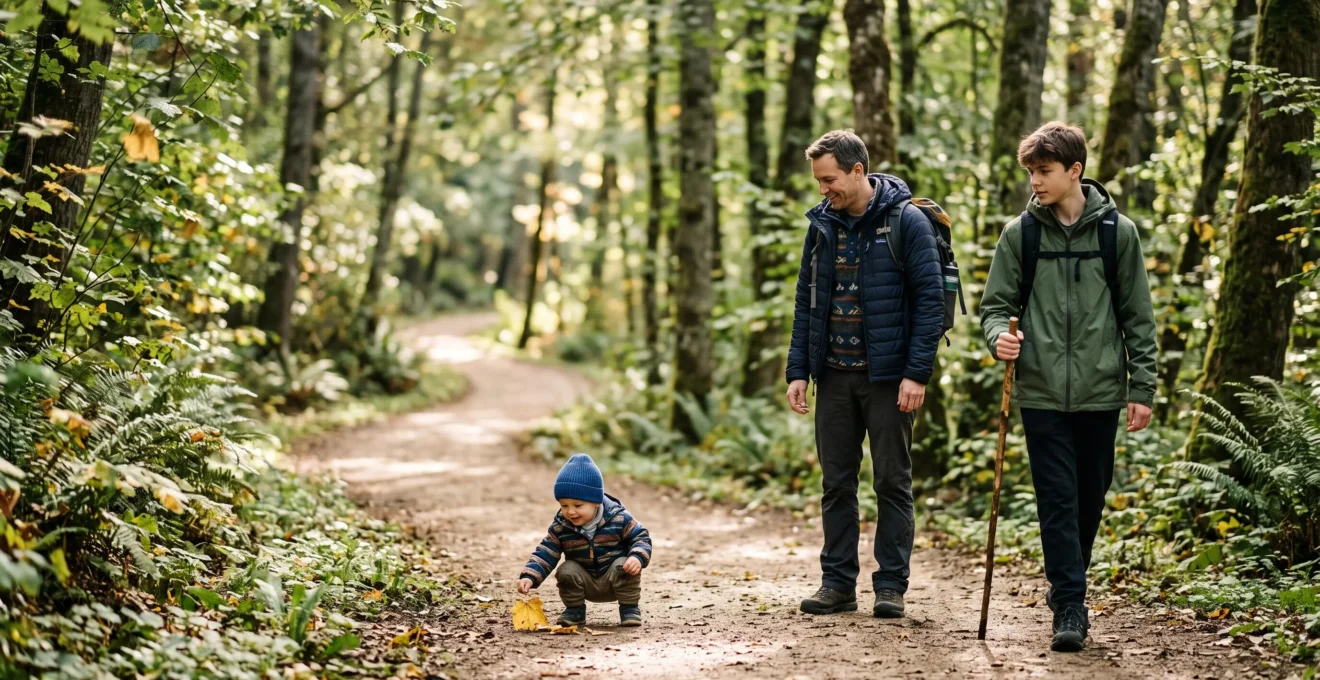
Every parent has pictured it: the perfect family hike. Sun-dappled trails, happy children exploring nature, and a shared sense of accomplishment at the summit. Yet, the reality for many UK families is often a stark contrast—a toddler refusing to walk, a teenager glued to their phone, and parents caught in a frustrating tug-of-war between their goals and their children’s morale. It’s a familiar scene that can make the whole endeavour feel more like a chore than a cherished memory.
The common advice is to pack more snacks, pick easier trails, or simply « make it fun. » While well-intentioned, these tips only scratch the surface. They treat the symptoms—boredom and fatigue—without addressing the root cause: a fundamental mismatch in expectations and experience. The secret to successful family adventures doesn’t lie in a bigger snack bag or a flatter path. It’s about a radical shift in perspective.
What if the key wasn’t just managing the hike, but mastering the art of Experience Design? This approach involves proactively shaping the narrative, roles, and rewards of the journey for each member of the family. It’s about transforming a simple walk from A to B into a collaborative story where everyone, from the three-year-old to the fifteen-year-old, has a meaningful part to play. It’s less about reaching the destination and more about crafting the adventure along the way.
This guide will walk you through the principles of this design-led approach. We will deconstruct the common points of friction, provide strategies for building engaging narratives, explore the science of habit formation, and offer practical advice on gear and planning that puts the family’s shared experience first. You’ll learn not just what to do, but why it works, empowering you to become the architect of your family’s next great outdoor adventure.
Summary: How to Plan Family Hiking Trips That Keep Both Toddlers and Teens Engaged?
- Why Do 70% of Family Hiking Attempts End in Tears and Frustration?
- How to Transform a 3-Mile Walk into an Adventure Quest for Children Under 8?
- Weekly 2-Hour Walks vs Monthly Day-Long Hikes: Which Builds Family Outdoor Habits?
- The Family Hiking Error That Adds 8 kg to Your Backpack Unnecessarily
- When Should Your Toddler Transition from Backpack Carrier to Walking Independently on Trails?
- Established Campgrounds vs Wild Camping: Which Should Beginners Attempt First?
- Why Do 80% of Campers Over 50 Prefer Serviced Pitches to Basic Sites?
- How to Plan Your First Multi-Night Camping Trip Without Gear Mistakes?
Why Do 70% of Family Hiking Attempts End in Tears and Frustration?
The primary source of on-trail misery isn’t tired legs or a lack of snacks; it’s a fundamental clash of expectations. Adults often measure a hike by distance, elevation, and scenic viewpoints. For a child, these metrics are meaningless. Their world is measured in moments of discovery, fascinating insects, and the immediate state of their own comfort. When a parent’s goal of « reaching the waterfall » conflicts with a child’s goal of « examining every single stick on this path, » you create psychological friction.
This friction is amplified by a miscalculation of time and energy. Parents, accustomed to their own pace, often forget the simple physics of little legs and wandering minds. In fact, research from experienced family hikers shows that a walk with children can take two to three times longer than it would for adults alone. Ignoring this reality sets the stage for impatience and pressure, which inevitably leads to meltdowns—from both children and adults.
The solution isn’t to force children into an adult mindset but to adopt a child-centric one. This is the first step in Experience Design: abandoning the linear, goal-oriented hike in favour of a fluid, discovery-oriented journey. The focus must shift from « how far we’ve gone » to « what we can discover right here. »
Case Study: The « Treasure Map » Method
One family documented how they significantly reduced toddler meltdowns by reframing their walks. Before each hike, they would draw a simple « treasure map » marking not a final destination, but fun milestones along the way: a « troll bridge » (a small wooden footbridge), the « whispering pines » (a small grove of trees), and a spot for a « potion-making » break (a snack stop). This simple act of narrative framing transformed the walk from a parental chore into a child-led mission, effectively eliminating the primary source of frustration.
By understanding that the core problem is a conflict of purpose, parents can begin to design experiences that align everyone’s goals. The objective is no longer to conquer the trail, but to co-create a story on it.
How to Transform a 3-Mile Walk into an Adventure Quest for Children Under 8?
Once you accept that a child’s currency is imagination, not mileage, you can turn any walk into an epic quest. This isn’t about elaborate setups; it’s about applying a layer of narrative to the natural world. Instead of a « three-mile loop, » it becomes a « mission to find the dragon’s tooth » (an interesting white rock) or a « patrol of the fairy kingdom’s borders » (the edge of a field). This technique of narrative framing is the most powerful tool in your Experience Design toolkit.
The easiest way to implement this is with a themed scavenger hunt. This provides a clear, engaging structure that gives children a sense of purpose and control. The key is to tailor the quest to their developmental stage. For a teenager, a generic « find a leaf » list is patronising. For a toddler, it’s a perfect challenge. Engaging in these hands-on activities does more than just prevent boredom; research from the Journal of Environmental Education found that such tasks can boost scientific thinking skills by up to 40%.
To make this practical, here are some ideas for turning a simple walk into an immersive adventure:
As the image suggests, a simple, hand-drawn map can be the centrepiece of your quest. It turns the child from a passive follower into an active navigator and leader. For older children and teens who might resist a « treasure hunt, » reframe the activity. Give them a camera and a list of photographic challenges (e.g., « capture five different textures, » « find a perfect spiral in nature ») or introduce them to geocaching, a real-world treasure hunt using GPS.
- For Preschoolers (Ages 3-5): Colour & Texture Hunt. Give them a set of paint colour swatches from a DIY store and ask them to find things in nature that match each colour. It’s simple, visual, and teaches observation skills.
- For Young Children (Ages 5-8): The « Story » Scavenger Hunt. Create a list of 5-7 items (a smooth stone, a forked twig, a feather, something red). The challenge isn’t just to find them, but to weave them into a story by the end of the hike. The twig becomes a wizard’s staff, the stone a dragon’s egg.
- For Older Kids (Ages 9+): The « Survival » Mission. Frame the walk as a training mission. The tasks could be to identify a good spot for a shelter, find a source of (pretend) drinkable water, or navigate a short section of trail using only a compass.
The goal is always the same: to give every child a role, a purpose, and a sense of agency within a shared story. This is how you transform a potentially tearful trudge into a treasured adventure.
Weekly 2-Hour Walks vs Monthly Day-Long Hikes: Which Builds Family Outdoor Habits?
Many parents, inspired by the idea of grand adventures, fall into the « epic day out » trap. They plan a massive, all-day hike once a month, hoping it will instil a love for the outdoors. However, this approach often backfires. These high-stakes, high-pressure events are logistically exhausting and can easily go wrong, creating negative associations rather than positive habits. From a psychological perspective, consistency trumps intensity every time when it comes to building a new behaviour.
The science of habit formation tells us that automaticity—the point where a behaviour becomes second nature—is built through frequent repetition in response to a consistent cue. For example, a « Saturday morning walk after breakfast » creates a powerful habit loop (Cue: post-breakfast > Routine: walk > Reward: fresh air and family time). Infrequent, all-day hikes lack the repetition needed to forge this neural pathway. In fact, early research on habit formation found that on average, it takes around 66 days of repetition for a new habit to feel automatic.
This suggests a hybrid strategy is far more effective for families. Prioritise a short, weekly walk of 1-2 hours in a local park or nature reserve. This is the « habit builder. » It’s low-stakes, easy to execute, and provides the consistent repetition needed to make « going for a walk » a normal and expected part of family life. These short walks are where you practice your Experience Design skills, testing out new games and narrative frames.
The longer, monthly day-hike then serves a different purpose. It’s not the habit builder; it’s the motivational reward. It becomes the exciting « special event » that the family’s regular outdoor fitness and skills have been building towards. Because the family has an established routine and a baseline of outdoor confidence, these larger adventures feel less daunting and more genuinely fun. This approach, supported by studies on cue-triggered behaviour, separates the routine-building from the memory-making, allowing both to succeed.
The Family Hiking Error That Adds 8 kg to Your Backpack Unnecessarily
The most common packing mistake isn’t forgetting an essential item; it’s packing too many « just in case » items. This mindset, born from a desire to be prepared for every conceivable eventuality, is what leads to unnecessarily heavy backpacks. That extra 8kg isn’t a single heavy object; it’s the cumulative weight of redundant, single-purpose items: a separate rain jacket and windbreaker, three different types of snacks when one will do, and a bulky first-aid kit designed for a week-long expedition, not a three-hour walk in the Peak District.
The solution is to adopt a philosophy of multi-functionality. Before packing any item, ask a simple question: « Can this do more than one job? » A classic example is the humble bandana. It can be a headband, a neck cooler when wet, a napkin, a pre-filter for water in an emergency, or even a makeshift bandage. Likewise, a smartphone (in a waterproof case with a power bank) can replace a separate camera, GPS, compass, and notebook.
This minimalist approach isn’t about being unprepared; it’s about being intelligently prepared. It requires a mental shift from packing for fear to packing for function. Instead of packing a bulky fleece *and* a rain jacket, choose a single lightweight, waterproof, and breathable shell that can be layered over a base layer you’re already wearing. Instead of packing a full cutlery set, a simple spork for each person will suffice.
Reducing weight has a direct impact on the family’s experience. A lighter pack for the parents means more energy and patience to engage with the children. It also sets a valuable example for kids as they start carrying their own small packs. Teaching them the value of a single, well-chosen item over a dozen cheap gadgets is a lesson in resourcefulness that extends far beyond the trail. The goal is to be light, agile, and free to focus on the adventure, not burdened by the weight of your worries.
When Should Your Toddler Transition from Backpack Carrier to Walking Independently on Trails?
The transition from carrying your toddler to having them walk independently is one of the most significant shifts in family hiking. It marks the move from hiking *with* a child to hiking *as a family*. There is no magic age for this, as it depends heavily on the child’s physical development, temperament, and the nature of the trails you frequent. However, a general understanding of developmental milestones can guide your decision.
Most toddlers are capable of walking short distances on flat, even ground between 18 and 24 months. By age three, many can handle short, simple trails with minimal elevation, though their endurance will be extremely limited. The key is to see the carrier not as an all-or-nothing choice, but as a flexible tool. Start with « hybrid hikes »: let your toddler walk the first 10-15 minutes of the trail when they are full of energy, then put them in the carrier as they start to tire. This gradually builds their stamina and confidence without turning the hike into a battle of wills.
Pay close attention to your child’s cues. Are they actively trying to get out of the carrier to explore? Are they confidently navigating small obstacles like roots and rocks? These are signs they are ready for more independence. Conversely, if they are frequently stumbling or asking to be carried after just a few minutes, they may need more time. The goal is a positive experience, not a forced march.
It’s important for parents to manage their expectations during this phase. Progress will be slow, and your hiking distances will shrink dramatically. But this period is a critical investment in building a future hiker. As one expert source on the topic notes, patience during these early years pays off significantly.
After the age of 4, hiking with kids gets much easier!
– Run Wild My Child, A Beginner’s Guide to Hiking with Kids
This encouragement highlights that the challenging toddler years are finite. By age four or five, most children have the physical endurance and cognitive focus to complete a 1-2 mile hike with enthusiasm, provided it’s framed as an engaging adventure.
Established Campgrounds vs Wild Camping: Which Should Beginners Attempt First?
For a family graduating from day hikes to their first overnight trip, the choice of where to sleep can feel daunting. The romantic image of « wild camping »—a secluded tent by a remote loch—is powerful, but for beginners, it presents significant challenges in terms of logistics, safety, and legality. In the UK, wild camping is largely prohibited in England and Wales without explicit landowner permission, though it is broadly tolerated in many upland areas. In Scotland, the right to wild camp is enshrined in law, but it comes with a strict code of conduct. For a first trip, this can be an intimidating amount of responsibility.
Established campgrounds, on the other hand, are the perfect « soft entry » into family camping. They provide a crucial safety net of amenities: clean water, toilets, designated fire pits, and the reassuring presence of other people. This controlled environment removes numerous variables, allowing a family to focus on the core skills: setting up the tent, cooking outdoors, and sleeping comfortably under canvas.
The most effective approach for beginners is to adopt a ‘Base Camp’ mentality. Don’t see the campground as a compromise; see it as a strategic launchpad. This is supported by the trend of « Hybrid Campers, » who seek a blend of comfort and authentic nature experiences. You can set up your tent in the security of a serviced site but spend your days exploring the wilder trails that lead away from it. This gives you the best of both worlds: the thrill of adventure during the day and the comfort of a hot shower and a level pitch at night.
This strategy allows you to tailor the experience to your family’s comfort level. You can have a campfire and roast marshmallows in a designated area, then take a short night walk with headtorches to a nearby clearing to stargaze, creating a sense of wildness without the associated risks. The campground becomes your reliable base, from which you can launch a series of manageable micro-adventures. It’s the ideal way to build confidence and skills before contemplating a true wild camping expedition.
Why Do 80% of Campers Over 50 Prefer Serviced Pitches to Basic Sites?
The preference among older campers, particularly those over 50, for serviced pitches over basic, off-grid sites is driven by a simple and logical desire for comfort, convenience, and security. As we age, the appeal of roughing it diminishes, replaced by a desire to enjoy nature without unnecessary hardship. A serviced pitch, which typically offers an electrical hook-up and easy access to water, bridges the gap between the wildness of camping and the comforts of home.
The electrical hook-up is often the single most important factor. It allows for the use of small heaters on chilly nights, lighting inside the tent, and the ability to charge devices. Crucially, it also enables the use of essential medical equipment, such as CPAP machines for sleep apnoea, which makes camping accessible to individuals who would otherwise be unable to participate. This is not about luxury; it’s about enabling continued participation in a beloved activity.
Furthermore, serviced pitches are almost always located in more accessible, well-maintained parts of a campground. They are often flatter, closer to toilet and shower blocks, and better lit at night. This reduces the risk of trips and falls and provides a greater sense of security, which is a significant consideration for many older adults. As research from camping industry leaders confirms, this demographic prioritises ease and comfort.
Boomers and Silent Generation campers often prefer the comfort and convenience of RV camping, exploring national parks and scenic routes.
– KOA Research Team, KOA: Mutual Desire to Connect with Nature Spans Generations
While this citation refers to RVs, the underlying principle is identical for tent campers. It’s about removing the physical barriers to enjoying the outdoors. For a multi-generational family trip that includes grandparents, booking a serviced pitch is a key element of good Experience Design. It ensures that everyone is comfortable, safe, and able to fully enjoy the shared family time, which is the ultimate goal of the trip.
Key Takeaways
- The root of family hiking frustration is a clash of expectations, not a lack of snacks.
- Transform any walk into an adventure by applying a layer of narrative and giving children a role in the story.
- Build a lasting outdoor habit with short, frequent, and consistent walks, using longer hikes as a motivational reward.
How to Plan Your First Multi-Night Camping Trip Without Gear Mistakes?
Planning your first multi-night camping trip can feel overwhelming, with gear choices seeming to multiply exponentially. The key is to shift your focus from accumulating « stuff » to fostering cohesion and safety. A successful trip is measured not by the sophistication of your equipment, but by the quality of your shared experience. As the latest KOA Camper Profile report found that the average trip length is now several days, learning to plan for this duration is a vital skill.
The biggest gear mistakes stem from poor planning in three areas: comfort, engagement, and nutrition. For comfort, the non-negotiables are a quality tent that is genuinely waterproof, sleeping bags with an appropriate temperature rating for the UK’s unpredictable weather, and insulated sleeping mats to protect from the cold ground. Beyond that, focus on layers of clothing rather than bulky single garments. Engagement is about ensuring everyone feels involved. This can be as simple as giving each child their own headtorch—a simple item that provides a huge sense of independence and fun after dark.
Finally, planning meals is crucial. Don’t rely on complicated recipes. For a first trip, stick to simple, one-pot meals and bring more snacks than you think you’ll need. Turning essential tasks into part of the adventure is a core principle of Experience Design. Involve the kids in washing vegetables, stirring the pot, or setting up a « hot chocolate station. » These small acts of shared responsibility build confidence and transform chores into cherished rituals.
To ensure your planning is on the right track, it’s helpful to audit your preparation against a clear set of priorities. This ensures you cover all the essential bases before you leave home.
Your Pre-Trip Gear and Safety Audit
- Shelter & Sleep System: Check your tent for leaks in the garden first. Does each person have a sleeping mat and a bag rated for the expected low temperature?
- Clothing & Layers: Inventory your layers for each person. Do you have a waterproof outer layer, an insulating mid-layer (fleece), and a moisture-wicking base layer? Pack one extra set of dry socks per person.
- Navigation & Safety: Do you have a map and compass (and know how to use them), or a fully charged phone with offline maps and a power bank? Is your first-aid kit stocked and accessible?
- Food & Hydration: Plan each meal simply. Have you packed enough high-energy snacks for the trail? Does each person have a reusable water bottle?
- Engagement & Roles: What specific task or role will each child have (e.g., Chief Firewood Collector, Head Navigator, Snack Distributor)? Have you packed one small « fun » item per person (a book, a pack of cards, a special torch)?
By shifting your focus from logistics to Experience Design, you transform family outings from a source of stress into a powerful engine for connection, resilience, and shared joy. Start small, be consistent, and remember that the best adventures are the ones you write together.