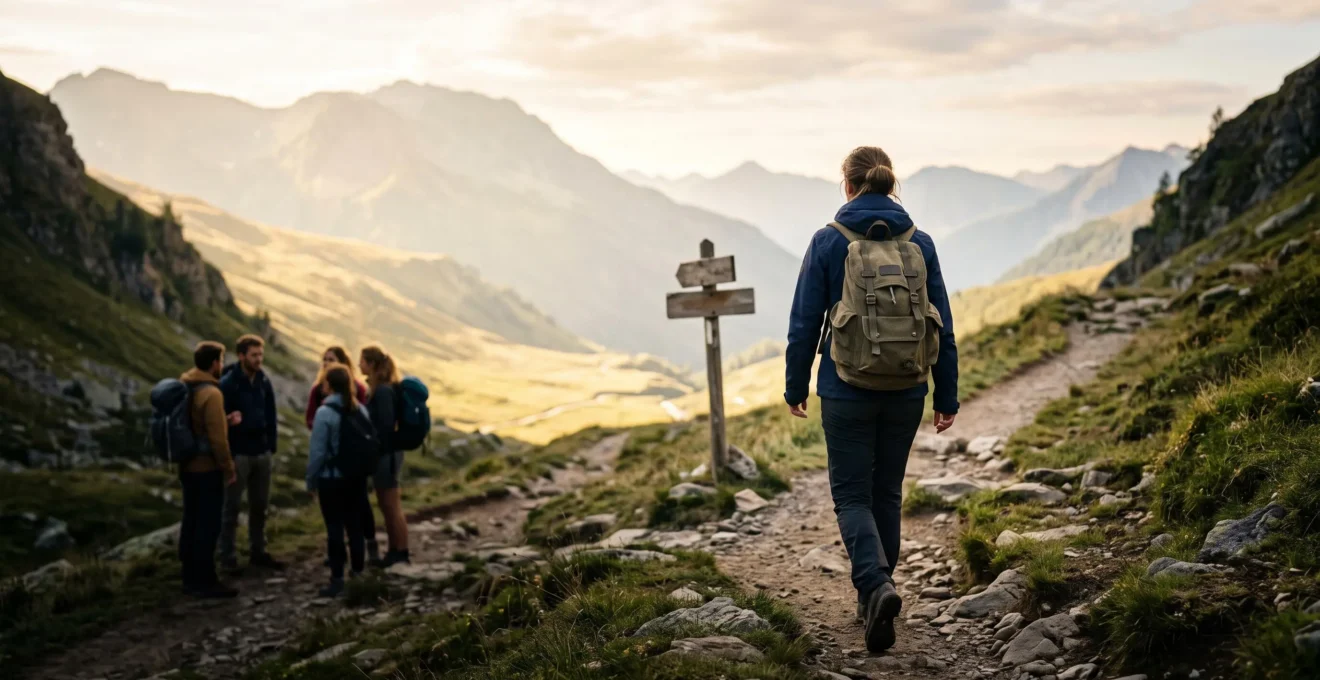
Many assume the leap to solo hiking is about physical fitness or buying more gear. The reality is that true solo confidence comes from mastering a psychological shift: transitioning from a shared group consciousness to complete self-reliance. This guide isn’t about what to pack, but how to mentally prepare for making every decision alone, managing your inner monologue, and turning fear into focused competence.
The feeling is familiar for many experienced group hikers. You’re competent, you know the gear, and you’ve logged countless miles with friends. Yet, the thought of setting out on a trail completely alone triggers a knot of anxiety. You’re not worried about the physical challenge, but about the silence—the sudden, total responsibility for navigation, safety, and morale. The usual advice is to simply « start small » or « tell someone your plan, » but this often fails to address the core issue: the profound cognitive shift required when the safety net of the group disappears.
This transition is less about trail skills and more about mental frameworks. It’s about learning to trust your own judgment when there’s no one to offer a second opinion. It involves managing the « what-if » scenarios that your brain loves to invent in the quiet moments and building a robust system of self-reliance that makes you feel prepared, not just equipped. The fear of isolation and emergencies is valid, but it can be managed and overcome with the right strategies.
This guide acts as your personal wilderness coach, focusing on the psychological barriers that hold you back. We will deconstruct the anxiety, provide concrete frameworks for handling emergencies, and lay out a clear, progressive path to building unshakeable solo confidence. By understanding the ‘why’ behind the fear, you can master the ‘how’ of solo adventuring and unlock a new level of freedom in the wild.
In this comprehensive guide, we’ll explore the mental and practical steps needed to make that transition safely. You’ll find actionable strategies to build your confidence, from managing initial anxiety to selecting the perfect UK trails for your first solo journeys.
Summary: How to Transition from Group Hiking to Confident Solo Adventures Safely?
- Why Do 60% of Experienced Group Hikers Feel Anxious on Their First Solo Day Walk?
- How to Handle Ankle Injuries or Equipment Failures When Hiking Solo in Remote Areas?
- Detailed Itinerary Sharing vs Flexible Solo Exploration: Which Solo Safety Approach?
- The Solo Adventure Error That Delays Rescue for 48 Hours When Things Go Wrong
- When Should You Progress from Day Solo Hikes to Overnight Solo Wild Camping?
- Why Do Waymarked Paths Reduce Navigation Anxiety by 85% for Solo Walkers?
- Why Does Multi-Day Trekking Require 3x the Mental Resilience of Day Hiking?
- Which UK Waymarked Paths Offer the Best Self-Guided Adventures for Solo Hikers?
Why Do 60% of Experienced Group Hikers Feel Anxious on Their First Solo Day Walk?
The anxiety experienced group hikers feel before their first solo trip has little to do with their physical ability or knowledge of the outdoors. It stems from a fundamental change in mental state known as the cognitive load shift. In a group, responsibilities are distributed subconsciously. Someone is keeping an eye on the map, another is monitoring the time, and a third is gauging the group’s energy levels. This creates a buffer, a shared consciousness that reduces the mental burden on any single individual. When you hike alone, that entire load—every decision, every observation, every risk assessment—falls squarely on your shoulders.
This sudden weight of total self-reliance is what triggers the anxiety. Your brain, accustomed to the background chatter and shared problem-solving of a group, is now hyper-aware of every sound, every potential wrong turn, and its own vulnerability. This heightened state of alert can be exhausting and is often the source of the pre-hike « what if » spiral. It’s not a sign of incompetence; it’s the natural reaction to becoming the sole decision-maker, navigator, medic, and motivator.
This experience is near-universal. As one veteran solo hiker explains, even after years of adventures, the mental spiral that can happen before you even leave the trailhead remains one of the most challenging parts of going alone. Acknowledging this isn’t a personal failing but a predictable psychological shift is the first step. The goal isn’t to eliminate the feeling but to develop strategies for managing your inner monologue and building a self-reliance framework you can trust, transforming anxiety into focused awareness.
How to Handle Ankle Injuries or Equipment Failures When Hiking Solo in Remote Areas?
The fear of an accident happening while alone is perhaps the single biggest barrier to solo hiking. Whether it’s a twisted ankle, a broken stove, or getting disoriented, the absence of a partner to help can feel terrifying. However, you can mitigate this fear by replacing it with a concrete, pre-planned emergency protocol. The key is to shift your mindset from « What if something goes wrong? » to « When something goes wrong, I know exactly what to do. » This is where a systematic approach becomes your most valuable piece of gear.
The most effective and widely taught protocol for any backcountry incident is the S.T.O.P. method. It’s a simple acronym that prevents panic and ensures you make rational decisions when under stress. The moment you realize something is wrong—you’re injured, lost, or a piece of critical gear has failed—you must immediately apply it. This mental checklist forces a pause, preventing a minor issue from escalating into a serious emergency through panicked action. Remember, most lost hikers are found very close to where they first became disoriented; staying put is often the safest choice.
Having the right gear is part of the equation, but knowing how to use it within a clear plan is what builds true confidence. Your emergency kit isn’t just a collection of items; it’s a system for self-preservation. This proactive approach to potential problems is the essence of solo self-reliance. It transforms fear of the unknown into confidence in your preparedness.
Your Emergency Response Checklist: The S.T.O.P. Method
- Stop: The very first action. Stop moving. Sit down. Take a deep breath and have a drink of water. This prevents you from moving further into a bad situation or worsening an injury.
- Think: Engage your brain. How did you get here? Retrace your steps mentally. What was the last landmark you recognized? What resources do you have in your pack?
- Observe: Look around you carefully. Are there any immediate dangers? Can you see a trail, a landmark, or a potential shelter? Check your phone for a signal or prepare your satellite messenger.
- Plan: Based on your thinking and observation, make a deliberate plan. Is it safer to stay put and signal for help (three whistle blasts are universal) or can you safely self-rescue? Do not act on impulse.
Detailed Itinerary Sharing vs Flexible Solo Exploration: Which Solo Safety Approach?
The classic safety advice to « leave a detailed itinerary » can feel restrictive to a solo hiker craving freedom and spontaneity. The desire to follow an unexpected path or change plans based on weather or mood is a core part of the appeal. This creates a conflict: how do you balance the need for a reliable safety net with the desire for flexible exploration? The answer lies in adopting a modern, two-tiered approach to trip planning that leverages technology to provide the best of both worlds.
The first tier is the « macro-plan. » This is the fixed, unchangeable information you give to your designated emergency contact. It should include your start and end points, your planned car parking location, the general area you’ll be hiking in (e.g., « the northern fells of the Lake District »), and, most importantly, a hard deadline for your return or check-in. This deadline is the trigger for your contact to initiate a search if they haven’t heard from you. This macro-plan provides the essential « where and when » for rescue services without shackling you to a specific minute-by-minute route.
The second tier is the « dynamic-update » layer, made possible by satellite messengers like a Garmin inReach or a Zoleo. These devices allow you to maintain flexibility while keeping your contact informed. You can send pre-set messages like « All OK, continuing on » or custom texts to update your progress. Some modern platforms even offer a better way to manage this. For example, as noted in a review of modern trip-planning tools, platforms with public share links let your emergency contact see your planned route and camps, which can then be updated with live tracking from your device. This hybrid approach allows for safe, spontaneous exploration within a pre-defined safety framework.
The Solo Adventure Error That Delays Rescue for 48 Hours When Things Go Wrong
Carrying a Personal Locator Beacon (PLB) or a satellite messenger with an SOS function is a critical part of a modern solo hiker’s safety system. However, owning the device is only half the battle. The most significant error a solo hiker can make—one that can delay a rescue by days—is hesitation to activate the SOS button. This delay is almost always driven by psychological factors: ego, understatement of the severity of the situation, or the fear of being a « burden » on rescue services.
In a group, someone else will often make the call to hit the button. When you are alone, that decision rests entirely with you. You might tell yourself, « I’ll just rest a bit longer, » or « Maybe I can crawl back to the trail. » This internal negotiation wastes critical time and can allow a manageable injury to become life-threatening, especially if weather conditions are deteriorating. Rescue organizations consistently advise that if you are in a situation with a clear and grave threat to life or limb, you should activate your beacon immediately. They would much rather respond to a call that turns out to be minor than a recovery mission that could have been a rescue.
The difference between a prompt activation and a delayed one can be the difference between a story with a good outcome and a tragedy. Mastering your self-reliance framework means having the confidence to make that decisive call when necessary.
Case Study: Decisive Action in the Backcountry
The stark difference in outcomes is illustrated by numerous backcountry incidents. In one account shared by a long-distance hiker, a companion on a remote trail suffered a serious injury. Thanks to the immediate activation of a PLB, the hiker’s story highlights how a PLB brought a helicopter to a remote hut in around two hours for the injured party. This contrasts sharply with incidents where hikers wait, hoping to self-rescue, resulting in multi-day searches after they are reported missing. The two-hour rescue was not a matter of luck; it was the direct result of having the right tool and, more importantly, the mental clarity to use it without hesitation.
When Should You Progress from Day Solo Hikes to Overnight Solo Wild Camping?
The transition from solo day hiking to your first overnight wild camp is a significant milestone. It introduces new challenges: the fear of the dark, the sounds of the night, and a greater reliance on your gear and skills. There is no magic number of day hikes you must complete before you’re « ready. » Instead, readiness is measured by your level of procedural confidence and your ability to manage your inner monologue, not just for a few hours, but for a full 24-hour cycle.
The progression should be gradual, built on a series of successful, confidence-building experiences. This is what can be called the Competence-Confidence Loop: each successful outing provides tangible proof of your ability, which in turn fuels your confidence for the next, slightly more challenging adventure. The goal is to slowly expand your comfort zone, not to leap out of it. Start with short, easy solo hikes on well-traveled trails. As you feel more comfortable, gradually increase the difficulty.
- Begin with short, familiar solo hikes to keep the experience well within your comfort zone.
- Choose well-marked and relatively popular trails initially, as the presence of others can be psychologically reassuring.
- Systematically increase the mileage, elevation gain, and remoteness of your day hikes with each successful trip.
- Before your first wild camp, practice setting up your tent and using your stove in your garden or a local park until the actions are second nature.
A crucial part of this readiness is mastering your check-in discipline. As one experienced solo traveler warns, spontaneously extending a day hike into an unplanned overnight is a dangerous mistake. If you miss your scheduled check-in and your contact doesn’t know your new plan, they will not know where to start the search. True readiness for an overnight trip means you have demonstrated consistent, reliable communication and planning on your day hikes. You are ready when the thought of an overnight trip feels like the next logical step, not a terrifying leap.
Why Do Waymarked Paths Reduce Navigation Anxiety by 85% for Solo Walkers?
For a new solo hiker, navigation is a major source of anxiety. Without a partner to double-check the map or confirm a bearing, the fear of getting lost can be overwhelming. This is why starting your solo journey on the UK’s well-maintained network of waymarked National Trails and long-distance paths is such a powerful strategy. These trails dramatically reduce the cognitive load of navigation, freeing up your mental energy to focus on enjoying the experience and managing other aspects of self-reliance.
Following a waymarked path with clear signposts, acorn symbols (for National Trails in England and Wales), or thistles (in Scotland) acts as a constant source of reassurance. Each marker you pass confirms you are on the right track, preventing the build-up of navigational doubt that can lead to a negative mental spiral. This doesn’t mean you should abandon your map and compass—these are still essential backup tools—but it does mean you won’t need to be constantly checking them. This frees you to be more present in your surroundings, to notice the wildlife, and to simply enjoy the act of walking.
This reduction in mental strain is the key to building foundational solo confidence. By removing one of the biggest sources of stress, you create a positive feedback loop. Your first solo hikes are more likely to be enjoyable and successful, which reinforces your desire to do more. As the editorial team at Trekology notes, succeeding on these initial, supported adventures:
builds a foundation of confidence that will stick with you long after you’ve left the trail
– Trekology Editorial Team, Trekology — ‘How to Manage Solitude Anxiety on Solo Hikes’
These early successes on waymarked paths provide the psychological scaffolding you need to eventually tackle more complex, off-trail navigation with confidence. It’s a classic example of learning to walk before you run.
Why Does Multi-Day Trekking Require 3x the Mental Resilience of Day Hiking?
Completing a multi-day solo trek requires a level of mental resilience far beyond that needed for a single day hike. The challenge is no longer just about managing your mindset for a few hours; it’s about sustaining it through cumulative fatigue, changing weather, and the psychological weight of prolonged solitude. Each consecutive day on the trail adds a new layer of physical and mental stress that can erode your resolve if you’re not prepared for it.
On a day hike, you know you’ll be returning to a warm bed and a good meal. This provides a psychological safety net. On a multi-day trek, your camp is your only refuge, and you are solely responsible for creating that comfort and security each night. A small blister on day one can become an agonizing liability by day three. A night of poor sleep can impact your decision-making the next day. This compounding effect of small discomforts is what truly tests your mental fortitude. The challenge shifts from acute problem-solving to endurance-based resilience.
This is where your inner monologue management becomes paramount. It’s easy to be positive and motivated on a sunny afternoon, but maintaining that positivity when you’re tired, soaked through, and facing another steep climb is the real test. Multi-day trekking teaches you to break the journey down into manageable chunks: just get to the next ridgeline, just make it to the planned campsite. It forces a level of mindfulness and self-awareness that day hiking only hints at. You learn to recognize the difference between genuine physical limits and the mental barriers your tired brain erects. Mastering this is the pinnacle of the solo hiker’s journey.
Key Takeaways
- Solo hiking anxiety is normal and stems from a ‘cognitive load shift’, not incompetence.
- A pre-planned emergency protocol like the S.T.O.P. method is more critical than any single piece of gear.
- Start on well-waymarked UK trails to reduce navigation stress and build a foundation of confidence.
Which UK Waymarked Paths Offer the Best Self-Guided Adventures for Solo Hikers?
The UK is blessed with an extensive network of National Trails and long-distance paths that are perfect for the aspiring solo hiker. These trails offer a brilliant combination of clear navigation, accessible services, and stunning scenery, allowing you to focus on building your confidence without unnecessary navigational stress. Choosing the right trail for your first few solo outings is a strategic decision that sets you up for success.
When selecting a path, consider three factors: clarity of waymarking, frequency of services (like villages or pubs), and logistical simplicity (transport to and from the trail). A trail that excels in these areas provides a fantastic training ground. Here are a few outstanding options in the UK that are ideal for building solo hiking competence:
- The Ridgeway (87 miles): Often called Britain’s oldest road, this National Trail runs from Wiltshire to Buckinghamshire. Its primary advantage for solo hikers is its outstandingly clear navigation, often following an obvious ancient track across open chalk downland. The terrain is generally gentle, and the trail passes through several villages, offering easy resupply and bail-out options.
- Hadrian’s Wall Path (84 miles): A UNESCO World Heritage Site, this path follows the famous Roman wall across the north of England. It is exceptionally well-waymarked and boasts a unique « bus service » (the AD122) that runs parallel to the trail, making it incredibly easy to hike sections or return to your base. The frequent historical sites and fellow walkers provide a sense of security without compromising the feeling of a grand journey.
- The West Highland Way (96 miles): Scotland’s most famous long-distance trail is an excellent choice for a more rugged but still manageable solo adventure. While the scenery is wilder, the path is extremely popular and well-defined for most of its length. A robust network of baggage transfer services, bunkhouses, and campsites along the route removes much of the logistical headache, allowing you to experience the Highlands with a solid safety net.
Starting with one of these trails allows you to practice your solo routine—packing, pacing, and managing your day—in a relatively controlled environment. Each successful day completed is another deposit in your confidence bank, preparing you for the wilder adventures that lie ahead.
Your journey into solo hiking begins not with a giant leap, but with a single, well-prepared step. Start by choosing a short, familiar route, apply these mental frameworks, and begin building the self-reliance that will unlock a lifetime of adventure.