The secret to a successful UK boat trip for a beginner isn’t choosing destinations, but mastering the sea’s natural rhythms like tides and weather.
- Opting for a skippered charter removes the need for a sailing licence and provides expert local guidance.
- Ignoring tidal flows is the single biggest mistake; they dictate your entire schedule and safety on the UK coast.
Recommendation: Start your nautical journey in sheltered waters like the Scottish sea lochs or the Solent to build confidence before tackling exposed coastlines.
The vision of dropping anchor in a secluded cove, with a rugged island all to yourself, is a powerful draw. The UK, with its thousands of miles of coastline and myriad islands, offers a lifetime of such adventures. For many, however, the dream stops there, blocked by the assumption that you need to be a seasoned sailor to even begin. The common approach is to plan a boat trip like a road trip: pick a few spots on a map and connect the dots. This is the first, and most fundamental, mistake.
While the allure of island-hopping is strong, true nautical tourism isn’t about imposing a schedule on the sea. It’s about learning to work in harmony with it. The real key to unlocking the UK’s most breathtaking and remote locations lies not in your itinerary, but in your understanding of the forces that govern the coast. This guide is built on a different perspective: planning a successful boat trip starts with respecting the sea’s natural rhythms. We will shift your focus from simply ‘where to go’ to ‘how to move with the water’.
By understanding the critical choices around your vessel, your crew, and your environment, you can transform a potentially stressful experience into one of profound freedom and discovery. This article will walk you through the essential mindset and practical steps to plan your first coastal adventure, ensuring it’s memorable for all the right reasons.
Summary: A Beginner’s Guide to Planning a UK Coastal Sailing Adventure
- Why Does Nautical Tourism Offer Access to 300+ UK Islands Unreachable Otherwise?
- How to Choose Between Crewed Yacht Charters and Self-Skippered Boat Hire for Coastal Trips?
- Sailing Yachts vs Motor Cruisers: Which Nautical Tourism Style for Non-Sailors?
- The Nautical Tourism Error That Ruins Trips for 60% of First-Time Boat Travelers
- When Should First-Time Nautical Tourists Choose Sheltered Scottish Lochs Over Exposed Coastlines?
- Single-Region Immersion vs Multi-Destination Sampling: Which Itinerary Style for Limited Time?
- 3-Month Single-Location Apartment vs Moving Between 3 Monthly Rentals: Which Long Stay Approach?
- How to Plan 3-Month Long Stays Abroad for Deep Cultural Integration?
Why Does Nautical Tourism Offer Access to 300+ UK Islands Unreachable Otherwise?
The primary allure of travelling by sea is access. While the UK mainland has an extensive road and rail network, its true wildness is often found just offshore. A boat is not merely transport; it’s a key to a hidden kingdom of coves, sea caves, and entire islands that have no ferry service, no bridges, and no other means of access. This is where the feeling of genuine exploration begins, far from the well-trodden tourist paths. It’s the ability to see your own country from a perspective that few ever experience.
Consider the sheer scale of this opportunity. While official figures vary, the UK is surrounded by over 6,000 islands, with hundreds being substantial enough to explore. In the Isles of Scilly, for instance, a single English archipelago counts more than 140 islands and islets, most of which are uninhabited and only reachable by private boat. This pattern repeats across the country, from the secluded isles of the Inner Hebrides to the wild stacks off the Pembrokeshire coast. Having your own vessel, or chartering one, allows you to create an itinerary based on discovery rather than public transport schedules.
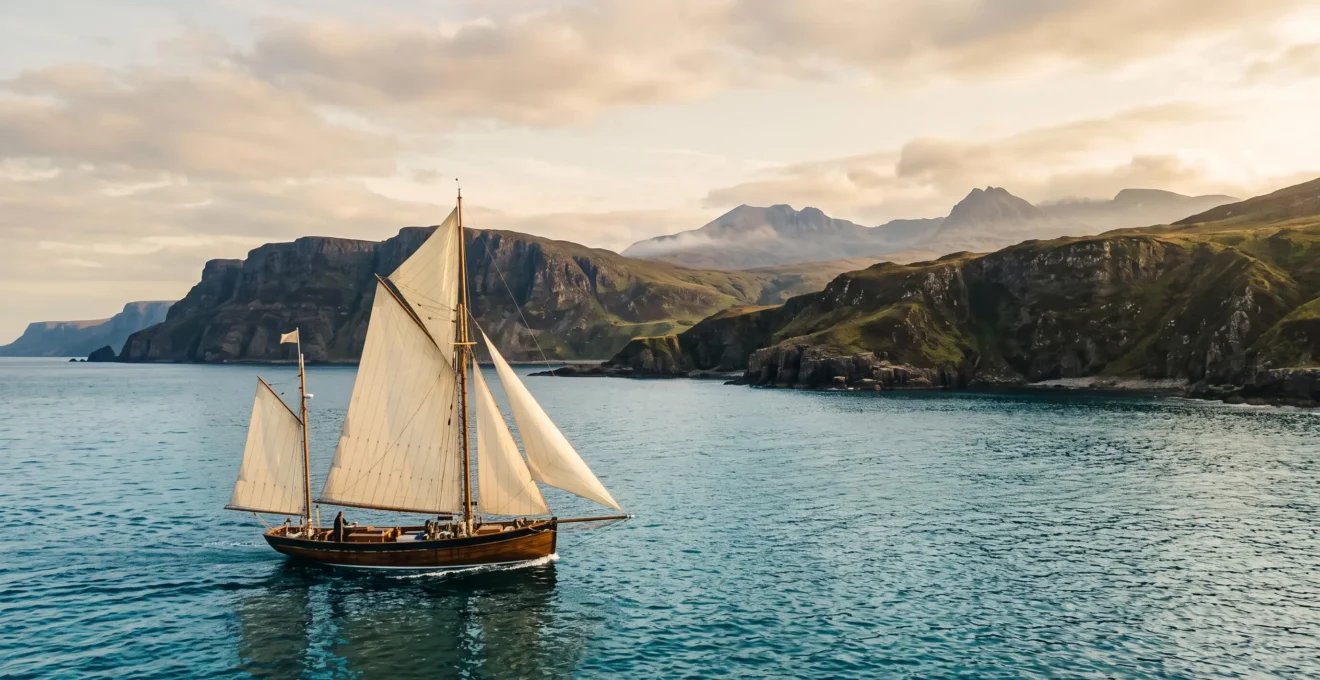
This freedom unlocks a different kind of travel. It’s the ability to wake up in a silent anchorage, watch seabirds on a deserted beach, and feel a sense of solitude that is increasingly rare. The illustration below captures this essence perfectly: the quiet satisfaction of reaching a place on your own terms, powered by wind and water.
As you can see, the reward is not just the destination itself, but the profound sense of peace and accomplishment that comes with it. This is the ultimate promise of nautical tourism: not just to see a place, but to experience a state of being that is impossible to find on land. It’s a chance to disconnect from the noise and reconnect with the natural world in its purest form.
How to Choose Between Crewed Yacht Charters and Self-Skippered Boat Hire for Coastal Trips?
For the aspiring nautical tourist, the single biggest question is often: « But I don’t know how to sail. » This is where understanding charter options becomes liberating. You don’t need years of experience to set sail on the UK coast. The crucial decision is choosing the right level of support, which directly relates to who holds the responsibility for the vessel. This choice defines your entire holiday experience, from the level of relaxation to the budget required.
The main options are a bareboat charter (where you are the skipper), a skippered charter (where you hire a professional captain along with the boat), or a fully crewed charter (an all-inclusive luxury experience with a permanent crew). For a non-sailor, the choice is realistically between a skippered or fully crewed charter. A skippered charter offers a fantastic balance: you have an expert on board to handle the boat, navigate safely, and provide invaluable local knowledge, but you can still be as involved as you wish in the sailing and itinerary planning.
The following table breaks down the key differences, helping you align your expectations, budget, and desired experience level with the right charter type. It’s the first and most important practical step in your planning process.
| Charter Type | Who Commands the Boat | Relative Cost | Best Suited For | Qualification Required |
|---|---|---|---|---|
| Bareboat (Self-Skippered) | You, the charterer | Lowest | Experienced sailors wanting full independence | Valid skipper licence (e.g. ICC/RYA) and VHF certificate |
| Bareboat + Skipper | Hired freelance skipper aboard your chartered boat | Mid-range | Confident beginners or families wanting guidance with flexibility | None for guests; skipper holds the licence |
| Fully Crewed Charter (MYBA standard) | Permanent live-aboard captain and crew | Highest | Vacationers seeking all-inclusive comfort and service | None required |
As the table shows, the « no experience necessary » options are accessible, turning the dream of a sailing holiday into a practical reality. A skipper isn’t just a driver; they are a guide and a safety net, allowing you to relax and soak in the scenery without the stress of managing the vessel, especially in unfamiliar waters with complex tides.
Sailing Yachts vs Motor Cruisers: Which Nautical Tourism Style for Non-Sailors?
Once you’ve decided on the level of crew support, the next choice is the vessel itself. This isn’t just a practical decision; it defines the very character and rhythm of your journey. The two main options for coastal cruising are sailing yachts and motor cruisers, and for a non-sailor, the difference in experience is profound. It’s a choice between embracing the journey as the destination or focusing on the destinations themselves.
A sailing yacht offers an immersive experience connected to the natural world. It’s about harnessing the power of the wind and moving in sync with the elements. The pace is generally slower, and the journey itself—the quiet glide through the water, the gentle heel of the boat, the teamwork of trimming sails—is a central part of the pleasure. This style of travel encourages a deeper appreciation for the « sea rhythms. » You learn to watch the weather, feel the shifts in the wind, and celebrate the successful passage to your next anchorage. It is, in essence, a more active and engaged form of travel.
A motor cruiser, by contrast, offers speed, power, and comfort. It’s less dependent on the wind, allowing for more direct and predictable passage times. This can be a major advantage if your goal is to cover more ground and visit more locations in a limited period. The experience is often more akin to a luxury apartment on the water, with spacious decks and a stable platform at anchor. However, it can also be a more detached experience from the sea itself, with the noise of the engines and the focus on getting from A to B. It prioritizes the destination over the journey.
For a first-timer looking to connect with the coastal environment, a skippered sailing yacht often provides the most authentic and memorable introduction. It forces a slower, more deliberate pace that is perfectly suited to the philosophy of appreciating the journey. A motor cruiser might be a better fit for those with a packed itinerary or for whom creature comforts and speed are the top priorities.
The Nautical Tourism Error That Ruins Trips for 60% of First-Time Boat Travelers
There is one force that governs all UK coastal travel more than any other: the tide. Ignoring or underestimating the power of tidal currents is the single most common and dangerous error a first-time boat traveller can make. Unlike the Mediterranean, which is virtually non-tidal, the UK coast sees massive movements of water twice a day. These currents can be faster than your boat’s top speed, turning a pleasant trip into a frightening battle or, at best, ruining your schedule completely.
This isn’t a minor inconvenience; it’s a fundamental rule of the environment. Planning to go « against the tide » is like trying to drive the wrong way up a motorway. In certain areas, known as tidal gates, this effect is magnified to an astonishing degree. The Pentland Firth in Scotland, for example, is home to some of the fastest tidal currents in the world, reaching speeds of up to 16 knots. Even in more benign areas like the Solent or the Bristol Channel, a 2-3 knot current is common. Your entire itinerary—when you leave, when you arrive, which route you take—must be planned around the tide tables.
This is precisely why hiring a local skipper is so valuable. They possess an intimate knowledge of these « sea rhythms. » They know when to transit a tidal race and when to stay put. As the experts at Yachting Monthly magazine note when discussing the UK’s challenging tide races:
The tides run up to seven knots through here and there can be strong squalls so this is definitely a place where you need the engine on for a safe passage.
– Yachting Monthly, The UK’s 11 fiercest tide races
The critical takeaway for a beginner is navigational humility. Your plan must bend to the will of the water. Fighting the tide wastes fuel, puts immense stress on the vessel and crew, and is ultimately a losing battle. A successful trip is one that works in harmony with this powerful natural cycle, using its energy to your advantage.
When Should First-Time Nautical Tourists Choose Sheltered Scottish Lochs Over Exposed Coastlines?
Embracing the principle of navigational humility leads to a crucial strategic decision: where to go on your first trip. The temptation for many is to plot an ambitious route along a dramatic, open coastline. However, for a first-time nautical tourist, the wisest choice is almost always to start in more sheltered waters. This allows you to experience all the joys of sailing—the scenery, the quiet anchorages, the rhythm of life on board—without the added stress of large waves, strong winds, and complex open-sea navigation.
The UK is blessed with world-class « nursery » sailing grounds that are perfect for beginners. The sea lochs of Scotland’s west coast are a prime example. These deep, fjord-like inlets are protected from the worst of the Atlantic swell, offering calm waters and stunning mountain scenery. You can sail for days, hopping between picturesque villages and remote anchorages, without ever being fully exposed to the open ocean. Other excellent options include the Solent on the south coast of England, with its countless harbours and creeks, or the Fal estuary in Cornwall.
The best time to plan such a trip is during the main sailing season, from May to September, when the weather is generally more settled and daylight hours are long. However, even in summer, the UK weather is notoriously unpredictable. This is another reason why sheltered waters are so advantageous. If a gale blows through, you can simply find a protected spot and wait it out in safety and comfort, turning a potential crisis into a cosy afternoon reading a book. On an exposed coastline, your options are far more limited and stressful.
Choosing a sheltered area for your first trip isn’t a compromise; it’s a smart strategy. It allows you to build your « sea legs, » gain confidence, and confirm that you enjoy the lifestyle before committing to a more challenging adventure. It’s about setting yourself up for success and ensuring your first taste of nautical tourism is overwhelmingly positive.
Single-Region Immersion vs Multi-Destination Sampling: Which Itinerary Style for Limited Time?
With a destination chosen, the next question is how to structure your time. When you have a limited window, perhaps a week or two, there are two competing philosophies: multi-destination sampling or single-region immersion. The first involves covering as much ground as possible, ticking off a list of islands and harbours. The second involves exploring one specific area, like a single archipelago or a stretch of coast, in greater depth.
The temptation of « sampling » is strong, fueled by the desire to see everything. As National Geographic Traveller suggests, the mobility of a boat lends itself to this approach:
Sailing enables you to access remote spots that are often inaccessible by land and to experience the diversity of a region, exploring islands, villages and resorts in a single trip.
– National Geographic Traveller (UK), 6 ultimate island-hopping itineraries
While this is true, for a beginner on a short timeline, this approach can be counterproductive. It creates a « road trip » mentality, where you are constantly on the move and under pressure to keep to a tight schedule. This directly conflicts with the core principle of respecting the sea’s rhythms. What happens if the weather or tides are unfavourable for your planned 40-mile passage? The pressure to push on can lead to poor decision-making.
For this reason, single-region immersion is almost always the better strategy for a first trip. By choosing a rich area like the Firth of Clyde or the Isles of Scilly and committing to exploring it thoroughly, you grant yourself the gift of flexibility. You can linger an extra day in a beautiful anchorage, make a spontaneous diversion to a newly discovered cove, or wait patiently for a weather window without your entire plan falling apart. This relaxed pace allows you to truly soak in the atmosphere of a place, meet local people, and discover the hidden gems that aren’t in the guidebooks. It’s the difference between seeing a country through a train window and actually getting out to walk its paths.
3-Month Single-Location Apartment vs Moving Between 3 Monthly Rentals: Which Long Stay Approach?
While a three-month sabbatical might be the ultimate dream, a similar strategic choice emerges even on a shorter multi-week sailing trip. The question translates from the world of apartments to marinas: is it better to establish a single « home base » and explore from there, or to adopt a nomadic approach, constantly cruising from one overnight stop to the next? Each approach offers a distinct style of long-stay coastal exploration.
Establishing a single home base marina for a week or more offers a sense of stability and simplicity. You can fully unpack, get to know the local facilities, and make day-sails to nearby points of interest without the pressure of having to find a new berth each night. This is an excellent option for families or those new to the lifestyle, as it reduces logistical stress. It allows you to explore a region in depth while having a familiar and secure place to return to. The downside is that your range is limited by how far you can comfortably sail out and back in a single day.
The alternative, moving between different « rentals » (marinas or anchorages), is the classic cruising model. This approach provides the ultimate sense of freedom and discovery, with a new view every morning. It allows you to cover a much larger area and experience a wider variety of locations. However, it requires more intensive planning. Each day involves passage planning, checking weather, and securing your next stop, whether it’s a pre-booked marina berth or a suitable anchorage. It’s a more adventurous style that fully embraces the nomadic spirit of sailing.
For a longer trip of two weeks or more, a hybrid approach often works best. You might spend the first few days at a base marina to settle in, then embark on a multi-day cruise to explore further afield, before perhaps returning to another base for the final part of your trip. This balances the comfort of stability with the thrill of exploration.
Key Takeaways
- Your first UK boat trip’s success hinges on working with tides and weather, not against them.
- Skippered charters are the ideal entry point for non-sailors, providing safety and expert local knowledge.
- For beginners, choosing sheltered « nursery » grounds like Scottish lochs over exposed coastlines is a smart, confidence-building strategy.
How to Plan 3-Month Long Stays Abroad for Deep Cultural Integration?
True cultural integration on the water isn’t about visiting a foreign country; it’s about becoming part of the centuries-old maritime community. For any long stay at sea, learning its unique language, customs, and etiquette is the key to a deeper, more rewarding experience. This « foreign culture » has its own protocols and social norms, and showing that you understand them opens doors, builds friendships, and enhances safety for everyone.
The most important tool for this is the VHF radio. It’s the primary means of communication between vessels and with harbour masters and the Coastguard. Using it correctly is a sign of a competent mariner. As the experts at Sailing Totem point out, good etiquette is more than just polite; it’s practical. In their guide to radio use, they emphasize a simple truth:
Learning and modeling good protocol pays off.
– Sailing Totem, VHF radio etiquette
Beyond the radio, integration happens dockside. It’s in the small gestures: offering to help a neighbouring boat with their lines, keeping your own boat tidy, and greeting the harbour master with a smile. This is the social fabric of the cruising world, built on mutual respect and a shared passion. A warm handshake and a friendly chat can turn a simple overnight stop into a memorable connection.
To truly integrate, you need to learn the unwritten rules. The following checklist covers the absolute basics of VHF radio etiquette, the « language » of the sea. Mastering these simple steps will immediately signal that you are a considerate and safety-conscious member of the community.
Your Action Plan: Essential VHF Radio Etiquette
- Familiarize yourself with the channels: Channel 16 is for distress, safety, and initial calling only. Never use it for routine chat.
- Switch to a working channel: Once you’ve made contact on Ch16, agree to switch to a « ship-to-ship » or working channel (e.g., 68, 69, 72) for your conversation.
- Keep it professional: Maintain a courteous tone. Remember that your conversation is public and can be heard by all nearby vessels and the coast guard.
- Keep it brief: Plan what you’re going to say before you press transmit. Short, concise messages keep the channel clear for others who may need it.
- Listen before you transmit: Always listen for a few moments to ensure the channel is clear and you are not interrupting an ongoing conversation or a safety broadcast.
Now that you understand the mindset and the key decisions, the next logical step is to start exploring your options. Begin by researching charter companies that operate in the sheltered waters we’ve discussed, such as the West Coast of Scotland or the Solent, and see what adventures await.