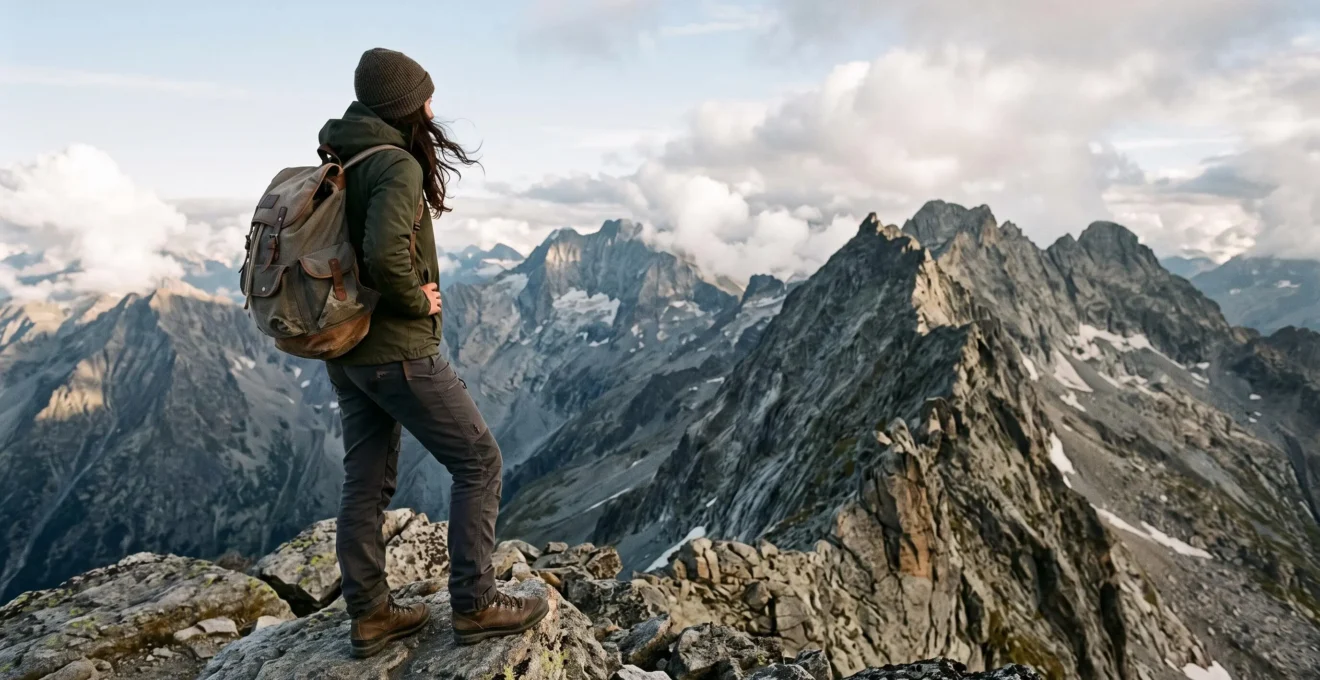
Your UK scrambling and navigation skills are the perfect foundation for the Alps, but only if you recalibrate them for altitude, scale, and objective hazards.
- Alpine routes demand a shift from endurance to strategic timing, especially regarding weather and altitude.
- Technical skills like via ferrata and scree descent require new techniques, not just more effort.
Recommendation: Prioritise a structured acclimatisation plan over a rushed ascent; it is the single most important factor for success and safety at high altitude.
There’s a moment of profound satisfaction standing atop a British peak. Whether it’s the view from Helvellyn’s summit shelter or the wind-blasted trig point on Ben Nevis, you feel competent, strong, and at home. You can read a map, handle a Grade 1 scramble, and endure a full day of « character-building » weather. This hard-won experience makes you eye the bigger prizes: the jagged skylines of Chamonix, the epic trails of the Dolomites, the 4,000-metre peaks of Switzerland. You’re ready for the Alps. But are your skills?
The common advice is predictable: you need to be fitter, buy better gear, and watch the weather. While true, this misses the crucial point. The transition from UK mountains to the Alps isn’t just an upgrade in scale; it’s a fundamental shift in mindset. Your British mountaincraft is an invaluable asset, but if misapplied, it can create « competency traps »—blind spots where your confidence outstrips your specific Alpine awareness. Thinking you can simply « go harder » or « walk for longer » is the most common mistake a seasoned UK hiker can make.
This guide acts as your translation manual. As a certified guide who has led many UK clients in the Alps, I understand the specific gaps that need bridging. This isn’t about starting from scratch; it’s about recalibrating your existing expertise. We will deconstruct the real challenges, moving beyond the platitudes to focus on the tangible differences in skill, strategy, and risk assessment. Together, we’ll explore why your skills don’t transfer 1:1, how to approach new challenges like via ferrata safely, and the critical, non-negotiable rules of altitude and weather that govern everything above the tree line. This is how you turn your UK experience into a launchpad for safe and successful Alpine adventures.
This article provides a structured path to understanding the key differences between UK hillwalking and Alpine trekking, offering practical advice to help you prepare. Below is a summary of the topics we will cover, from skill translation to critical safety procedures.
Summary: A UK Hiker’s Guide to Achievable Alpine Treks
- Why Do UK Mountain Skills Transfer Only 60% to Alpine Trekking Challenges?
- How to Safely Navigate Via Ferrata Routes on Your First Alpine Trekking Trip?
- Hut-to-Hut Trekking vs Base Camp Day Hikes: Which Alpine Style Suits First-Timers?
- The Alpine Trekking Error That Triggers Altitude Sickness in 70% of Sea-Level Residents
- When Should You Abort an Alpine Trek Due to Afternoon Thunderstorm Risk?
- Why Do Fit Athletes Sometimes Suffer Worse Altitude Sickness Than Casual Hikers?
- How to Maintain Safe Hand and Foot Placement on Grade 2 Scrambling Routes?
- How to Prevent Altitude Sickness on Your First High-Altitude Summit Attempt?
Why Do UK Mountain Skills Transfer Only 60% to Alpine Trekking Challenges?
The « 60% transfer » isn’t a scientific calculation but a concept I use with clients to manage expectations. Your proficiency in UK navigation, scrambling, and enduring a long day is the solid foundation—that’s the 60%. The 40% gap isn’t a deficit in your ability but a collection of new environmental factors unique to the Alps. The first is unrelenting scale and verticality. A big day in the UK might involve 1,000 metres of ascent; in the Alps, many classic routes start there. It’s not uncommon for long alpine routes to involve over 1,000m of ascent and take more than 8 hours, day after day. This isn’t just about endurance; it’s about managing energy, hydration, and pace over a multi-day trip where recovery is limited.
The second major difference is the nature of the terrain underfoot. UK mountain paths are often well-trodden and maintained, even on scrambles. The Alps introduce vast, unstable environments that are actively shaped by geology and ice. Mastering descents on loose scree and moraine becomes a critical, energy-saving skill that is rarely practised to the same extent in Britain.
This image captures a common Alpine reality: the descent can be more technically demanding than the ascent. Unlike a solid UK path, every step on loose scree requires balance, a low centre of gravity, and the use of trekking poles for stability, not just propulsion. It’s a completely different technique, often described as « skiing » on your heels. This is a perfect example of a skill that must be learned, as simply applying a UK « head down and march » approach leads to exhaustion and increases the risk of a fall. The final factor is objective hazard—risks like rockfall and glacial movement that are largely independent of your actions. This requires a new layer of observation and route-finding that goes beyond simply following a path on a map.
How to Safely Navigate Via Ferrata Routes on Your First Alpine Trekking Trip?
Via ferratas, or « iron ways, » are a major draw of the Alps, allowing hikers to access terrain that would otherwise require rock climbing skills. Equipped with steel cables, ladders, and rungs, they can seem like a straightforward and secure way to tackle spectacular, exposed faces. This perception is a classic competency trap. While your hiking legs feel ready for anything, the reality of a via ferrata is a different physical test. As one hiker aptly put it, « Your hiking legs feel fine. Your forearms are on fire. That’s the moment every hiker discovers that via ferrata isn’t just hiking with hardware. » This sudden forearm fatigue can lead to poor decisions.
The primary danger on a via ferrata is not the route’s difficulty but complacency. A UIAGM guide’s mantra is « you are always clipped in with at least one carabiner when moving. » Period. It’s shocking how often confident hikers, feeling secure on a wide ledge, will unclip both lanyards to move faster. This is the single most dangerous mistake you can make. Indeed, an analysis of via ferrata accidents in Austria found that falling while climbing unsecured is the leading cause of death. You must treat the system with absolute discipline: clip, unclip, move, clip, unclip, move. Never have both carabiners detached from the cable at the same time.
Beyond discipline, technique makes a huge difference to your energy levels. Don’t just haul yourself up the cable with your arms. Your strong hiking legs should do most of the work. As the experts at Via Ferrata Dolomites advise in their handbook: « This technique is not exhausting and really much more elegant! Use the natural elasticity of the iron wire to facilitate your climbing. » This means using the cable for balance and security, but using your feet to push yourself upward on the rock holds. Trust your feet, keep your arms straight whenever possible to conserve energy, and maintain a smooth, steady rhythm. This approach transforms the via ferrata from a brute-force exercise into an elegant and enjoyable mountain dance.
Hut-to-Hut Trekking vs Base Camp Day Hikes: Which Alpine Style Suits First-Timers?
Choosing your logistical style is a critical decision that shapes your entire Alpine experience. It’s not just a matter of preference; it directly impacts acclimatisation, flexibility, and the types of objectives you can achieve. For a first-timer, the two main options are establishing a « base camp » in a valley town and doing day hikes, or undertaking a multi-day hut-to-hut trek. Neither is inherently better, but they suit different goals and mindsets.
A base camp style, often based in a hub like Chamonix or Grindelwald, offers maximum flexibility. You can check the weather each morning and choose an objective accordingly. It allows you to tackle bigger day trips without the weight of a multi-day pack and, crucially, it’s the perfect setup for a « climb high, sleep low » acclimatisation strategy. This is the gold standard for preparing your body for altitude. In contrast, hut-to-hut trekking, like the famous Tour du Mont Blanc, is about the journey itself. You carry less each day but are committed to a fixed itinerary due to hut bookings. This provides a magical sense of immersion in the high mountains, but it removes your ability to wait out bad weather or easily descend if you feel unwell.
The following table breaks down the core differences to help you decide which style aligns with your goals for a first Alpine trip. Pay close attention to the ascent profile and flexibility columns, as these have the biggest impact on safety and enjoyment.
| Criteria | Hut-to-Hut Trekking | Base Camp Day Hikes |
|---|---|---|
| Ascent profile | Enforced gradual daily progression | Enables ‘climb high, sleep low’ cycles |
| Pack weight | Lighter, minimal gear carried daily | Heavier logistics, gear cached at camp |
| Schedule flexibility | Rigid, tied to hut bookings | Flexible, can wait for weather windows |
| Best suited objective | The journey / long-distance trail | A specific technical summit |
Action Plan: Maximising Hut-to-Hut Logistics
- Join an Alpine Club (e.g., the Austrian Alpine Club UK chapter) before your trip.
- Use membership to access discounted overnight rates in mountain huts.
- Check if your club participates in the International Reciprocal Rights Agreement for discounts in huts belonging to other national clubs.
- Confirm your membership includes rescue and repatriation service coverage for remote hut-to-hut terrain.
The Alpine Trekking Error That Triggers Altitude Sickness in 70% of Sea-Level Residents
The single biggest mistake a fit, eager UK hiker makes in the Alps is ascending too high, too fast on the first or second day. You arrive in the valley, feel fresh after a travel day, and look up at the pristine peaks. The temptation to take a cable car high up and « bag » a summit is immense. This is the error that triggers Acute Mountain Sickness (AMS) in a vast majority of cases. Your cardiovascular system, honed on Scafell Pike, is ready to go, but your blood chemistry is not. Acclimatisation is not about fitness; it’s a slow, physiological process of your body producing more red blood cells to cope with lower oxygen pressure.
The data is stark for those of us who live at sea level. Research has consistently shown that your starting altitude dictates your risk. For instance, a study at a Colorado ski resort showed that the risk of developing AMS was 27% for sea-level residents versus just 8.4% for those living at higher altitudes. This highlights that simply arriving in the Alps puts you in a higher risk category. Your body needs time. The « 70% » figure in the title isn’t a single statistic but represents the broad consensus in high-altitude medicine that the vast majority of AMS cases among tourists are directly linked to a rapid rate of ascent.
The Ascent Rate Case Study
Numerous studies confirm the direct link between ascent speed and AMS. A prominent case-control study analysing risk factors found that the incidence of AMS was positively correlated with the rate of ascent, particularly in the first 48 hours at altitude. It was also negatively correlated with any pre-trek acclimatisation. This effectively proves that how fast you go up on day one and two directly drives your risk of getting sick, regardless of how « fit » or « fresh » you feel upon arrival.
The key takeaway is to force yourself to be patient. Spend the first day or two on lower-level valley walks or only ascend for a few hours before returning to the valley floor to sleep. This « climb high, sleep low » principle is the cornerstone of safe acclimatisation. Resisting the urge to go hard from the start is the most important decision you will make on your entire trip. Your holiday is not a race.
When Should You Abort an Alpine Trek Due to Afternoon Thunderstorm Risk?
In the UK, a forecast of « afternoon showers » might mean you pack a waterproof jacket. In the Alps, a forecast of « afternoon thunderstorms » is a critical safety briefing that dictates your entire day’s plan. Alpine weather is driven by different forces; strong sun on the valleys in the morning creates powerful convection currents, pulling moist air upwards. This moisture rapidly condenses into towering cumulus clouds that can build into violent electrical storms with startling speed, usually in the early to mid-afternoon.
The danger is not just getting wet; it’s being on exposed terrain—a ridge, a summit, or a via ferrata—when lightning is a possibility. The statistics are a sobering reminder of when this risk peaks. For example, a study of lightning strike patients found that nearly all incidents occurred between noon and 10 p.m. This isn’t random; it’s a direct result of the daily weather cycle. This means your number one defence is timing. The Alpine start is not a cliché; it’s a survival strategy. You must plan your day to be up and over the high point, and well on your way down, before these storms typically develop.
The decision to turn back is one of the hardest for any mountaineer, but it’s the hallmark of an experienced one. The question isn’t « when should I abort? », but « what is my non-negotiable turn-around time? ». You must determine this time *before* you set off. For example: « If I am not on the summit by 11 a.m., I turn around, no matter how close I am. » This removes emotion from the decision. If you see clouds building like in the image above while you are still on an exposed ridge, you have already made a planning error. The time to abort was hours ago, in your head, when you set your turn-around time. Heed the forecast, start early, and respect your own deadline.
Why Do Fit Athletes Sometimes Suffer Worse Altitude Sickness Than Casual Hikers?
It’s one of the great paradoxes of the mountains: the super-fit marathon runner is laid low with a splitting headache and nausea, while a more moderately paced hiker feels fine. This isn’t an anomaly; it’s a well-documented phenomenon. The reason lies in a fundamental misunderstanding of what altitude sickness is. AMS is not a failure of fitness; it is a failure to acclimatise. Physical fitness, while essential for the demands of mountaineering, offers no protection against AMS. In fact, it can often be a liability.
This counter-intuitive fact has been proven time and again. For instance, a study following 332 lowland-dwelling volunteers on an identical ascent profile found 73.5% overall AMS occurrence, with no link whatsoever to fitness levels or BMI. The decisive factor was, and always is, the rate of ascent and an individual’s genetic predisposition. The danger for fit athletes is that their powerful cardiovascular « engine » allows them to ascend far quicker than their body’s « software » can adapt. They don’t feel out of breath, so they push harder, climbing rapidly into a physiological danger zone. The casual hiker, forced by their own aerobic limits to go slower, is inadvertently following the golden rule of acclimatisation.
The mindset of an athlete is often goal-oriented and competitive, even against themselves. This drive, so beneficial at sea level, can be your worst enemy at altitude. You must consciously uncouple your physical ability from your ascent schedule. As high-altitude expert Dr. Robert Shapiro states, the benefits of patience are immense. He notes that « Even a single day spent at elevation before a climb can reduce the likelihood of sudden cardiac death by six times. » This underscores the profound physiological changes that happen when you simply give your body time. The fittest person in the group is not the one who gets to the hut first, but the one who is best acclimatised.
How to Maintain Safe Hand and Foot Placement on Grade 2 Scrambling Routes?
For a UK hiker familiar with routes like Striding Edge or Crib Goch, a Grade 2 scramble in the Alps might not sound intimidating. However, the context is entirely different. While the technical difficulty might be similar, the nature of the rock and the consequences of a fall are often magnified. The key mental shift is from assuming rock is solid to assuming it is not. You must adopt a « test, don’t trust » philosophy for every single hand and foot placement.
Unlike the well-worn, rain-scrubbed rock of a popular UK scramble, Alpine rock can be « chossy » or friable, especially limestone. It can be broken apart by the constant freeze-thaw cycles. Pulling on a loose block or weighting a foothold that then breaks away is a primary cause of accidents. The scale of this risk is significant; a 13-year analysis of rock climbing emergencies in the Austrian Alps found that of 894 falls, 229 were preceded by rockfall and 143 by a hold breaking out. This isn’t just bad luck; it’s a predictable environmental hazard that you must actively manage with your technique.
This image perfectly captures the correct mindset. Before fully committing your weight, you should gently tap and pull on a handhold. Listen for a hollow sound. Watch for any movement. For footholds, apply pressure progressively rather than jumping onto them. Always maintain three points of contact with the rock—two hands and one foot, or two feet and one hand. This provides redundancy; if one hold fails, you are still connected to the mountain. Look for holds that are part of the main rock mass rather than smaller, attached blocks. And always be aware of hikers below you; a small rock you dislodge can become a deadly missile.
Key Takeaways
- Acclimatisation is a physiological process, not a measure of fitness. Ascending slowly is the most critical safety rule.
- Alpine risk is governed by timing and objective hazards. Your plan must be built around avoiding afternoon thunderstorms and managing exposure.
- Adapt your UK skills, don’t just apply them harder. Test every hold, respect the scale, and trade your summit fever for a patient, strategic mindset.
How to Prevent Altitude Sickness on Your First High-Altitude Summit Attempt?
Prevention is the only cure for altitude sickness. Once you have moderate to severe symptoms, the only effective treatment is immediate descent. Therefore, your entire strategy for a high-altitude trip must be built around a robust prevention plan. It’s not complicated, but it is non-negotiable. As the US Centers for Disease Control and Prevention (CDC) state unequivocally in their high-altitude travel guide, « Travelers can optimize acclimatization by adjusting their itineraries to avoid going ‘too high too fast’. » Every other piece of advice stems from this single principle.
A successful prevention plan is a structured itinerary, not a collection of vague hopes. Climbers who follow a methodical, staged ascent with planned rest days consistently report less discomfort and a higher success rate. A case study of climbers on major expeditions showed that those with structured acclimatisation stages had faster recovery times and a reduced risk of exhaustion, injury, and AMS compared to those who simply pushed on until they felt tired. Your plan must be your guide, overriding the temptations of a sunny day or the pressure to keep up.
So what does a good plan look like in practice? It follows a few simple, field-tested rules. Think of the following checklist not as a set of recommendations, but as the fundamental laws of high-altitude travel. Violating them significantly increases your risk of illness and failure.
Checklist: The Core Rules of Acclimatisation
- Follow the ‘climb high, sleep low’ maxim: you can ascend over 1,000 feet in a day as long as you descend to sleep at a lower altitude.
- If moderate symptoms appear (e.g., a persistent headache, nausea), do not go higher until they completely subside. ‘Don’t go up until symptoms go down’.
- Eat a high-carbohydrate diet, aiming for more than 70% of your calories from carbohydrates while at altitude to fuel your body’s adaptation.
- Avoid dehydration, over-exertion, and alcohol. All three are known to inhibit or complicate the acclimatisation process.
These rules are your safety system. They require discipline, patience, and the humility to listen to your body over your ego. By making these principles the foundation of your trip, you shift the odds dramatically in your favour, ensuring your first Alpine summit attempt is a memorable success, not a painful lesson.
Your Alpine journey begins not on the trail, but with meticulous planning. Use this guide to create a conservative, intelligent itinerary for your first trip, or consider hiring a certified guide to ensure your transition from the British fells to Alpine summits is a safe and successful one.