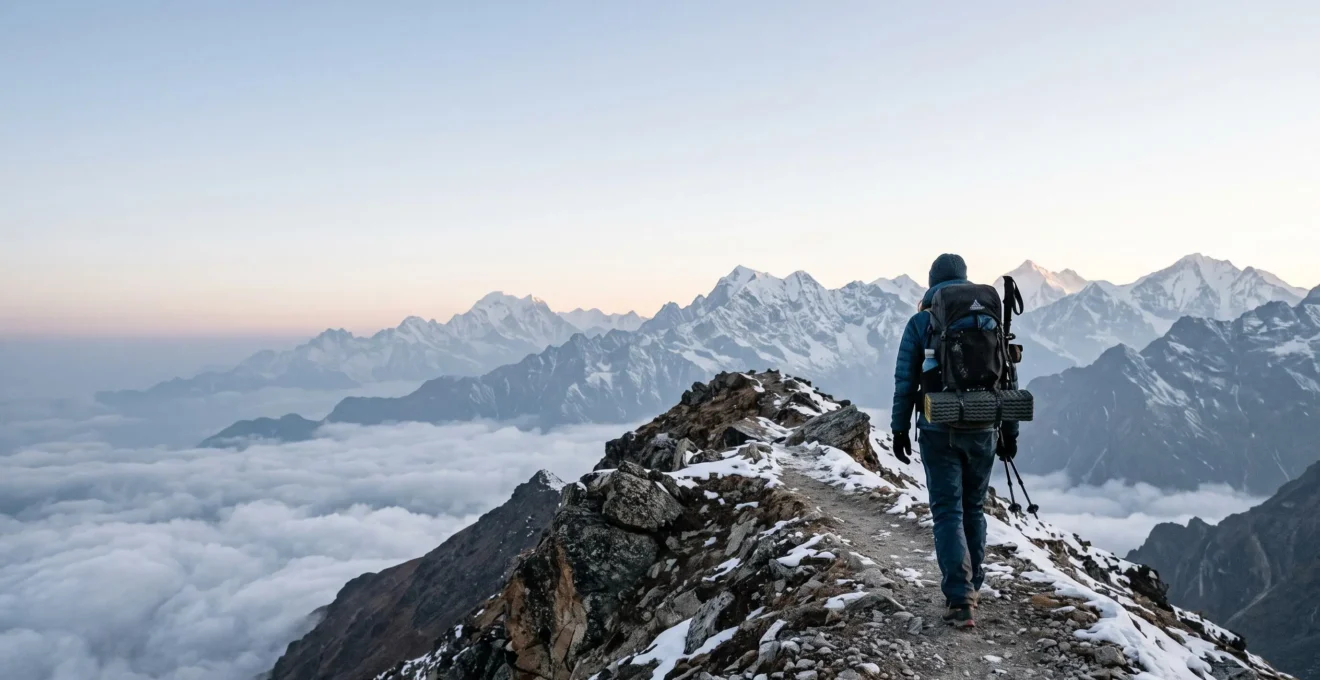
The greatest risk for altitude sickness isn’t a lack of fitness, but a misunderstanding of how the body adapts to thin air; treating acclimatization as a strategic physiological investment is the key to a safe ascent.
- Fit hikers often get sick by ascending too quickly, accumulating a « physiological debt » their body can’t repay.
- Distinguishing normal fatigue from dangerous Acute Mountain Sickness (AMS) requires monitoring a specific cluster of symptoms, not just a headache.
Recommendation: Prioritise a slower ascent rate over speed, strictly adhere to the « climb high, sleep low » principle, and be prepared to turn back based on objective signs, not summit fever.
For any hiker planning their first ascent into the great ranges—be it the Alps, the Andes, or the Himalayas—the spectre of altitude sickness looms large. You’ve trained, you’re fit, and you feel ready to conquer peaks. The common advice echoes in online forums and guidebooks: ascend slowly, drink plenty of water, and maybe consider medication. While sound, this advice often fails to address the crucial underlying mechanism, particularly for the ambitious, athletic trekker. Many believe their cardiovascular fitness from running or cycling at sea level will provide a shield against the effects of thin air. This is a dangerous misconception.
The challenge of high altitude isn’t about leg strength or lung capacity in the conventional sense. It’s about your body’s ability to perform a complex series of physiological adaptations to an environment it was not designed for. This process, known as acclimatization, is a slow, methodical biological investment. Pushing your body too fast, even if you feel strong, is like taking out a high-interest physiological loan. The symptoms of Acute Mountain Sickness (AMS) are simply the debt collectors coming to call, and in severe cases, they can lead to life-threatening conditions like High-Altitude Pulmonary Edema (HAPE) or Cerebral Edema (HACE).
This guide moves beyond the platitudes to offer a medical framework for your first high-altitude expedition. As a doctor specializing in high-altitude medicine, my goal is to help you understand the *why* behind the rules. We will deconstruct the ‘fitness paradox’, provide clear tools to distinguish benign fatigue from dangerous warning signs, and reframe acclimatization as a deliberate strategy. By understanding how to manage your body’s oxygen budget, you can turn a potentially hazardous gamble into a successful and awe-inspiring adventure.
To help you navigate this complex topic, this article is structured to answer the most critical questions a first-timer faces. From the science of why fit people can suffer more, to the practical logistics of planning a safe expedition, we will cover the essential knowledge needed for your ascent.
Summary: A Doctor’s Guide to High-Altitude Acclimatization
- Why Do Fit Athletes Sometimes Suffer Worse Altitude Sickness Than Casual Hikers?
- How to Distinguish Normal Altitude Fatigue from Dangerous AMS Symptoms?
- 2-Day Summit Push vs 5-Day Acclimatization: Which High-Altitude Strategy for First-Timers?
- The High-Altitude Mistake That Causes Pulmonary Edema in Otherwise Healthy Hikers
- When Should You Turn Back from a High-Altitude Summit Despite Feeling Fine?
- The Alpine Trekking Error That Triggers Altitude Sickness in 70% of Sea-Level Residents
- When Can You Safely Attempt Patagonia or Himalayan Expeditions After UK Mountain Experience?
- How to Organize a 4-Week Long-Distance Trekking Expedition Without Logistical Failure?
Why Do Fit Athletes Sometimes Suffer Worse Altitude Sickness Than Casual Hikers?
One of the most dangerous myths in mountaineering is that physical fitness provides immunity to altitude sickness. In reality, the opposite can be true. An athlete’s ability to push harder and move faster at sea level becomes a significant liability at high altitude, a phenomenon I call the « Fitness Paradox. » The core issue is that a fit person can easily out-climb their body’s ability to acclimatize. They feel strong, so they ascend quickly, accumulating a massive physiological debt that their body cannot pay back in the oxygen-thin environment. As internist Dr. Carolyn Mudry of Summit Health notes, this vulnerability is universal.
Anyone can get altitude sickness, despite their age and level of physical fitness.
– Carolyn Mudry, DO, Internist, Summit Health
This isn’t just anecdotal. The medical community has long studied this, and a case-control literature review found no significant association between physical training and a reduced risk of Acute Mountain Sickness (AMS). The deciding factor is not your VO2 max, but your rate of ascent. A fascinating 2023 study in the Journal of Applied Physiology confirmed this by comparing soldiers who hiked to 3,600 meters versus those driven to the same altitude. The active group developed AMS symptoms much faster. Their fitness allowed them to create a rapid oxygen deficit, triggering symptoms sooner. A slower, less fit hiker is often forced into a safer, more gradual ascent pace, giving their body the crucial time it needs to adapt.
How to Distinguish Normal Altitude Fatigue from Dangerous AMS Symptoms?
Feeling tired, a bit breathless, and having a mild headache is common upon arriving at a new, higher altitude. The critical question is: is this normal fatigue or the onset of something more sinister? The key is to look for a symptom cluster rather than isolated signs. AMS is formally diagnosed as a headache *plus* at least one other symptom, such as nausea, dizziness, fatigue, or loss of appetite. A headache alone could simply be dehydration. A headache combined with nausea is a major red flag.
While subjective feelings are the primary diagnostic tool, a pulse oximeter can provide valuable objective data. It measures your blood oxygen saturation (SpO2). A normal reading at sea level is 95-100%; this will naturally drop at altitude. It is not about hitting a specific number, but about tracking your personal trend. A stable or gradually increasing SpO2 is a good sign of acclimatization. Conversely, a continuously falling SpO2 can be a warning. Indeed, a 2024 systematic review of pulse oximetry studies found that there is a positive predictive relationship between a drop in SpO2 and the development of AMS. Monitoring your SpO2, especially overnight, can provide an early warning that your body is struggling to adapt.
The most important skill is to be honest with yourself and your team about how you feel. Use a structured checklist to assess your condition regularly.
Action Plan: Differentiating AMS from Fatigue
- Isolate the Headache: A headache alone is not AMS. First, hydrate and take a mild painkiller. If it persists and is joined by other symptoms, then you must suspect AMS.
- Check for the Symptom Cluster: Look for the classic combination: a persistent headache plus dizziness, loss of appetite, nausea, or significant fatigue beyond normal tiredness.
- Monitor the Timeline: Mild AMS symptoms typically begin 12-24 hours after reaching a new altitude and should start to ease by the third day. Symptoms that worsen or fail to improve are a serious warning.
- Assess Overnight Symptoms: Symptoms are often worse at night due to decreased respiratory drive during sleep. A rough night is common, but waking up feeling significantly worse or with a wet cough is a red flag.
- Apply the « Stop and Wait » Rule: If symptoms are mild and not worsening, it’s okay to stay at your current altitude. If symptoms intensify, you must stop ascending immediately. If they become severe, you must descend.
2-Day Summit Push vs 5-Day Acclimatization: Which High-Altitude Strategy for First-Timers?
For a first-timer, the choice between a rapid « summit push » and a longer, more methodical acclimatization schedule is not a choice at all—it’s a matter of safety and success. A rushed itinerary is the single biggest contributor to developing severe altitude sickness. You are not trying to conquer the mountain; you are asking its permission to ascend, which requires giving your body time to adapt. This is not a matter of opinion but of statistical reality. The longer you take, the better your body acclimatizes and the higher your chance of safely reaching the summit.
This path of gradual acclimatization is the « Acclimatization Investment » strategy, while the rapid push represents a « Physiological Debt » that often leads to failure. The visual contrast is stark.
The data from expeditions on mountains like Kilimanjaro provides irrefutable proof. Rushed 5-day itineraries have an abysmal success rate, while longer 8-day trips that allow for proper acclimatization have a very high rate of success. Each additional day spent on the mountain is a direct investment in your chances of reaching the top.
| Itinerary Duration | Typical Summit Success Rate |
|---|---|
| 5 days | 27% |
| 6 days | 44% |
| 7 days | 64% |
| 8 days | 85% |
These figures are backed by medical guidelines. The Wilderness Medical Society provides clear, evidence-based rules for ascent, as highlighted in the CDC’s Yellow Book on high-altitude travel. The core principles are to avoid large jumps in sleeping altitude and to build in rest days. Specifically, they recommend ascending no more than 500 meters (1,650 ft) per night in sleeping altitude once you are above 3,000 meters (9,800 ft), and incorporating a rest day with no ascent every 3-4 days. For your first high-altitude trek, choosing an itinerary that follows these rules is non-negotiable.
The High-Altitude Mistake That Causes Pulmonary Edema in Otherwise Healthy Hikers
Of all the forms of altitude sickness, High-Altitude Pulmonary Edema (HAPE) is one of the most dangerous and rapidly progressing. It is a condition where fluid leaks from blood vessels into the air sacs of the lungs, effectively causing the person to drown from the inside. The single biggest mistake that leads to HAPE in healthy hikers is ignoring the early warning signs of AMS and continuing to ascend. It is almost always preceded by symptoms of AMS, which are then compounded by further ascent.
The key warning signs for HAPE are a persistent, bubbly, or « wet » sounding cough, extreme breathlessness even at rest, and a gurgling sound in the chest. Lips or fingernails may turn blue or grey (cyanosis). The onset can be swift, and immediate descent is the only effective treatment. The mistake is dismissing a cough as a simple « cold » or breathlessness as just being « out of shape. » At altitude, these symptoms must be treated as potential HAPE until proven otherwise. This is the ultimate, and potentially fatal, consequence of accumulating too much physiological debt.
While HAPE is relatively rare, its incidence rises dramatically with the speed of ascent. For climbers ascending rapidly, research indicates that HAPE incidence can be as high as 4%. It is a terrifyingly real risk, particularly on popular high-altitude peaks where schedules can be compressed.
Case Study: HAPE as the Leading Killer on Kilimanjaro
An analysis of fatalities on Mount Kilimanjaro, which sees roughly 30,000 climbers per year, found that while the overall death rate is low (around 0.03%), HAPE was identified as the direct cause in a staggering 76% of those deaths in one study. This highlights how a seemingly minor symptom like a wet cough, if ignored in the pursuit of the summit, can escalate into a fatal medical emergency. It is the ultimate price for pushing past your body’s clear warning signals.
When Should You Turn Back from a High-Altitude Summit Despite Feeling Fine?
The decision to turn back is one of the hardest a mountaineer can make, especially when the summit feels within reach. « Summit fever » is a powerful psychological force that can cloud judgment. Therefore, the decision should be based on objective rules set before you even start, not on subjective feelings in the moment. You should turn back not just when you feel bad, but when certain pre-defined conditions are met, even if you personally feel « fine. »
The first and most important rule is to consider the group as a whole. Your pace must be set by the slowest member, and your ascent is only as safe as your most affected team member. As the editors of Backpacker Magazine wisely state, you should « only ascend once everybody in your group has acclimatized. » If a team member is showing worsening symptoms of AMS, the entire group’s plan must change. Pushing on and leaving them behind (or forcing them to keep up) is a recipe for disaster. The responsible decision is to stop, assess, and potentially descend together.
Another critical reason to be cautious is your own medical history. If you have had altitude sickness before, your risk is significantly higher. In fact, clinical data shows that individuals with a prior episode of AMS are at least twice as likely to experience it again. If you have this history, your margin for error is smaller, and you should be even more conservative with your ascent profile and more willing to turn back at the first sign of recurring trouble. Finally, external factors like a worsening weather forecast or passing a pre-determined « turn-around time » (a time of day by which you must turn back to descend safely before dark, regardless of your position) are non-negotiable reasons to abandon a summit attempt.
The Alpine Trekking Error That Triggers Altitude Sickness in 70% of Sea-Level Residents
For many UK-based hikers planning a trip to the Alps, the most common and critical error happens before they even set foot on the trail. The mistake is driving from a low-elevation airport or city (like Geneva at 375m) directly to a high-altitude trailhead or ski resort (like Chamonix at 1,035m or a higher pass) and immediately starting a strenuous hike. This rapid transition is a profound shock to the system and is a primary trigger for AMS.
Your body has no time to even begin the acclimatization process. This error essentially front-loads the physiological debt, putting you in a deficit from the very first step. While the altitudes may seem modest compared to the Himalayas, the rapid rate of ascent is what does the damage. Studies consistently show a high prevalence of AMS among travelers who ascend quickly from sea level; clinical data shows that AMS affects 25% to 43% of individuals ascending to between 2,500m and 4,300m, a typical range for many Alpine treks. The risk is not theoretical; it is a common clinical reality.
The direct link between this « drive high, hike high » behaviour and AMS was clearly demonstrated in a 2023 case-control study conducted among trekkers in Nepal. It found that rapid ascenders were significantly more likely to get sick than those who took their time. The simple solution is to build in an « acclimatization day. » Spend at least one full day (and two nights) at your entry-point town, like Chamonix or Zermatt, before starting any serious ascent. Do nothing more strenuous than a gentle walk around town. This small investment of time allows your body to begin the crucial process of adaptation and dramatically reduces your risk of getting sick on the trail.
When Can You Safely Attempt Patagonia or Himalayan Expeditions After UK Mountain Experience?
For a hiker whose experience is rooted in the UK’s mountains—like Snowdon (1,085m), Scafell Pike (978m), or even Ben Nevis (1,345m)—making the leap to the greater ranges is a significant undertaking. While the skills of navigation, hill fitness, and dealing with challenging weather are invaluable, UK mountains do not prepare your body for the primary challenge of Patagonia or the Himalayas: sustained high altitude. There is no physiological acclimatization that occurs from climbing Ben Nevis that will benefit you on a 5,000-meter pass in Nepal.
The transition should be seen as a ladder of experience, not a single leap. After gaining solid experience with multi-day trekking and wild camping in the UK, the logical next step is an intermediate-altitude environment like the European Alps. A trip involving ascents over 3,500m and sleeping consistently above 2,500m is the perfect testing ground. This allows you to experience a true acclimatization process for the first time, see how your body responds, and practice the principles of slow ascent in a less remote and logistically complex environment than the Himalayas.
Only after you have successfully completed several multi-day treks at these intermediate altitudes (e.g., the Tour du Mont Blanc, or classic routes around Zermatt or the Bernese Oberland) should you consider an expedition to places like Patagonia or the Himalayas. By that point, you will have a much better understanding of your personal response to altitude, you will have refined your gear and self-care strategies, and you will have the confidence that comes from managing yourself safely in a genuine high-altitude setting. The jump from Snowdon to Island Peak without this intermediate step is a dangerous gamble on your health.
Key Takeaways
- Acclimatization is a physiological process, not a test of fitness; a fast ascent pace is the primary risk factor for altitude sickness.
- The diagnosis of Acute Mountain Sickness (AMS) relies on identifying a cluster of symptoms (headache plus others), not just isolated fatigue.
- Gradual ascent is statistically proven to increase summit success and safety. A good rule of thumb is to not increase sleeping altitude by more than 500m per day above 3,000m.
How to Organize a 4-Week Long-Distance Trekking Expedition Without Logistical Failure?
Organizing a month-long expedition in a remote, high-altitude region is a masterclass in logistics, where failure is not an option. While gear, food, and route planning are crucial, the single most important logistical element—the one that underpins the entire success of the trip—is building a conservative and flexible acclimatization schedule. Everything else depends on it. If your schedule is too aggressive, team members will get sick, and the entire expedition will grind to a halt or end in a medical emergency.
A successful 4-week plan must therefore be built around the principles we’ve discussed. It must start with at least two full days of rest at the entry altitude. It must follow the « climb high, sleep low » mantra, incorporating day hikes to higher elevations followed by descents to sleep. Most importantly, it must have contingency days built into the itinerary. These are blank days that can be used as extra rest days if a team member is slow to acclimatize, or to wait out bad weather. A rigid schedule with no buffer is brittle and destined to break.
Beyond acclimatization, successful long-distance logistics are about redundancy and self-sufficiency. This means carrying a comprehensive medical kit with medications for AMS, HAPE, and HACE, and knowing how to use them. It means having multiple navigation tools (GPS, map and compass, satellite messenger). It means a robust communications plan for checking in and for emergencies. On a four-week trek, you cannot rely on external support for day-to-day problems. Your plan must assume that you are entirely on your own. Every decision, from the ascent profile to the number of spare batteries you carry, must be viewed through the lens of safety and self-reliance.
By approaching your high-altitude ambitions with a foundation of medical knowledge and a respect for the acclimatization process, you can ensure your expedition is memorable for its breathtaking views, not for a medical evacuation. Apply these principles diligently, plan conservatively, and you will be well-prepared to safely explore the world’s most beautiful high places.