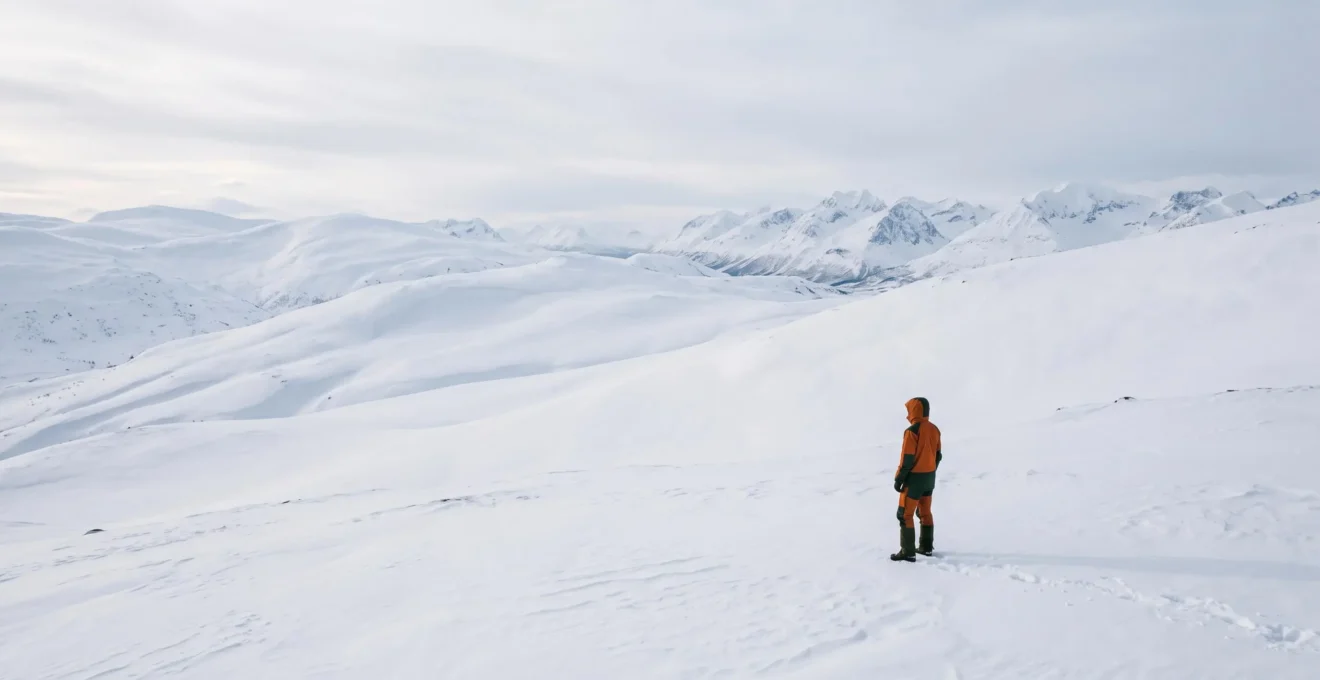
Contrary to intuition, the most alluring, seemingly gentle powder fields are often the most dangerous avalanche traps for recreational hikers and photographers.
- The visual appeal of a landscape has no correlation with its safety; many fatal avalanches occur on slopes that appear benign.
- True safety comes from a systematic process of terrain evaluation that actively distrusts what your eyes see.
Recommendation: Before your next winter outing, learn to identify the invisible connections between a « safe » meadow and the hazardous slopes above or around it. This guide shows you how to begin.
You stand at the edge of a forest, looking out at a breathtaking expanse of untouched snow. The meadow before you is a pristine, glittering blanket, begging to be crossed and photographed. For any winter hiker or snowshoer, this is the moment of pure magic that makes the cold and effort worthwhile. It feels serene, peaceful, and above all, safe. And that feeling is the most dangerous part of your day.
The standard advice is always to check the avalanche forecast and carry the right gear—a beacon, shovel, and probe. This is essential, but it’s only the start. It doesn’t address the powerful psychological pull of a beautiful landscape. The very features that make a powder field so visually appealing—its openness, its smooth surface, its lack of obvious threats—are the same features that can mask deadly hazards. This is the perceptual trap: our brain equates beauty and tranquility with safety, a bias that can have catastrophic consequences in the backcountry.
But what if the key to safety wasn’t just about avoiding what looks dangerous, but about learning to fundamentally distrust what looks safe? The true skill of winter travel is not in your fitness or your gear, but in your ability to see the invisible connections in the terrain. It’s about understanding that a gentle meadow might be the runout zone for a steeper slope miles away, or that a subtle convexity in the snow hides a 35-degree angle perfectly primed to slide.
This guide is designed to retrain your eyes. We will move beyond the basic checklists to explore the terrain deceptions that lure people into danger. We will analyze gear choices in the context of efficiency versus exposure, discuss the critical moments when a photo is not worth the risk, and build a framework for making go/no-go decisions based on objective data, not deceptive feelings. Your journey into the heart of winter’s beauty starts with respecting its hidden power.
Summary: A Guide to Crossing Open Powder Fields and Avoiding Avalanche Dangers
- Why Do Seemingly Gentle Snow Fields Cause 30% of Recreational Avalanche Deaths?
- How to Protect Camera Batteries and Electronics During Winter Photography in Powder Fields?
- Snowshoes vs Backcountry Skis: Which for Exploring Open Powder Landscapes?
- The Powder Field Error That Puts Snowshoers in Avalanche Paths Unknowingly
- When Should You Prioritize Safety Over Fresh Powder Photography Opportunities?
- When Does Snowshoeing Require Avalanche Safety Gear and Training?
- Why Does One Shortcut Across Moorland Vegetation Create Damage Lasting a Decade?
- How to Start Snowshoeing as a Winter Alternative to Hiking?
Why Do Seemingly Gentle Snow Fields Cause 30% of Recreational Avalanche Deaths?
The most dangerous terrain is often the one that looks the safest. The idea of a deadly avalanche conjures images of massive, steep, jagged peaks. Yet, a significant portion of fatalities occurs in areas that recreational users might describe as « gentle » or « moderate. » In fact, sobering research and statistics on avalanche accidents reveal that approximately 30% occur when the official danger rating is « moderate »—a level easily misinterpreted as low-risk. This is the heart of the perceptual trap.
The reason for this tragic statistic lies in terrain deception and invisible connections. A wide, open powder field with a seemingly low angle can be fatally connected to avalanche terrain in ways that aren’t immediately obvious. It might be sitting directly in the runout zone of a much steeper slope above, or it could contain a subtle « false flat »—a convex roll that steepens the slope just enough to trigger a slide. Your eyes see a uniform blanket of snow, but the physics of the snowpack are dictated by the unseen angles beneath.
As the image above illustrates, light and shadow can create powerful optical illusions, making it nearly impossible to judge slope angle accurately with the naked eye. A review of fatalities by the Mount Washington Avalanche Center starkly highlights that even experienced individuals can be caught, noting that avoiding low-angle slopes in avalanche terrain is « near impossible in most cases » because all terrain is interconnected. The victims aren’t necessarily reckless; they are often misled by a landscape that looks far more benign than it truly is. This is why relying on a visual « feel » for safety is a failed strategy. Only a systematic evaluation using tools like a clinometer can reveal the objective truth hidden beneath the beautiful surface.
How to Protect Camera Batteries and Electronics During Winter Photography in Powder Fields?
While navigating terrain is the primary safety concern, a secondary battle is fought inside your camera bag. Cold is the enemy of electronics, particularly batteries. The chemical reactions that generate power slow down dramatically in frigid temperatures, and the effect is not subtle. In fact, field data shows that battery life is roughly halved for every 10°C (or 18°F) drop in temperature. A fully charged battery can appear dead in moments, only to magically recover once warmed up—but by then, your photo opportunity is long gone.
Beyond batteries, condensation is the other major threat. Bringing a frigid camera and lenses into a warm car or cabin causes moisture in the air to instantly condense on every cold surface, both outside and, more disastrously, inside the electronics and lens barrels. This moisture can short-circuit components and lead to fungus growth. Protecting your gear requires a disciplined routine that begins before you even finish your shoot.
A proactive strategy is essential. The core principle is temperature management. Keep your active batteries warm and your inactive camera sealed from warm, moist air. This means keeping spare batteries in an internal pocket close to your body, not in the cold outer pocket of a backpack. It involves rotating batteries before they die completely. Most importantly, it requires the discipline to seal your entire camera setup in an airtight bag *before* you go indoors, allowing it to warm up slowly and preventing the catastrophic effects of condensation. This simple foresight ensures your expensive equipment survives to shoot another day.
Snowshoes vs Backcountry Skis: Which for Exploring Open Powder Landscapes?
Choosing how you travel over snow is as critical as choosing your route. For the winter hiker and photographer, the decision often boils down to snowshoes versus backcountry skis or a splitboard. The choice is not just about preference; it’s about efficiency, terrain capability, and energy expenditure. On long, rolling powder fields, the difference is profound. As one backcountry gear comparison notes, a distance covered in hours on skis could equate to an overnight trek on snowshoes. The gliding motion of skis offers unparalleled efficiency for covering distance on open, undulating terrain.
However, speed isn’t everything. Snowshoes provide superior maneuverability in tight, steep, and forested terrain. They allow you to walk directly up a slope without needing to know how to set a skin track or perform a kick-turn. This makes them an excellent tool for accessing a specific viewpoint through dense woods. The best tool depends entirely on the landscape you intend to explore. A photographer planning to traverse a long, open valley to capture a distant peak will benefit from skis, while one aiming for a waterfall just inside a dense forest line will be better served by snowshoes.
The following table helps match the tool to the objective, a key step in planning a safe and successful day of winter photography.
| Terrain Type | Recommended Tool | Why |
|---|---|---|
| Long, open valleys | Backcountry Skis | Efficient gliding covers rolling ground quickly, ideal for scouting multiple compositions |
| Steep, forested ascents to a viewpoint | Snowshoes | Snowshoes handle deep, unconsolidated snow and tight, technical terrain without a mode switch |
| Undulating, mixed terrain | Splitboard | Splits between climbing and riding modes, bridging the gap between the other two tools |
Ultimately, your gear choice influences your route, your speed, and the amount of time you are exposed to potential hazards. Choosing the right tool isn’t just about convenience; it’s a fundamental component of your safety plan.
The Powder Field Error That Puts Snowshoers in Avalanche Paths Unknowingly
The single greatest error in judgment, especially for those drawn to the aesthetics of a winter landscape, is mistaking the absence of tracks for an invitation. An untouched powder field is the holy grail for a photographer, but in the language of avalanches, it’s a giant, blinking warning sign. Why? Because statistical analysis of avalanche accidents shows that a staggering 85% occur on slopes with no existing tracks. This means the victim is almost always the first person to travel on that specific slope that day.
This statistic reveals a dangerous psychological bias. We see pristine snow and think « opportunity » and « beauty, » not « untested » and « potentially unstable. » The presence of other tracks, while not a guarantee of safety, at least indicates that the snowpack has borne a load. An untouched slope offers no such information. You are the test subject. This is particularly relevant for snowshoers, who may be exploring off the beaten path and seeking that solitude. The very act of finding it puts you at a statistically higher risk if you are not diligently assessing the terrain.
Compounding this error is the familiarity heuristic—a mental shortcut that assumes if something was safe in the past, it will be safe today. As the experts at Baker Mountain Guides wisely caution, this is a fatal assumption. In their words:
Just because you’ve ridden something before and didn’t trigger an avalanche doesn’t make it safe.
– Baker Mountain Guides, Human Factor in Backcountry Skiing
The snowpack is a dynamic entity, changing hourly with wind, sun, and temperature. The slope that was stable yesterday can easily be a loaded, hair-trigger slab today. The « powder field error » is the combination of seeking untracked snow and assuming past stability equals present safety. It’s a mental trap that can only be defeated by treating every outing as unique and every slope as guilty until proven innocent through careful assessment.
When Should You Prioritize Safety Over Fresh Powder Photography Opportunities?
The answer is simple: always. But in the moment, with epic light and a perfect composition in front of you, this is one of the hardest decisions to make. This is where human factors—like summit fever, social pressure, or the desire for a « trophy shot »—can override rational thinking. The most crucial thing to remember is that the vast majority of avalanches are not random acts of nature; they are caused by people. In fact, avalanche safety educators estimate that around 90% of avalanches that involve people are triggered by the victim or a member of their own party.
This statistic is not meant to blame victims, but to empower the living. It means that in nine out of ten situations, the tragedy was preventable. The power to avoid the accident rested with the group. This is where a systematic decision-making process becomes your most important piece of safety gear. It removes the emotional, in-the-moment calculus and replaces it with a pre-determined, objective framework. You make the hard decisions from the safety of your home, not at the base of a loaded slope.
Every member of a group, regardless of experience, has a role to play in this process. As AIARE Instructor Ryan states, your observations are valid and necessary. He emphasizes:
Whether you’re the least experienced or the most experienced in a group, you need to have an opinion based on your personal observations.
– Ryan, AIARE Instructor, The Mountaineers — Avalanche Safety: Making Safe Decisions in the Backcountry
Voicing concern is not a sign of weakness; it’s a sign of a healthy group dynamic. To make this process concrete, use a pre-departure checklist to establish a clear plan and boundaries before you even leave the house. This turns the vague question of « Is it safe? » into a series of objective, answerable questions.
Your Go/No-Go Decision Checklist
- Review the plan: Have you systematically reviewed the day’s avalanche and weather forecasts and visualized the route and terrain in advance?
- Define « no-go » zones: Have you identified and agreed upon terrain to avoid from home, before human factors can bias your decisions on tour?
- Establish backup plans: Does your plan include alternative route options (Plan B, Plan C) in case conditions are not what you expected?
- Confirm communication protocol: Have you established clear and open communication within the group, ensuring everyone feels empowered to speak up?
- Check your gut: Does anything about the plan or the day feel « off »? Acknowledge and discuss these feelings before leaving.
When Does Snowshoeing Require Avalanche Safety Gear and Training?
There is a common and dangerous misconception that snowshoeing is inherently safer than skiing and therefore exempt from avalanche protocols. The question should be reframed. It is not the activity (snowshoeing vs. skiing) that dictates the need for gear and training; it is the terrain. If you are snowshoeing in or near avalanche terrain, you require the same gear (beacon, shovel, probe) and the same level of training as a backcountry skier.
What constitutes « avalanche terrain »? It’s any slope steep enough to slide (generally accepted as 30 degrees or more), but also the flat ground beneath it (the runout zone) and the gentle ridges above it. Because of these invisible connections, you can be in an avalanche path without ever setting foot on a steep slope. If you are walking through a valley with steep-sided walls, or traversing a meadow beneath a large, open bowl, you are in avalanche terrain. Therefore, the simple answer is: any time you leave manicured, designated, and controlled trail systems and venture into the backcountry, you should assume you will encounter avalanche terrain.
The purpose of the gear is not primarily for your own survival if you are buried. It is for companion rescue. The gear allows your partners to find you, and you to find them. The urgency cannot be overstated. According to companion-rescue data, the probability of survival for a completely buried victim plummets with every passing minute. Survival rates drop below 50% after just 15 minutes and fall to less than 25% after 35 minutes. Professional rescue is almost always too far away. Your only realistic chance of survival is being found and dug out by your partners in that critical first 15-minute window. Without training, the gear is useless. Without gear, your training is useless. They are a single, indivisible system required for any travel in avalanche country.
Why Does One Shortcut Across Moorland Vegetation Create Damage Lasting a Decade?
On the surface, this question seems disconnected from the immediate life-or-death decisions of avalanche safety. It deals with ecology, not snow science. But it offers a profound and essential metaphor for developing a true backcountry mindset. A single person taking a shortcut across fragile alpine or moorland vegetation can create a scar that lasts for years. The thin soil and slow-growing plants, perfectly adapted to a harsh environment, are easily destroyed. Once a path is started, others follow, and erosion quickly turns a faint line into a permanent trench.
The damage is not immediate or catastrophic to the individual, but it is cumulative and long-lasting for the environment. It stems from a small, seemingly insignificant decision—a shortcut—made for personal convenience, without regard for its wider impact. This is where the parallel to avalanche safety becomes crystal clear. Every seasoned backcountry traveler knows that there are no real « shortcuts » in the mountains. The designated trail or the established skin track exists for a reason; it has been planned to navigate terrain safely and efficiently, minimizing hazard.
The desire to take a shortcut across a snow-covered slope is the same impulse as cutting across a switchback on a summer trail. It’s a desire to save a few minutes or a bit of effort. But in winter, the consequences are not a decade of ecological damage; they can be instantaneous and final. That shortcut might lead you directly across the convex « sweet spot » of a loaded slope, the most likely place to trigger a slide. The lesson of the moorland is a lesson in respect and foresight. It teaches us that our actions have consequences beyond our immediate perception, and that the « long way around » is often the only sustainable and safe path forward. Both ecological stewardship and avalanche safety are born from the same principle: understanding and respecting the environment you are moving through, rather than simply imposing your will upon it.
Key Takeaways
- Your eyes will deceive you; what looks like a safe, gentle snowfield can be a deadly avalanche trap due to hidden slope angles and connections to other hazards.
- The desire for untouched, pristine powder is a major risk factor, as the vast majority of human-triggered avalanches occur on slopes with no previous tracks.
- A systematic, pre-planned decision-making process (a Go/No-Go checklist) is more reliable than in-the-moment feelings or visual assessments.
How to Start Snowshoeing as a Winter Alternative to Hiking?
Making the transition from three-season hiking to winter snowshoeing is an exciting step that unlocks a whole new world of silent, snow-covered landscapes. It is more than just an alternative; it’s a different way of seeing and interacting with the wild. But « getting started » in snowshoeing involves more than just buying a pair of snowshoes. The true first step is a mental one: adopting a winter safety mindset. As this guide has emphasized, the winter environment operates by a different set of rules, where terrain deception is a primary hazard.
Before even considering gear, your priority should be education. Seek out a foundational course on winter travel or avalanche awareness. Learning to read a specialized avalanche forecast, understanding how to use a slope meter (clinometer), and recognizing basic signs of instability are the foundational skills of this sport. This knowledge provides the context for all other decisions, from where you go to what you carry.
Once you have a basis in safety, you can turn to gear. The choice of snowshoes should be dictated by your intended use. Will you be on packed trails or breaking trail in deep powder? Do you anticipate steep or icy terrain that requires aggressive crampons? For most beginners, a good pair of rolling-terrain snowshoes is a versatile starting point. But remember the lessons from earlier: your gear is just one part of a larger system. Your clothing (layering is key), your navigation tools (GPS and a map/compass, as batteries fail), and your emergency kit are all equally vital components. Starting snowshoeing is not about conquering the winter, but about learning to move through it with humility, respect, and a deep understanding of its beautiful but unforgiving nature.
The logical next step in this journey is not to buy more gear, but to invest in certified training. An introductory avalanche safety course (like an AIARE 1 in the US) is the single best action you can take to turn these concepts into life-saving skills. Find a course near you and begin your education today.