In summary:
- Moving from lake to river kayaking is a psychological challenge as much as a technical one; fear often overrides skill.
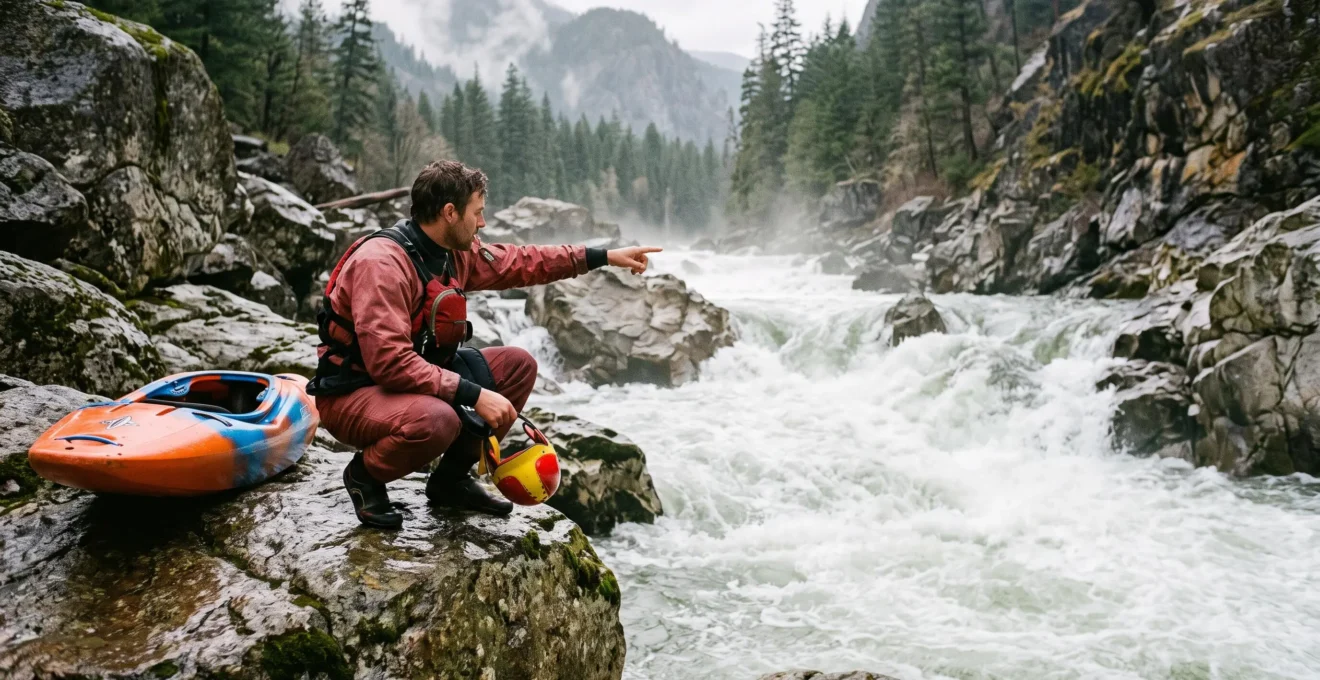
- Effective river reading involves a systematic process of scouting from the bank to identify Obstacles, Markers, and Swimmer outcomes (OMS).
- Post-storm high water doesn’t just make rapids faster; it fundamentally changes their character, introducing new, lethal hazards like strainers.
- Learning to assess risk and choosing to walk around a rapid (portage) is a sign of an expert paddler, not a beginner’s failure.
- Treat the river and its surrounding environment as one interconnected system, where weather forecasts directly predict river conditions.
For a kayaker comfortable on the mirror-like surface of a lake, the leap to a moving river is profound. You may have a powerful forward paddle stroke and a solid sweep, but the moment your boat enters the dynamic, chaotic water of a Grade 2 rapid, those skills can feel useless. Suddenly, the water is in charge. This transition is less about paddle technique and more about learning an entirely new language: the language of the river. Many guides focus on simple feature identification, like spotting the « downstream V » that marks a clear channel, but this only scratches the surface.
The real challenge is a mental one. It’s about shifting your mindset from a static environment to a dynamic one. The core skill is not just spotting hazards, but understanding the river as a predictable system of energy. It’s about developing the psychological readiness to make calm, proactive decisions instead of panicked, reactive ones. This guide moves beyond the basics. We’re not just going to identify features; we’re going to build a framework for decision-making, risk assessment, and developing the confidence that turns fear into focused respect.
This article, written from the perspective of a British Canoeing whitewater coach, will break down this complex skill into manageable parts. We will explore the psychology of fear, provide a structured method for scouting, analyse different learning pathways, and examine the critical errors that can escalate risk. By the end, you will have a foundational understanding of how to read the water, the weather, and yourself to ensure your journey into whitewater is both safe and rewarding.
Contents: A Paddler’s Guide to River Reading
- Why Do Calm Lake Kayakers Panic in Grade 2 River Rapids Despite Good Paddle Technique?
- How to Identify Safe Lines Through Rapids by Reading Water from the Bank?
- Solo Whitewater Kayaking vs Guided Raft Trips: Which Builds River Skills for Beginners?
- The Rapid River Error That Turns Grade 2 into Lethal Grade 4 After Storms
- When Should You Walk Around a Rapid Rather Than Risk Swimming?
- How to Read Mountain Weather Forecasts to Decide Go or No-Go for Your Hike?
- When Does Snowshoeing Require Avalanche Safety Gear and Training?
- How to Learn Rock Climbing Skills for Ascending Technical Mountain Routes?
Why Do Calm Lake Kayakers Panic in Grade 2 River Rapids Despite Good Paddle Technique?
The transition from a placid lake to a moving river introduces an element that technique alone cannot conquer: fear. On a lake, you are the primary force of movement. On a river, the water holds the power, and your role shifts to one of navigation and reaction. This fundamental change can trigger a primal panic response, causing even a technically proficient paddler to freeze, brace incorrectly, or fixate on a hazard. This psychological hurdle is often a greater barrier than any physical one on introductory whitewater.
This experience is common. One beginner kayaker documented her journey and described needing to use breathing techniques and personal mantras to manage her anxiety beside Class II rapids, even as her paddling skills were improving. This highlights a crucial distinction: psychological readiness and technical ability develop on separate tracks. Fear is an amorphous feeling, an internal response to the unknown, whereas danger is a tangible ‘something’—a rock, a log, a powerful hydraulic. The skilled flat-water paddler panics because they haven’t yet learned to separate the feeling of fear from the objective assessment of danger. Their brain interprets the loud, chaotic environment as a mortal threat, overriding the rational part that knows the correct paddle stroke to use.
Overcoming this requires experience, but also a conscious effort to build mental resilience. It involves acknowledging the fear, controlling your breathing, and learning to trust your equipment and your decisions. The goal isn’t to eliminate fear—it’s a vital tool for survival—but to manage it, so it informs your choices rather than dictates your actions. You must learn to paddle with a quiet mind before you can truly navigate a loud river.
How to Identify Safe Lines Through Rapids by Reading Water from the Bank?
The single most important safety habit in whitewater is ‘scouting’—getting out of your boat to inspect a rapid from the bank before you run it. For the transitioning lake paddler, this is where you turn chaos into a plan. Looking down from a high bank, a messy rapid resolves into distinct channels, waves, and eddies. Your goal is not just to spot hazards but to connect a series of safe moves, creating a ‘line’ through the rapid. This is the essence of proactive navigation: making your decisions on the stability of land, not in the panic of the moment.
Professional river guides use structured frameworks to ensure they don’t miss anything critical. Rather than a vague look-see, a systematic approach provides clarity and confidence. The OMS framework is an excellent tool for beginners and experts alike, breaking the process into three manageable steps. It forces you to move beyond just seeing obstacles to planning a complete run, including a plan for if things go wrong. A formal scouting process is your best defence against the unexpected.
Your Action Plan: The OMS Scouting Framework
- Obstacles: First, identify everything you must avoid—rocks, powerful hydraulics (holes), and strainers (e.g., fallen trees). Critically, once you’ve noted them, shift your focus from the hazards to the clear water and the best route through the rapid. Don’t fixate on what you want to miss.
- Markers: Pick out sequential visual reference points on your chosen line. This could be a distinctively shaped rock, a large wave, or an eddy. These markers help you track your progress and confirm you are on the right line as you move through the rapid.
- Swimmers: Before you commit, mentally rehearse the consequences of a mistake. This is your ‘consequence analysis’. Ask yourself: « If I swim here, where will the current take me? Is the exit safe, or does it lead into another hazard? » This step determines if the risk is acceptable.
One final professional tip, as outlined in a guide for aspiring trip leaders, is to scout from the bottom up. Start by identifying the safe exit point and the final calm eddy pool. Knowing you have a safe place to finish allows you to work your way back up the rapid, analysing the entrance moves with more confidence. This simple change in perspective, detailed by Brazilian Expeditions’ guide on scouting, reframes the entire process from one of hazard avoidance to one of goal-oriented planning.
Solo Whitewater Kayaking vs Guided Raft Trips: Which Builds River Skills for Beginners?
Once you’ve decided to learn, the next question is how. The two most common entry points are joining a guided raft trip or taking the plunge into solo whitewater kayaking, likely as part of a course. While both involve navigating rapids, they build fundamentally different skills and suit different learning temperaments. A raft trip offers a safe, low-commitment way to experience the power of a river, while kayaking demands immediate personal responsibility and a steeper learning curve. Neither is definitively ‘better’; they are simply different tools for development.
In a raft, you are part of a team, following the instructions of a professional guide who makes all the critical decisions about reading the water and choosing the line. It’s an excellent way to gain a macro-level understanding of river dynamics and witness firsthand how major currents and features work. In contrast, a solo kayak forces you to engage at a micro-level. Every paddle stroke, every edge of the boat, and every decision is yours alone. It is a full-body workout that requires constant focus and builds boat control and self-reliance from the very first eddy you catch.
The following comparison, based on an analysis of the two sports by OutdoorPlay, breaks down the key differences for a beginner focused on skill acquisition. Understanding these distinctions will help you choose the path that best aligns with your goals and comfort level.
| Criteria | Guided Raft Trip | Solo Whitewater Kayak |
|---|---|---|
| Decision-making | Passive: guide reads the river and calls the line | Active: paddler reads and executes every decision |
| Skill focus | Macro reading of major current and overall river flow | Micro boat control, eddy turns, precise strokes |
| Physical demand | Shared effort across the group, less individually taxing | Full upper-body and core workout, solo endurance required |
| Safety responsibility | Guide manages steering and rescue decisions | Paddler is solely responsible for self-rescue and safety |
| Best for beginners who… | Want to safely witness river power before piloting themselves | Want independence and are ready to build personal command |
Ultimately, the choice depends on your objective. If your goal is to simply experience whitewater, rafting is a fantastic and safe option. If your goal is to become a self-sufficient whitewater kayaker, you must eventually get in a kayak. Many paddlers find a combination of both is ideal: starting with a raft trip to build confidence and respect for the river before progressing to a formal kayaking course.
The Rapid River Error That Turns Grade 2 into Lethal Grade 4 After Storms
Perhaps the most dangerous mistake a developing paddler can make is assuming a river is the same today as it was last week. A heavy storm in the catchment area can dramatically increase a river’s volume and velocity, transforming a familiar, friendly Grade 2 rapid into a raging and unforgiving Grade 4. The error is not just underestimating the speed, but failing to understand that high water fundamentally changes the *nature* of the river’s hazards. Features that were minor obstacles can become lethal traps.
The primary danger in high water is the increased risk of entrapment against new or empowered obstacles. Submerged logs or branches that were previously visible and avoidable can become deadly ‘strainers’ that let water through but pin a boat or a swimmer. An analysis of whitewater accidents shows that pinning against obstacles like strainers and rocks is a leading cause of fatalities. When the water level rises, the river’s power to hold you against an object increases exponentially.
The greatest risk of death in nonmotorized whitewater sports is associated with strainers, sieves, or large hydraulics.
– David J. Farstad & J. Matthew Luttrell, Wilderness & Environmental Medicine
This change in danger is starkly illustrated by the phenomenon of « flush drowning. » This occurs in very powerful, high-volume water where a swimmer is unable to stay on the surface and is repeatedly pushed down, leading to drowning without ever being trapped. Understanding this specific risk is vital for anyone paddling in post-storm conditions.
Case Study: How Water Volume Changes the Cause of Fatalities
A revealing study highlighted in Outside Online compared whitewater fatalities in different regions. In the warmer, lower-volume rivers of the Southeastern U.S., 74% of deaths were due to entrapment. In stark contrast, an analysis of incidents in the cold, high-volume Rocky Mountain rivers found that 61% of deaths were from flush drowning. This demonstrates that more water doesn’t just make a river faster—it introduces an entirely different and more powerful lethal mechanism. The river you paddled last month might not be the same river at all.
When Should You Walk Around a Rapid Rather Than Risk Swimming?
In whitewater culture, there can be an unspoken pressure to run every rapid. For a beginner, this can lead to a dangerous mindset where walking around a rapid—known as ‘portaging’—feels like failure. This is a critical misconception. The decision to portage is one of the most important and professional skills a paddler can develop. It is a sign of mature consequence analysis and self-awareness, not a lack of courage.
So, when should you walk? The decision rests on a simple question: « Are you 100% confident you can make the line, and are the consequences acceptable if you don’t? » If the answer to either part of that question is no, you should portage. This calculation changes based on many factors: the difficulty of the rapid, the water temperature (a swim in cold water is far more serious), the presence of hazards downstream, the skill level of your group, and your own physical and mental energy levels. As one safety volunteer wisely noted, swimming in whitewater is exhausting for even the strongest paddlers.
Never let ego or peer pressure influence your decision. A five-minute walk through the woods is infinitely better than a dangerous, uncontrolled swim. If you are scouting a rapid and feel a knot of anxiety in your stomach, listen to it. That feeling is your internal risk management system telling you that something is amiss. Acknowledge the feeling and re-evaluate objectively. If you cannot identify a clean line, if you don’t see a safe recovery zone after the main hazard, or if you simply feel ‘off’, then the professional decision is to shoulder your boat and walk. It’s a choice you will never regret.
How to Read Mountain Weather Forecasts to Decide Go or No-Go for Your Hike?
While seemingly unrelated, the skill of reading a mountain weather forecast is directly transferable to whitewater kayaking. A river is not an isolated feature; it is the drainage point for a vast catchment area of hills and mountains. The weather in those mountains is a direct predictor of the conditions you will face on the water hours or even days later. A ‘go or no-go’ decision for a hike is therefore analogous to a go or no-go decision for a paddle: both rely on interpreting forecasts to predict the behaviour of a dynamic environment.
For a paddler, the most critical forecast data points are precipitation amount and freezing level. A forecast for « 20mm of rain » is the input; a rising river level is the output. Specialised resources like the Met Office’s ‘Mountain Weather’ forecast or the Mountain Weather Information Service (MWIS) are invaluable. They provide detailed information on wind speed at different elevations, the likelihood of precipitation, and—crucially—the freezing level. A rising freezing level combined with heavy rain can indicate rapid snowmelt, leading to a sudden, dramatic surge in river volume known as a spate.
Your decision-making process should be a funnel. Start with the broad, multi-day forecast to see large weather systems approaching. The day before your trip, check the detailed mountain forecast, paying close attention to precipitation totals and the freezing level. On the morning of the paddle, check the live data from river level gauges (available online for many UK rivers via the Environment Agency or SEPA). This process of moving from macro forecast to micro data is identical to reading a rapid: you start with the big picture and then focus on the fine details to make your final decision.
When Does Snowshoeing Require Avalanche Safety Gear and Training?
The decision-making process in potential avalanche terrain offers a powerful parallel to navigating whitewater. Both environments feature immense, unseen power hidden beneath a seemingly simple surface. On a snow-covered slope, just as in a rapid, the most dangerous hazards are often invisible. The stability of the snowpack, like the power of a hydraulic, can only be assessed through careful observation, knowledge of underlying principles, and a deep respect for the potential consequences.
Avalanche safety training is required the moment you step onto a slope steep enough to slide (typically over 30 degrees) where the snowpack is unstable. The key takeaway for a kayaker is not the specifics of snow science, but the methodology of risk assessment. Avalanche education (like that provided in Scotland by the SAIS) teaches a three-part framework: having the right gear (transceiver, shovel, probe), the right training to use it, and—most importantly—the right mindset to make conservative decisions. This is identical to the whitewater trinity of gear, training, and judgement.
The core of this judgement is ‘reading’ the terrain. Snow experts look for signs of instability: recent avalanche activity, cracking in the snowpack, or a ‘whumpfing’ sound that indicates a collapsing weak layer. This is the winter equivalent of spotting an upstream V or a turbulent eddy line on a river. In both sports, the expert is constantly gathering data from the environment and asking, « What is this feature telling me about the hidden energy here? » The decision to avoid a slope is the same as choosing to portage a rapid. It’s a choice based on an objective assessment of risk versus reward, and a clear-eyed analysis of the consequences should that assessment be wrong.
Key takeaways
- River reading is a mental skill of managing fear and understanding the river as a system of predictable energy flows.
- Use a structured scouting method like OMS (Obstacles, Markers, Swimmers) to make calm, proactive decisions from the riverbank.
- High water levels after a storm fundamentally change a river’s character, creating new and powerful hazards that can turn an easy rapid into a lethal trap.
How to Learn Rock Climbing Skills for Ascending Technical Mountain Routes?
At first glance, rock climbing seems a world away from paddling. One is a vertical ascent on static rock; the other is a horizontal descent on moving water. Yet, the mental process of ‘reading a line’ is remarkably similar and provides a final, crucial lesson in proactive navigation. When a climber looks at a rock face, they do not see a blank wall; they see a sequence of holds, rests, and body positions. They are planning their micro-movements several steps ahead. This is the ultimate expression of the mindset a kayaker needs to cultivate.
Learning to climb, typically starting at an indoor wall before progressing outdoors with a qualified instructor, teaches the importance of breaking a large challenge into a series of small, manageable moves. A climber doesn’t think, « I need to get to the top. » They think, « Right hand to that crimp, left foot to that ledge, shift my hips, then rest. » This granular, sequential planning is exactly how a kayaker should approach a complex rapid. You don’t just « run the rapid »; you « catch the first eddy, ferry glide across the current, punch the wave, and exit left. »
This process builds an instinct for efficient movement and energy conservation. Climbers learn to read the rock to find the path of least resistance. Kayakers must learn to read the water to do the same, using the river’s own energy to move their boat rather than fighting against it. The skill of ascending a technical mountain route, therefore, reinforces the core principle of whitewater success: it is a game of foresight, planning, and precise execution, not one of brute force.
The journey from a calm lake to a flowing river is one of the most rewarding progressions in paddlesport. It opens up a new world of exploration and adventure. The key is to approach it with respect, a methodical desire to learn, and the humility to know when to walk away. Start small, take a course, and build your experience progressively. The river will be waiting.