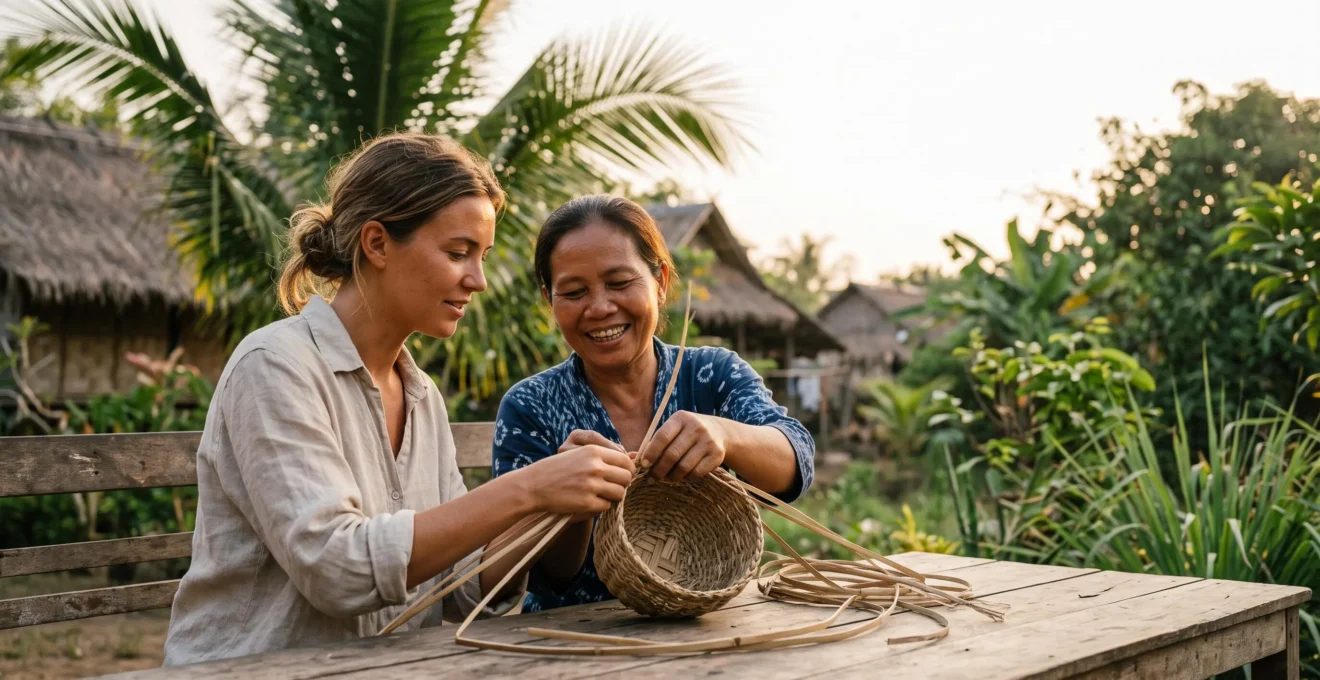
The greatest barrier to ethical tourism isn’t a lack of good intentions; it’s the hidden system of « economic leakage » that funnels your money away from local hands.
- Up to 80% of money spent by tourists in popular destinations can leave the country through foreign-owned operators, booking sites, and supply chains.
- Well-meaning actions, like unskilled « voluntourism » and orphanage visits, often perpetuate harm and displace local workers.
Recommendation: Shift your mindset from being a consumer of « ethical products » to a critical partner. Your primary tool is not a checklist, but one persistent question: « Can I verify where the money and power truly go? »
As a UK traveller, you are likely more conscious than ever about your impact on the world. You diligently pack your reusable water bottle, learn a few phrases in the local language, and make a genuine effort to buy authentic crafts. You travel with the best of intentions, hoping your holiday spend supports the vibrant communities you visit. Yet, a disquieting question often lingers: is your money actually helping, or is it being siphoned off by unseen forces, leaving the local community with little more than the cleanup?
The conventional advice— »eat local, » « shop local »—is a starting point, but it’s dangerously incomplete. It fails to address the systemic issue of economic leakage, a phenomenon where the majority of tourism revenue flows out of the host destination and into the pockets of international corporations. This isn’t just about all-inclusive resorts; it happens through the commission fees on booking platforms, imported goods in restaurants, and tour companies with headquarters thousands of miles away. This reality can turn our well-intentioned trips into an extractive process, inadvertently reinforcing the very inequalities we hope to challenge.
But what if the solution wasn’t a longer checklist of things to do, but a new lens through which to see? This guide moves beyond the platitudes. It provides a framework for harm reduction, teaching you how to critically evaluate the structures behind the smiling welcome. We will dismantle the mechanisms that cause tourism money to vanish and equip you with the tools to verify claims of « ethical » and « community-based » practices. It’s time to transform your role from a passive tourist into a conscious, impactful partner for local communities.
To navigate this complex landscape, this article provides a clear roadmap. We will explore the hidden financial drains in tourism, offer concrete methods for verifying the authenticity of community-led initiatives, and dissect common ethical traps from voluntourism to greenwashing. The following sections will guide you step-by-step toward a more responsible and truly beneficial way of travelling.
Summary: How to Practice Ethical Tourism That Truly Benefits Local Communities
- Why Does Tourism Money Fail to Reach 80% of Local Communities in Popular Destinations?
- How to Verify That Tour Operators Actually Employ and Empower Local Residents?
- Voluntourism Programs vs Direct Community Donations: Which Ethical Approach Actually Helps?
- The Ethical Tourism Error That Perpetuates Child Exploitation Through Orphanage Visits
- When Should Ethical Travelers Avoid Popular Destinations Due to Overtourism Damage?
- Visiting Iconic Nature Reserves vs Hidden Conservation Sites: Which Approach Helps More?
- Why Do 60% of Tour Companies Claim Sustainability Without Any External Certification?
- How to Identify Genuinely Certified Ethical Tour Agencies Versus Marketing Claims?
Why Does Tourism Money Fail to Reach 80% of Local Communities in Popular Destinations?
The most significant, yet invisible, hurdle to ethical tourism is economic leakage. This term describes the process where tourism revenue generated in a destination fails to stay there. Instead, it « leaks » out to pay for foreign-owned services, imported goods, and international company profits. While you may be standing in a local market, a huge portion of the money you’ve spent to get there and stay there has already been diverted. This is why some studies have estimated that in certain developing countries, as much as 80p of every £1 spent by tourists ultimately leaves the local economy.
A primary driver of this leakage is the dominance of global intermediaries. For example, international booking platforms typically charge commissions of 15% to 30% per booking on hotels and guesthouses. This is a direct extraction of value before the local business owner even sees a penny. The leakage continues when resorts and restaurants, even if locally staffed, are owned by foreign chains and import everything from their food and drink to their furniture, bypassing local suppliers and farmers entirely.
However, models that successfully combat this leakage do exist. The rise of locally-owned guesthouses in the Maldives provides a powerful counter-narrative. Historically dominated by foreign-linked resorts where leakage was high, the nation saw a shift as local entrepreneurs began opening their own accommodations. By building their own subsidiary offerings like diving excursions, restaurants, and craft markets, they created a contained ecosystem. This model ensures that a much larger share of tourism revenue is captured, retained, and reinvested directly into the community, keeping both ownership and supply chains local.
How to Verify That Tour Operators Actually Employ and Empower Local Residents?
The term « community-based tourism » (CBT) is frequently used, but its meaning is often diluted. True CBT is not just about employing locals as drivers or cleaners. As one academic review notes, it is a model rooted in social justice, empowerment, and genuine ownership. The core principle is that the community itself should have control over and benefit equitably from tourism activities in their area. Your task as a traveller is to discern between superficial claims and authentic community partnership.
A comparative 2025 analysis of tourism projects highlights what’s at stake. The study found that in Nepal’s Annapurna Conservation Area and Kenya’s Maasai Mara, where residents held direct control over tourism revenue, they consistently reinvested it in vital local infrastructure like schools and healthcare. In stark contrast, projects in other regions where decision-making remained with external organisations or governments saw funds misallocated, leading to community disengagement. This shows that empowerment isn’t a side-effect; it is the essential ingredient for success.
So, how do you verify these claims on the ground? You must move from being a passive consumer to an active investigator. Ask direct questions. Instead of « Are you local? », ask « Is this business owned by a person from this village, or a family from this region? » Look for transparency in their mission. A genuine CBT operator will be proud to tell you how they are structured, what percentage of profits are reinvested, and how the wider community is involved in decisions. Be wary of projects that showcase a single « spokesperson » or a small group of elites; true CBT involves the community as a whole.
Your checklist for identifying genuine community tourism:
- Verify ownership: Confirm that community members hold real ownership stakes and participate in decision-making, not just fill staffing roles.
- Trace the profits: Ask what share of profits is reinvested locally versus being paid out to external shareholders or operators.
- Assess community involvement: Check if the operator works with the community as a whole (e.g., through a council or cooperative) rather than just a few individuals.
- Observe long-term vision: Are environmental practices and group sizes managed to protect the destination for future generations?
- Look for dignified exchange: Ensure travellers are respectfully briefed and that residents can participate with dignity, not perform a cultural caricature for tourists.
Voluntourism Programs vs Direct Community Donations: Which Ethical Approach Actually Helps?
The desire to « give back » on our travels is a noble one, often leading well-intentioned travellers towards « voluntourism »—short-term, unskilled volunteer trips. However, the helpfulness of these programmes is being increasingly questioned. As the School of International Service at American University notes, « Critics argue that these trips can sometimes do more harm than good, reinforcing a narrative of Western saviorism. » Unskilled volunteers painting a school can take a paid job from a local painter, and a constant rotation of foreign caregivers can create attachment issues for vulnerable children.
A more effective model is to support local social enterprises—businesses with a core mission to solve community problems. A powerful example is Friends International in Cambodia. Instead of using short-term volunteers, this Cambodian-led organisation focuses on building long-term local capacity. They provide vocational training, run businesses to create jobs, and support families to keep their children in school. By supporting over 4,000 children’s school attendance and improving caregiving for 10,000 parents annually, they demonstrate how backing a sustainable, locally-run business can create far more profound and lasting impact than a one-off volunteering trip.
The choice between different forms of support can be complex, and each has its own risks and benefits. A direct donation to a community fund can be effective, but only if you can verify the organisation’s transparency and governance. Supporting a local social enterprise, either by using their services or buying their products, directly funds local jobs and expertise. The key is to shift from a model of direct intervention to one of empowering local actors.
To help clarify the decision, this comparative analysis highlights the fundamental differences in impact between the most common approaches. As this breakdown from ethical volunteering advocates shows, the highest economic benefit and lowest risk of harm often comes from supporting systems that are self-sustaining.
| Approach | Skill Requirement | Local Economic Benefit | Risk of Harm or Dependency |
|---|---|---|---|
| Unskilled voluntourism | Low; often mismatched to real needs | Limited; can displace local paid labor | High; risk of dependency and disrupted local systems |
| Impact investing in social enterprises | None required from traveler; supports trained local staff | High; revenue funds local jobs and training | Low; sustains itself beyond the traveler’s visit |
| Direct community donation | None required | Variable; depends on governance and transparency | Moderate; requires due diligence on fund use |
The Ethical Tourism Error That Perpetuates Child Exploitation Through Orphanage Visits
Of all the ethical pitfalls in tourism, perhaps the most damaging is orphanage tourism. Driven by compassion and a desire to help vulnerable children, travellers visit and volunteer in residential care institutions. However, a growing body of evidence from organisations like UNICEF and Lumos (J.K. Rowling’s charity) shows this practice does profound harm. The industry is not a solution but a business model that exploits both the good intentions of tourists and the vulnerability of children. In fact, research indicates that up to 80% of children in orphanages are not orphans but have at least one living parent, often placed in the institution due to poverty.
The demand from tourists for an « orphan experience » creates a perverse incentive to keep children in institutions rather than supporting them within their families. The money involved is substantial; a Walk Free Foundation report highlights that it is estimated that faith-based organizations alone donate approximately US$3.3 billion per year to residential care, often unknowingly propping up a harmful system. A recent review in *Frontiers in Sustainable Tourism* concluded unequivocally that « the limited benefits for children involved in orphanage tourism are outweighed by child protection concerns ».
The most ethical action a traveller can take is to unequivocally avoid all orphanage visits, tours, and volunteer placements. The solution is not to « find a good orphanage, » but to support organisations that work to keep families together. In 2018, Australia became the first country to recognise orphanage trafficking as a form of modern slavery in its legislation. This landmark decision, prompted by extensive advocacy, led many tour operators to remove orphanage visits from their itineraries entirely, redirecting support towards family-preservation and community-strengthening programs. This is the new ethical standard: supporting families, not institutions.
When Should Ethical Travelers Avoid Popular Destinations Due to Overtourism Damage?
The images are now familiar: overcrowded streets in Venice, queues on Mount Everest, and beaches in Thailand closed to recover from environmental damage. This is overtourism, a situation where the sheer number of visitors strains infrastructure, degrades the environment, damages the quality of life for residents, and ultimately ruins the visitor experience itself. As an ethical traveller, it raises a difficult question: is there a point where the most responsible action is to not go at all?
Avoiding a destination entirely can feel like a punishment, especially for the locals who do depend on tourism. However, the decision should be framed not as a boycott, but as a strategic pause to allow for healing and policy change. When a destination’s natural carrying capacity is consistently exceeded, your presence, no matter how well-behaved, contributes to the cumulative strain. It adds to the water and energy consumption, waste production, and traffic congestion that locals must endure long after you’ve left.
The decision to avoid a place is a personal one, but there are clear warning signs. When you read reports of local protests against tourism, new tourist taxes being implemented to manage crowds, or severe environmental restrictions being put in place, it’s a signal that the destination is under stress. Instead of contributing to the peak-season crush in places like Barcelona or Amsterdam, the ethical choice might be to explore an alternative, second-tier city in the same country. Or, if you are set on a popular spot, travel in the deep off-season when your visit can provide a more stable, year-round income for businesses without adding to the pressure.
Visiting Iconic Nature Reserves vs Hidden Conservation Sites: Which Approach Helps More?
It’s a common dilemma for the nature-loving traveller: should you visit the world-famous national park, sharing the trail with hundreds of others, or seek out a remote, little-known conservation project? It’s easy to assume that avoiding the crowds is the more ethical choice. However, the economics of conservation are often counter-intuitive. In many cases, visiting the « honeypot » site is precisely what funds the protection of the hidden gems.
Many national park systems and large conservation organisations operate on a model where a few highly popular, iconic sites generate the vast majority of their revenue. The significant entrance fees paid by thousands of visitors to see gorillas in Rwanda or the « Big Five » in the Serengeti are not just used to protect that specific area. This income cross-subsidises the vital, but less glamorous, work of protecting vast tracts of wilderness, funding anti-poaching patrols in remote regions, and supporting biodiversity research that doesn’t have a direct tourism appeal.
By choosing a well-managed, reputable, and often more expensive iconic reserve, you are effectively making a significant donation to conservation at a landscape scale. Your fee becomes part of a sustainable funding engine. In contrast, attempting to visit a small, under-resourced project in a remote area can sometimes place a burden on it, requiring staff to act as guides when their time is better spent on conservation work. Before visiting a lesser-known site, it is crucial to research whether they have a dedicated, properly managed tourism program that benefits their work, rather than distracting from it.
Why Do 60% of Tour Companies Claim Sustainability Without Any External Certification?
In the tourism industry, « sustainable, » « eco-friendly, » and « responsible » have become powerful marketing buzzwords. As travellers increasingly seek to make ethical choices, companies have responded by adopting the language of sustainability, but often without making substantive changes to their operations. This phenomenon, known as greenwashing or « ethical-washing, » creates a confusing landscape for the conscientious traveller. Many companies make bold claims on their websites but lack any transparent, verifiable proof to back them up.
The reason this happens is simple: making a claim is easy and cheap, while achieving genuine certification is hard and expensive. True sustainability requires a complete overhaul of business practices, from supply chain management and waste reduction to fair wages and community profit-sharing. It involves detailed record-keeping, performance measurement, and a willingness to be held accountable. Many companies find it far more profitable to simply apply a green label to their existing product and hope consumers don’t look too closely.
This is why the absence of external certification is a major red flag. A company can design its own beautiful logo with a green leaf or a helping hand, but this is meaningless without independent verification. A genuine certification is a signal that the company has submitted its operations to the scrutiny of a credible third party and has met a rigorous, publicly available set of standards. This process provides a level of assurance that self-proclaimed labels simply cannot match. The challenge for the traveller is to learn how to distinguish between a marketing sticker and a meaningful mark of accountability.
Key takeaways
- The primary obstacle to ethical tourism is « economic leakage, » where up to 80% of revenue leaves the local community.
- Your most powerful tool is verification; question claims and seek proof of genuine local ownership and empowerment, moving beyond surface-level marketing.
- The most ethical choice can sometimes be avoidance, particularly regarding orphanage visits, which perpetuate a harmful system, and « voluntourism, » which can displace local jobs.
How to Identify Genuinely Certified Ethical Tour Agencies Versus Marketing Claims?
Navigating the sea of « green » claims requires you to become a savvy detective, looking for proof, not just promises. The difference between a genuine certification and a marketing ploy lies in accountability and transparency. Your goal is to find operators who are willing to have their claims independently audited and verified.
First, learn to differentiate between types of labels. Be highly sceptical of self-made awards or logos that a company has created for itself. These are typically found in the website footer and feature vague terms like « Eco-Partner » or « Responsible Travel Seal » with no link to a governing body. These are marketing tools, not certifications. In contrast, a third-party certification is a standard awarded by an independent organisation. Look for globally recognised certifications like B Corp, which assesses a company’s entire social and environmental performance, or travel-specific ones like Travelife, which has a detailed, audited process for hotels and tour operators. These organisations have clear, published criteria and require regular re-assessment.
Beyond logos, look for a commitment to transparency. A truly ethical company isn’t afraid to be open about its impact. Does their website feature a detailed sustainability or responsibility report? This report should move beyond vague statements and include concrete metrics and data. For example, instead of saying « we hire locally, » they might state « 95% of our guides are from the regions we visit, and 70% of our management team are local hires. » Instead of « we support the community, » they will name the specific projects they fund and state exactly what percentage of their profit or revenue is donated. The presence of specific, measurable, and time-bound goals is a strong indicator of genuine commitment.
For your next journey, start with this critical lens. Applying this framework is the first step in transforming your travel from a simple transaction into a genuine act of partnership. Your effort to look past the marketing and find the proof is what will ultimately drive the entire industry towards a more just and sustainable future.