Hiking and camping
Stepping into the wilderness with a pack on your back represents one of humanity’s most rewarding pursuits. Hiking and camping connect us to landscapes that remain largely untouched, offering experiences that range from peaceful solitude to exhilarating challenges. Whether you’re planning a single overnight trip near home or dreaming of multi-day treks through remote terrain, understanding the fundamentals transforms these activities from daunting unknowns into achievable adventures.
The beauty of hiking and camping lies in their accessibility—you don’t need expensive gear or elite fitness to start. However, knowing which equipment truly matters, how to select appropriate trails, and which skills deserve priority attention makes the difference between struggling through discomfort and thriving outdoors. This comprehensive resource breaks down everything from your first gear purchases to environmental responsibility, providing the foundation you need to venture confidently into nature.
Essential Gear and Equipment
The outdoor industry offers countless products, but successful trips depend on a surprisingly short list of reliable essentials. Understanding what you actually need—versus what marketing suggests—saves money and reduces the weight you’ll carry.
Hiking Essentials
Your hiking kit should prioritize three categories: navigation, hydration, and emergency preparedness. A quality map and compass remain non-negotiable even in the smartphone era, as electronic devices fail when batteries die or signals disappear. Water capacity matters more than most beginners realize—carry at least two liters for moderate day hikes, and consider filtration systems for longer journeys where natural sources exist. The « ten essentials » concept provides an excellent framework: beyond navigation and hydration, pack sun protection, first aid supplies, illumination (headlamp with extra batteries), fire-starting tools, emergency shelter, extra food, and a repair kit with multi-tool.
Camping Must-Haves
Your overnight setup centers on three major systems that directly impact comfort and safety. First, your shelter system—whether tent, tarp, or hammock—must suit the expected conditions and your skill level. Beginners benefit from freestanding tents that don’t require perfect site selection, while experienced campers often prefer lighter tarp configurations. Second, your sleep system combines a sleeping bag rated for anticipated temperatures (always choose a rating 10-15 degrees lower than expected lows) with an insulated sleeping pad that prevents ground cold from sapping body heat. Third, your cooking setup can range from simple cold-soaking methods to lightweight stove systems, depending on trip duration and personal preferences.
Clothing and Layering
The layering principle outperforms any single « perfect » jacket because conditions change throughout the day. Start with a moisture-wicking base layer that pulls sweat away from skin—cotton fails here, while synthetic or merino wool fabrics excel. Add an insulating mid-layer (fleece or lightweight down) that you can remove as body heat increases during climbs. Finally, your outer shell should block wind and rain while allowing moisture vapor to escape; fully waterproof-breathable fabrics justify their cost on multi-day trips. Don’t neglect extremities—quality hiking socks prevent blisters far better than expensive boots, and a warm hat can be worn at camp while sitting still.
Choosing Your Trail and Campsite
Matching your abilities to appropriate terrain prevents the discouragement that sidelines many beginners. Trail difficulty depends on multiple factors beyond simple distance: elevation gain, technical terrain, exposure to weather, and remoteness all contribute to the challenge level.
Start by researching trails through established resources like land management websites, guidebooks, and reputable trip report databases. Pay attention to recent conditions—a trail listed as « easy » in summer may become genuinely dangerous during shoulder seasons when snow obscures the path. Calculate your realistic pace using the common formula: add one hour for every three miles covered plus one hour for every 1,000 feet of elevation gain. This conservative estimate accounts for rest breaks, navigation checks, and the natural slowdown that occurs when carrying a loaded pack.
Campsite selection involves both regulations and craft. Many popular areas require designated sites to prevent environmental damage, eliminating the romantic notion of camping « anywhere » but ensuring sustainable use. Where dispersed camping is permitted, look for previously used sites at least 200 feet from water sources—this distance protects riparian ecosystems and water quality while reducing wildlife conflict. Evaluate natural hazards: avoid dead standing trees that might fall, low spots that collect water during rain, and cliff edges where sleepwalking or nighttime bathroom trips could prove disastrous. The ideal site offers flat ground, natural wind protection, and morning sun to dry condensation from your tent.
Fundamental Outdoor Skills
Technical abilities matter less than sound judgment for most hiking and camping scenarios, but several core skills deserve practice before you need them urgently.
Navigation and Route-Finding
Modern GPS devices and smartphone apps provide incredible convenience, yet understanding map and compass fundamentals remains essential. Start by learning to orient your map to terrain—align it so features you see match their representation on paper. Practice taking and following bearings in familiar areas, noting how terrain features like ridges and valleys guide travel even without constant compass reference. Develop the habit of regular position checks rather than walking for hours before consulting your map. Understanding contour lines transforms flat paper into three-dimensional mental models: lines close together indicate steep terrain, while wide spacing suggests gentle slopes.
Shelter Setup and Camp Craft
Practicing tent setup at home—repeatedly—pays dividends when you arrive at camp exhausted or racing approaching darkness. Learn your shelter’s quirks: which poles connect where, how tension points should be staked, where guy lines attach. Beyond basic assembly, understand site preparation—clearing rocks and sticks prevents punctures and improves comfort far more than expensive sleeping pads compensate for rough ground. Master the art of the taut ridgeline and proper stake angle (45 degrees away from the anchor point) to keep fabric secure during wind.
Fire Building and Outdoor Cooking
While modern stoves often replace campfires for cooking, understanding fire craft provides both emergency backup and enhanced wilderness competence. Successful fires require three components in proper proportion: tinder (material that catches from a spark), kindling (pencil-to-finger thickness that catches from tinder), and fuel wood (thumb thickness and larger for sustained burning). Gather significantly more of each category than seems necessary—running out mid-process when flames haven’t established guarantees frustration. For cooking, lightweight canister stoves offer unmatched convenience, but learn your system’s quirks before the trip: how wind affects performance, how cold temperatures reduce pressure, and how to simmer rather than just boil.
Safety and Risk Management
Outdoor risks rarely announce themselves with clear warnings, making proactive awareness your primary defense. Weather represents the most common threat—conditions change rapidly, especially in mountainous terrain where afternoon thunderstorms develop with little warning. Check forecasts before departure, but also learn to read clouds and wind patterns that signal approaching systems. The combination of wetness and cooling temperatures creates hypothermia risk even in summer; recognize early symptoms like uncontrolled shivering and poor coordination before they progress to dangerous stages.
Wildlife encounters worry many beginners disproportionately—proper food storage prevents most conflicts. Bear-resistant canisters or proper hanging techniques (at least 12 feet high and 6 feet from tree trunks) keep food odors away from camp. Make noise while hiking through areas with limited visibility to avoid surprising animals. Most creatures prefer avoiding humans; attacks typically involve animals protecting young, feeling cornered, or seeking food rewards from careless campers.
Perhaps the most overlooked safety element involves simply telling someone your plans. Leave detailed information about your intended route, expected return time, and emergency contacts with a responsible person who will alert authorities if you don’t check in. This simple step has saved countless lives when injuries or navigational errors prevented timely returns. Carry means to signal for help—a whistle carries farther than shouting and requires less energy, while bright-colored items aid aerial searches.
Leave No Trace and Environmental Stewardship
The privilege of accessing wild places carries the responsibility to preserve them. The Leave No Trace framework provides seven principles that minimize human impact: plan ahead and prepare, travel and camp on durable surfaces, dispose of waste properly, leave what you find, minimize campfire impacts, respect wildlife, and be considerate of others.
Waste disposal deserves particular attention because mistakes create lasting problems. Pack out everything you pack in—every wrapper, every orange peel, every piece of trash. Human waste requires proper handling: dig catholes 6-8 inches deep and 200 feet from water, trails, and campsites, then disguise them after use. Pack out toilet paper rather than burying it, as incomplete decomposition creates unsightly discoveries for future visitors. Gray water from dishwashing should be scattered widely at least 200 feet from water sources after straining out food particles.
Campfire impacts extend far beyond the obvious burn scar. Use existing fire rings where permitted rather than creating new ones. Better yet, rely on stoves for cooking and warm clothing for comfort—fires aren’t necessary for successful camping. If you do build fires, keep them small, burn wood completely to ash, ensure they’re fully extinguished (cool enough to touch), and scatter the remains. The romantic image of campfires clashes with their real environmental cost in heavily used areas where demand for firewood strips forests of important nutrients and habitat.
Approaching hiking and camping with genuine respect for natural systems ensures these landscapes remain accessible and healthy. Your actions—individually small—combine with thousands of other visitors to either preserve or degrade wilderness character. By mastering essential skills, choosing appropriate challenges, and minimizing your impact, you join a community that finds renewal, adventure, and perspective in wild places. Each trip builds competence and confidence, opening doors to increasingly remote and rewarding destinations while deepening your connection to the natural world.
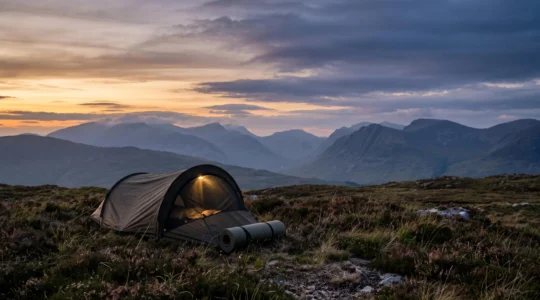
How to Bivouac Safely: A First-Timer’s Guide to UK Wild Camping
Many assume bivouacking is just tent camping without the comfort. The reality is that it’s an entirely separate skill. Success isn’t about enduring the elements, but reading the landscape to choose a micro-site that works with nature, not against it….
Lire la suite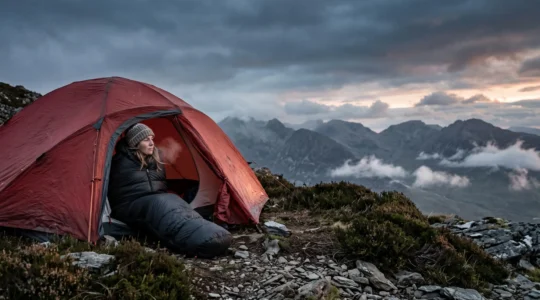
How to Choose a Sleeping Bag That Keeps You Warm on Cold UK Mountain Nights?
A sleeping bag’s temperature rating is a poor predictor of real-world warmth, especially on a damp UK mountainside. Ratings are based on a standardised mannequin in a lab, ignoring your metabolism and, crucially, cold seeping up from the ground. Your…
Lire la suite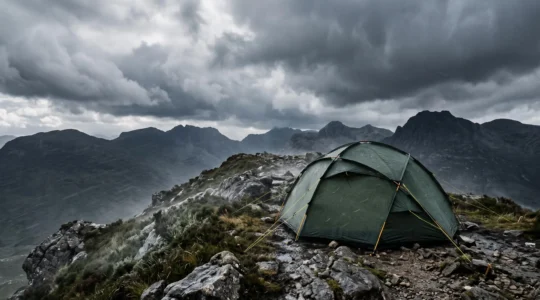
How to Choose a Tent That Withstands UK Mountain Weather Without Failure?
A tent’s storm-worthiness isn’t defined by its price tag or hydrostatic head rating, but by its predictable points of mechanical failure. Budget tents collapse because their components are not engineered to handle the dynamic load of UK mountain gusts. The…
Lire la suite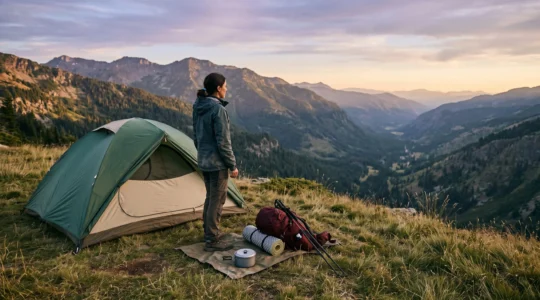
How to Plan Your First Multi-Night Camping Trip Without Gear Mistakes?
Successfully planning your first multi-night camping trip isn’t about buying a mountain of gear; it’s about systematically preventing the most common points of failure. Your pack weight is not a simple number; it’s a direct penalty on your energy and…
Lire la suite
How to Prevent Altitude Sickness on Your First High-Altitude Summit Attempt?
The greatest risk for altitude sickness isn’t a lack of fitness, but a misunderstanding of how the body adapts to thin air; treating acclimatization as a strategic physiological investment is the key to a safe ascent. Fit hikers often get…
Lire la suite
When Does Hiking End and Scrambling Begin? A Guide to the Crucial Mindset Shift
The line between hiking and scrambling isn’t just about using your hands; it’s a fundamental shift from walking *over* terrain to actively problem-solving your way *through* it. True scrambling begins when you must consciously assess the risk of every single…
Lire la suite
From Snowdon to the Summit: A UK Hiker’s Guide to Achievable Alpine Treks
Your UK scrambling and navigation skills are the perfect foundation for the Alps, but only if you recalibrate them for altitude, scale, and objective hazards. Alpine routes demand a shift from endurance to strategic timing, especially regarding weather and altitude….
Lire la suite
From Lowland Trails to UK Summits: How to Safely Make the Leap to Mountain Hiking
Many UK walkers hit a plateau, confident on hills but unsure how to safely tackle major mountains. The key isn’t just fitness, but a fundamental shift in mindset to manage a more consequential environment. This guide provides a clear progression…
Lire la suite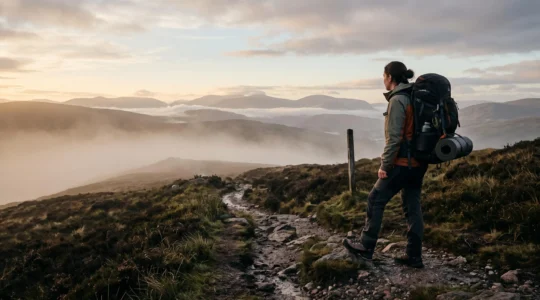
How to Plan Your First Multi-Day Trek Without Logistical Overwhelm?
Shifting from day hikes to a multi-day trek requires abandoning checklists in favour of mastering three core logistical systems. Food planning becomes a numbers game: target high calorie-density items to slash weight without sacrificing energy. Itinerary success depends on factoring…
Lire la suite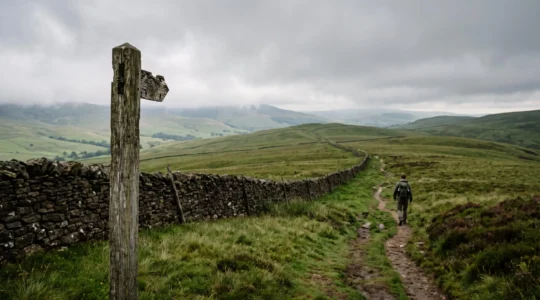
How to Unlock Solo Hiking Adventures on the UK’s Best Waymarked Paths
The primary barrier to solo hiking isn’t a lack of trails, but the fear of getting lost. This guide reframes the UK’s waymarked paths not as mere routes, but as a deliberate ‘System of Trust’. By understanding how this national…
Lire la suite